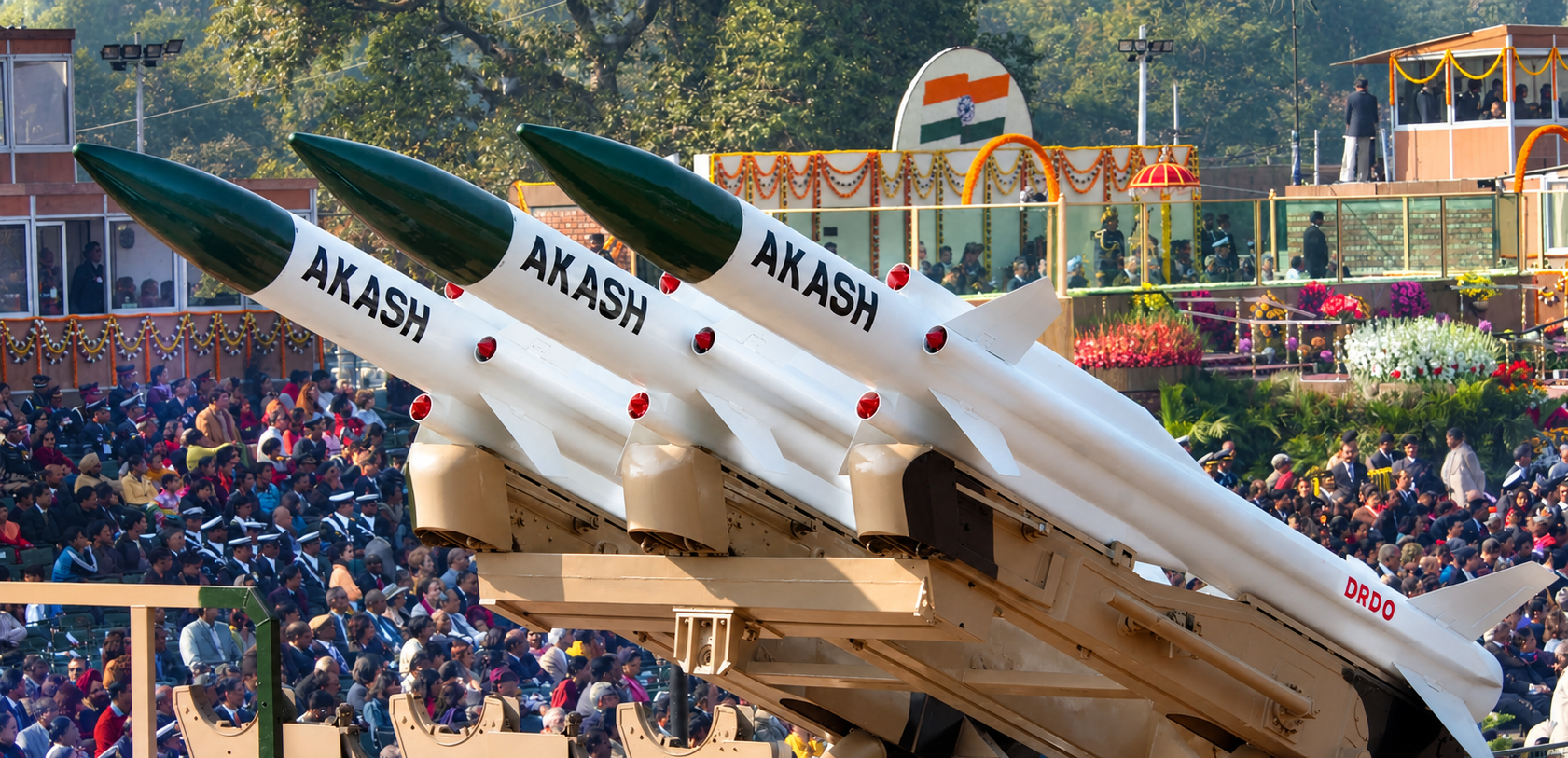
In a first, India has sold its home-grown Akash surface-to-air missile (SAM) system to Tajikistan and Turkmenistan this week. Defence Secretary Rajesh Kumar Singh confirmed the deals last Thursday to Indian news agency ANI. The sales give New Delhi its first publicly confirmed foothold in a region where Russia has long been the dominant arms supplier, and China has been gaining ground.
Singh said India has now exported the Akash to Armenia, Tajikistan and Turkmenistan. Calling it one of its success stories, he said India also has additional orders for its own armed forces and expects more interest from other parts of the world. These continuous orders have stabilised the system’s production, he explained.
Few details disclosed
Neither the Defence Ministry nor the Defence Research and Development Organisation (DRDO), which developed the system, has disclosed the number of batteries sold, the contract values, or the delivery schedules. Defence experts say that India could have exported the upgraded Akash-1S variant.
The Akash is a short-range SAM system that can engage multiple aerial targets at once and has built-in protection against electronic jamming. Akash can hit targets at altitudes between 100 metres and 20 km, with an operational range of 4.5 km to 25 km. The Akash-1S is a highly mobile, all-weather, medium-range SAM system capable of intercepting a versatile array of threats, including fighter jets, cruise missiles, drones and helicopters. It features a strike range of 18 to 30 km and can engage high-flying targets at altitudes up to 18–20 km.
The two buyers sit differently in the region’s security landscape. Tajikistan belongs to the Russia-led Collective Security Treaty Organisation (CSTO), and Russia and Tajikistan signed a defence cooperation programme covering 2026-30 last year. Russia’s 201st Military Base remains in the country. Turkmenistan maintains a self-declared neutrality and is not a CSTO member.
Armenia – first customer
Armenia became the first foreign buyer of the Akash in 2022, reportedly ordering 15 systems. Indian media have put the value of that order at about $720 million, but the figure is an estimate and has not been officially confirmed. The first battery shipped in November 2024. Each battery includes four launchers carrying three missiles each, along with a Rajendra 3D phased-array radar, according to defence reports. Bharat Dynamics Limited and Bharat Electronics Limited built the system.
Analysts cited by the South China Morning Post said the Central Asian sales reflect both sides' push to diversify. Atul Kumar of the New Delhi’s Observer Research Foundation said the buyers wanted to broaden their supplier base beyond Russia and China. Turkmenistan has already acquired Chinese air-defence systems, he said, and the Akash is expected to fill the mid-layer role in its air defences.
From Moscow’s point of view, Kumar said, Indian equipment in the region is likely preferable to Central Asia drifting towards NATO or Chinese military standards. Beijing, which has sought to become the region’s preferred military supplier, would not welcome Indian hardware on its western flank, he added.
Rahul Wankhede of the Manohar Parrikar Institute for Defence Studies and Analyses said the Akash offers high-end air-defence capability at a fraction of the cost of Western alternatives. He said domestic production lines and continuing orders from India's own forces give buyers confidence in supply, quick replenishment and training. India could also support Central Asian countries’ Russian-origin systems, and that’s an added advantage, he said.
Battle-hardened
Antoine Levesques of the International Institute for Strategic Studies called the Akash a battle-hardened system, pointing to its use during last year’s brief air war with Pakistan. Indian officials have said the system drew wide attention during Operation Sindoor in May 2025.
Cost is a central factor in India’s pitch. At an industry forum on September 25, Singh said Indian missiles can be offered at nearly a quarter of what foreign manufacturers charge. Exports create longer-term ties with buyers through maintenance, spares and other support.
India’s defence exports hit a record Rs 38,424 crore in 2025–26, up from Rs 686 crore in 2013–14, according to government data. India currently ranks 31st among global defence exporters, the SCMP report said. Singh said India could reach its Rs 50,000 crore export target possibly by 2028, while the official deadline is 2030.
Russian exports shrinking
Data from the Stockholm International Peace Research Institute (SIPRI) show how large the market India is entering remains in Russian hands. SIPRI figures show Russia supplied 83 per cent of Kazakhstan’s major-arms imports in 2021–25. Russia's total arms exports fell 64 per cent over that period against the previous five years, and nearly three-quarters went to India, China and Belarus. China has reportedly been catching up in Turkmenistan and Uzbekistan, though SIPRI supplier shares for Tajikistan and Turkmenistan were not immediately available.
Talking to SCMP, analysts say the Akash sales are unlikely to put India in direct competition with Moscow soon. C. Uday Bhaskar of the Society for Policy Studies said India would proceed prudently, given its work with Russia on the BrahMos missile. Competition with China, he added, “is a different story”. Aleksei Zakharov of the Observer Research Foundation said Tajikistan and Turkmenistan, like Armenia, may now consider other Indian equipment, including radars, artillery and missiles.