

New Zealand is known for its stunning scenery, ranging from snow-capped mountains and glaciers to volcanoes and hot pools, pristine golden beaches and lush subtropical rainforests. Though the picturesque country with a 5.5-million population continues to draw international visitors, more Kiwis (the name New Zealanders give themselves, after a unique flightless bird and not the fruit) are calling it quits.
Why and can this trend be reversed?
In the 12 months to January 2026 (February 2025 to January 2026), there were 63,626 long-term departures of New Zealand citizens, according to economist and media commentator Shamubeel Eaqub. Of that, 47,951 went to Australia. One of the latest to go was former New Zealand Prime Minister Jacinda Ardern, who won international acclaim for her swift and decisive response to the Covid pandemic. Ardern resigned in 2023 and stepped aside from politics. When she announced this year that she and her TV producer husband were moving across the Tasman Sea to Sydney, international media were quick to pick up on the story: Ardern’s move seemed unusual.
That’s only part of the story, however. Having accomplished remarkable achievements, Ardern was always going to move on to a new chapter in her life.
Many of those who are leaving now typically say they didn’t really want to go but had no choice. The reason: pure economics. Many people are finding the cost of living and work opportunities are simply better overseas. For instance, nurses and health professionals are burnt out by a health system that has been overwhelmed and short-staffed.Like other areas – housing, transport, for example – investment has failed to keep pace with demand and the centre-right coalition government seems more fixated on slashing debt and “balancing the books” than easing the cost of living crisis.
New Zealand housing is very expensive, partly because of the cost of imported building materials, but also because of the restricted land supply. (Something the government, to its credit, is trying to alleviate.) Skyrocketing food and electricity prices have added to the burden, not just for those on the lowest incomes but also for those on middle incomes, too.
Young people have always been keen to try the “Big OE” – head overseas for a while and experience life over there. The UK has always been a popular destination, but the problem is many Kiwis are moving and not coming back.
Is it really a crisis? Analysing the New Zealand Treasury data, Eaqub says the current level of outward migration “is pretty consistent with historical trends.” So, it’s not so much that it’s different this time, rather it is a case of those who go to Australia are more likely to stay there (six in 10), which isn’t new.
“They work hard, and in hard jobs in hospitals, social assistance, supermarkets, road freight and aged care in Australia,” Eaqub details. Sometimes, there is also myth-making that it’s all young graduates studying professional programmes like law and finance, or people earning megabucks in mines in Australia. Some do, of course. But most people are going over to do hard jobs. They are less likely to be professionals and more likely to be in admin roles, machine operators, drivers and labourers. Despite less formal education and more hands-on work, median family income is 27% to 37% higher than in NZ, depending on the measure you use. A 2024 Consumer NZ survey stated that Kiwis find Australia’s lower living costs, better child care and better public transport were incentivising the movement.
There are very few barriers for Kiwis working and living in Australia and the higher salaries are compelling. The economist maintains that the ‘West Island’ is objectively better. However, it doesn’t paint a picture of a brain drain. It’s a broad cross-section of Kiwis with drive, like immigrants before them, giving it a go in a foreign land, and making a good fist of it.
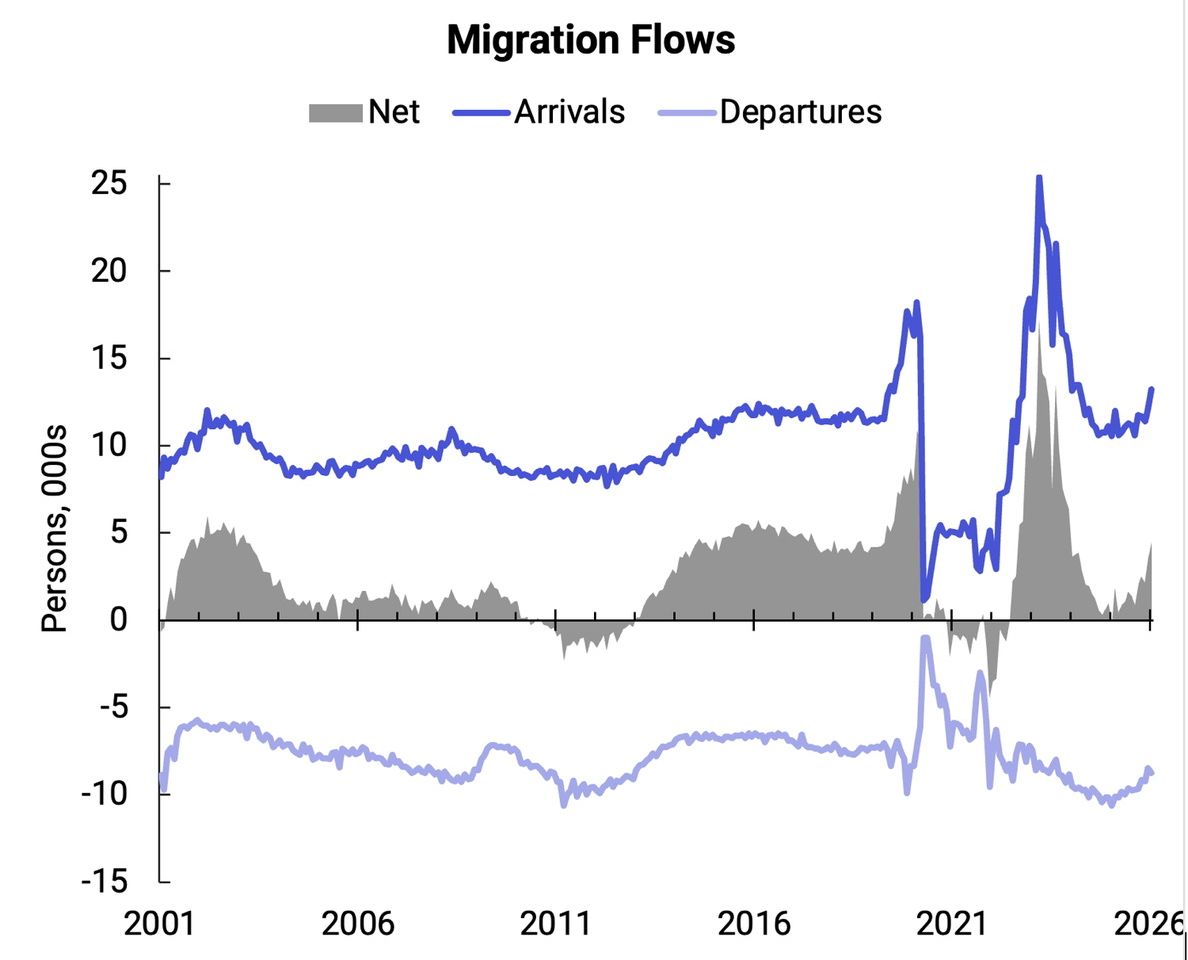
Losing people in the working age group means New Zealand is losing taxpayers and that could have an impact on the growing proportion of elderly depending on government superannuation. However, there is another side to the equation: inwards migration. More people are deciding to move here, especially from India, China and the Philippines. The government data shows that migrants far outnumber the New Zealanders leaving. So the net effect is we have a growing population, including of working age people…The impact is more social than economic or fiscal.
So, what are the fixes to keep Kiwis, if any? Eaqub says previous governments committed to closing the gap with Australia, through measures such as housing reforms, innovation, reducing reliance on ‘cheap migrant labour’, better regulatory design, investment in skills, ICT and infrastructure. But there’s a long way to go. New Zealand is geographically isolated. In today’s interconnected world, the country depends on international trade and a very long supply chain. The conflict in the Middle East has only underscored that dependence. And yet, New Zealand used to make many more of its own products instead of importing so many. It could do so again. Energy independence is vital and the country is blessed with abundant hydropower and plenty of wind. More solar panels on every building would make a big difference.
Some small Kiwi companies punch far above their weight and, in my view, encouraging innovation is definitely a good way to go. Which brings me to another crucial point: Not all industries have to be based in the big cities, notably Auckland and the capital, Wellington. Investment in growth in smaller regional centres, and building eco-friendly real communities supported by adequate infrastructure and amenities, would be a sound move.
New Zealand is a long skinny country, like Japan, but with a fraction of the population, and lots of mountainous, hilly terrain. Transport is not always easy, but it remains vital and needs more investment. Germany is a good example here. Many big German exporting companies indeed are based in small towns and villages. Besides historic reasons, Germany’s robust infrastructure ensures that businesses don’t feel any disadvantage, irrespective of their location. New Zealand could benefit from this model.
The solutions are out there. Some of them are not unique to New Zealand. What’s needed is a new approach, because the current ones are not working.