In a fresh tariff announcement on November 25, the Donald Trump administration proposed additional duties of up to 25 per cent on Indian goods, making India the second-most heavily targeted economy among 14 trading partners covered by a new US investigation into what Washington describes as ‘structural excess manufacturing capacity’.
Only Vietnam, which faces proposed additional duties of up to 35 per cent, has been assigned a higher rate. The US has indicated that India’s proposed rate could be reduced to 17 per cent if New Delhi concludes a bilateral trade agreement addressing Washington’s concerns.
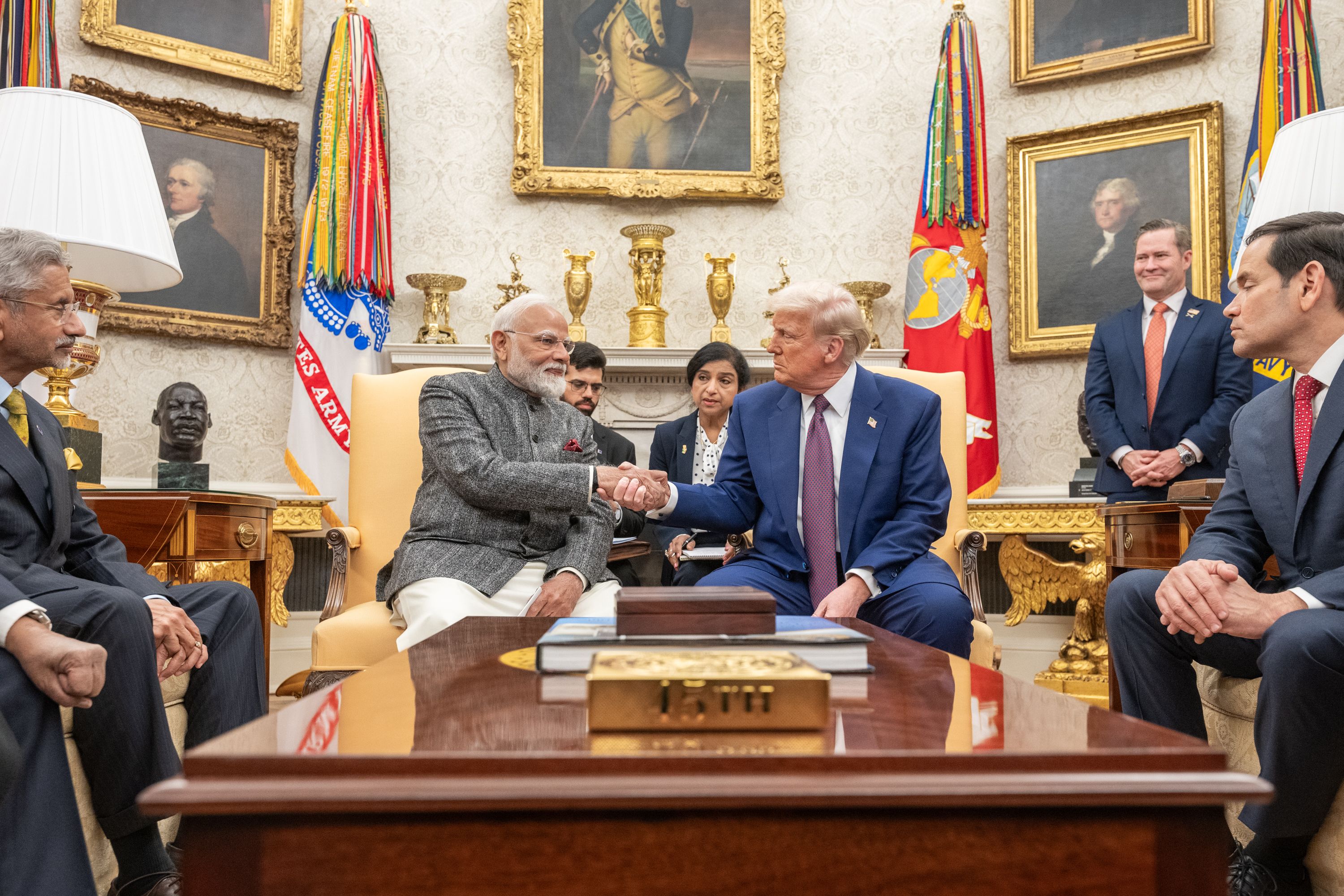
The announcement, made by US Trade Representative Jamieson Greer, comes despite months of negotiations between the two countries and efforts by Prime Minister Narendra Modi’s government to strengthen economic and strategic ties with the Trump administration. It also highlights the gap between India’s diplomatic engagement with Washington and the commercial concessions that the US is seeking in return.
The comparison with other Asian economies is particularly significant. Bangladesh, which signed a reciprocal trade agreement with the US in February, faces proposed additional duties of up to 18 per cent under the latest investigation. Japan, South Korea, Taiwan, Switzerland and the European Union face proposed rates of up to 15 per cent, while Singapore could secure a rate of 10 per cent if it concludes an agreement with Washington.
For India, the immediate challenge is to secure more favourable access to the American market without making concessions that could expose sensitive domestic industries, particularly agriculture and dairy, to greater competition.
Why has the US proposed a 25 per cent tariff on India?
The latest move follows an investigation under Section 301 of the US Trade Act of 1974, which allows Washington to investigate and take action against foreign government policies that it considers unreasonable or discriminatory and harmful to American commerce. The investigation, initiated on March 11, 2026, examined industrial policies, manufacturing incentives, labour protections, financial practices and trade barriers across 16 economies. On November 25, the US Trade Representative announced findings against 14 of them.
Washington alleges that India’s industrial policies and manufacturing incentives contribute to excess production capacity, distort international competition and disadvantage American manufacturers.
The US has identified five broad areas of concern in India’s case: industrial plans to expand manufacturing, inadequate labour protections, financial repression policies, sustained barriers to market access, and failure to address global excess capacity, including through imports and foreign direct investment from non-market economies.
The investigation identifies pharmaceuticals, medical devices, steel, solar energy and information and communications technology as sectors of particular concern.
Greer said that several trading partners had adopted industrial strategies involving manufacturing subsidies, labour suppression, financial support and other market-distorting practices that undermined America’s manufacturing base. India has, however, rejected the allegation of structural excess manufacturing capacity, maintaining that it does not have excess capacity in any sector.
In a statement following the announcement, the Ministry of Commerce and Industry said India had taken note of the US determination and was examining the notice. It reiterated that trade-related concerns should be addressed through the ongoing bilateral trade agreement negotiations.
The proposed duties are subject to public consultation, with written comments due by January 5, 2027, and hearings scheduled to begin on January 25. The full details of the US investigation and proposed tariff measures are available on the USTR website.
How does India compare with other countries?
The US has proposed additional duties of up to 35 per cent on Vietnam, 25 per cent on India and 20 per cent on China and Singapore. Bangladesh, Cambodia, Indonesia, Malaysia and Thailand face proposed rates of up to 18 per cent, while Japan, South Korea, Taiwan, Switzerland and the European Union have been assigned rates of up to 15 per cent.
Some rates could be lowered if countries reach agreements with Washington. Vietnam’s rate could fall to 20 per cent, Singapore's to 10 per cent and India's to 17 per cent. Even at 17 per cent, India would face a higher proposed rate than Japan, South Korea and the European Union. The figures relate to additional duties proposed under the latest investigation, not the total tariffs applicable to imports.
Why has Bangladesh secured a different arrangement?
Bangladesh offers an important comparison because it has already signed an Agreement on Reciprocal Trade with the United States. The agreement, signed on February 9, 2026, was the first such trade pact between Washington and a South Asian country under the Trump administration. Under the agreement, the US reduced its reciprocal tariff rate on Bangladeshi goods to 19 per cent, with certain products eligible for a zero reciprocal tariff rate.
It also agreed to establish a mechanism allowing specified quantities of Bangladeshi textile and apparel products to enter the American market at zero reciprocal tariff rates. The eligible volumes are linked to Bangladesh’s purchases of US-produced cotton and man-made fibre textile inputs. In return, Dhaka agreed to provide preferential market access to a wide range of American industrial and agricultural products, including chemicals, machinery, medical devices, motor vehicles, dairy products, beef, poultry and agricultural commodities.
Bangladesh also made commitments on regulatory standards, labour rights, environmental protection and digital trade. The agreement signed by Washington and Dhaka demonstrates the extent of concessions Washington has been able to secure from a South Asian trading partner in exchange for more favourable market access.
However, Bangladesh is not exempt from the latest US trade investigation. The November 25 proposal assigns it additional duties of up to 18 per cent, taking into account existing duties, ongoing consultations and commitments made under the February agreement. This is an important distinction. Bangladesh’s 19 per cent reciprocal tariff arrangement and the newly proposed 18 per cent rate under the manufacturing-overcapacity investigation are separate components of the US trade framework and should not be treated as a single cumulative rate.
India, meanwhile, has not concluded its agreement. The difference is therefore not simply that Bangladesh has been offered a lower tariff. It is that Dhaka has already concluded an agreement involving substantial market-access commitments, while New Delhi is still negotiating the terms of its own arrangement.
What about Pakistan, Nepal and Sri Lanka?
Pakistan, Nepal and Sri Lanka are not among the 14 economies covered by the November 25 manufacturing-overcapacity investigation. They have therefore not been assigned proposed tariff rates under this particular action. However, Pakistan and Sri Lanka, along with India and Bangladesh, were covered by a separate US Section 301 investigation into whether countries adequately prohibit and enforce restrictions on imports produced using forced labour.
Under the final measures announced in July 2026, the US prescribed a 10 per cent Section 301 duty for India, Bangladesh, Pakistan and Sri Lanka, among other economies. Nepal does not appear on the list of economies covered by that investigation or the November manufacturing-overcapacity investigation.
Consequently, Bangladesh provides the most relevant South Asian comparison for assessing the latest US announcement, while the positions of Pakistan, Nepal and Sri Lanka need to be understood in the context of separate trade measures and the broader US tariff regime. The July Section 301 announcement on forced-labour imports provides the details.
What is holding up the India-US trade agreement?
India and the US began negotiations for a bilateral trade agreement in February 2025, with the objective of expanding two-way trade, reducing tariffs and addressing longstanding market-access barriers. The negotiations gained momentum on February 6, 2026, when the two countries announced a framework for an interim trade agreement. Under the framework, Washington agreed to apply an 18 per cent reciprocal tariff on covered Indian-origin goods, while New Delhi agreed to reduce or eliminate tariffs on a range of American industrial and agricultural products. These included dried distillers’ grains, red sorghum for animal feed, tree nuts, fresh and processed fruit, soybean oil, wine and spirits, among other products.
India also agreed to address American concerns over market access for medical devices, information and communications technology products, import licensing and regulatory standards. Another significant element was India’s stated intention to purchase $500 billion worth of American energy products, aircraft and aircraft parts, precious metals, technology products and coking coal over five years. The framework was intended to form the first phase of a larger bilateral trade agreement, with further negotiations expected to expand market access and cover additional areas. However, the framework has not translated into a final agreement.
The US Supreme Court subsequently invalidated the Trump administration’s use of emergency powers to impose sweeping reciprocal tariffs, prompting Washington to introduce a different tariff structure. This altered the negotiating landscape and created uncertainty over earlier tariff commitments. The November 25 Section 301 findings have now added another complication, giving Washington fresh leverage in the negotiations.
Agriculture and dairy remain major sticking points
The biggest disagreements involve agriculture, dairy, market access and regulatory barriers. Washington wants India to lower tariffs and remove restrictions affecting American agricultural and industrial exports. India, however, remains reluctant to expose politically sensitive sectors, particularly dairy, poultry and certain agricultural commodities, to greater American competition.
Agriculture is especially sensitive because it supports the livelihoods of millions of Indian farmers. New Delhi is concerned that cheaper and heavily subsidised American agricultural products could put pressure on domestic prices and rural incomes. India has also sought to protect products such as rice, wheat and dairy from extensive market opening commitments.
The United States, meanwhile, wants greater access for its agricultural exports, medical devices and technology products. It has also pressed India to recognise American standards and ease regulatory restrictions that it considers barriers to trade.
Greer has previously acknowledged the difficulty of negotiating access to India’s agricultural market. Speaking about the negotiations, he described India as a “tough nut to crack” because of its longstanding protection of agricultural markets, while indicating that Washington was working to identify areas where the two sides could reach an agreement.
There are also disagreements over tariff certainty. India wants assurances that concessions made under a bilateral agreement will not be followed by fresh American duties or changes in tariff policy. The Trump administration’s repeated use of tariffs as a negotiating instrument has made this an important concern for New Delhi.
Russian oil purchases have further complicated the broader relationship, with Washington pressing India to reduce its dependence on Russian crude while New Delhi has maintained that its energy purchases are guided by domestic requirements and national interests.
What do Jaishankar and Greer say?
External Affairs Minister S Jaishankar has maintained that negotiations are in their final stages, but India wants an agreement that does not compromise its economic interests. Speaking at the Hindustan Times Leadership Summit on November 14, Jaishankar said most issues had been resolved, although some remaining concerns arose from developments on the American side.
“There is the last stretch of issues and in many cases, these concerns are not so much at our end because the changes have been more at the American end than our end,” he said. He added that India’s objective was to secure an agreement that was “beneficial, balanced and which would give us a comparative advantage over groups of comparable economies.”
Jaishankar also stressed that the negotiations could not be rushed because they involved jobs, businesses and people’s livelihoods. His remarks reflect India’s position that concluding an agreement is important, but not at the cost of concessions that could disadvantage domestic producers or leave Indian exporters at a competitive disadvantage against other Asian economies. The External Affairs Minister’s comments at the November summit underline New Delhi’s insistence on a balanced agreement.
Greer, meanwhile, has acknowledged that negotiations are progressing but has cautioned against expecting an immediate agreement. After meeting Commerce and Industry Minister Piyush Goyal on the sidelines of the G20 Trade Ministers' Meeting in October, Greer said the two sides had identified the outstanding issues but had yet to resolve them. “We are in the short strokes. So I think we’re toward the end of it,” he said, adding, “At the same time I don't think there's something imminent.”
He also said, “We truly have identified the universe of items that are sticking points. We are working diligently toward them.”
The US Trade Representative’s comments in October suggest that the negotiations are not stalled for lack of engagement, but that significant differences remain over the terms of the agreement.
The latest tariff proposal provides Washington with an additional incentive to push New Delhi towards a settlement. Greer has indicated that lower proposed rates for certain countries take account of commitments made under their respective trade agreements.
Why does the agreement matter for India?
The United States is India’s largest export market, making the tariff dispute particularly consequential for Indian businesses. Indian merchandise exports to the US reached $42.79 billion between April and August 2026, compared with $40.39 billion during the corresponding period a year earlier, according to Reuters. The major export categories include pharmaceuticals, electronics, textiles, engineering goods, gems and jewellery.
A higher tariff burden could make Indian products less competitive against goods from countries that have secured more favourable terms. It could also influence investment decisions, supply chains and India’s ambition to emerge as a major alternative manufacturing destination to China.
For Bangladesh, the stakes are particularly high in textiles and garments. For Vietnam, they extend across electronics, footwear, textiles and other manufacturing sectors. For India, the challenge is more complex because it is simultaneously seeking greater access to the American market and trying to protect domestic industries from foreign competition.
The proposed 17 per cent rate would be an improvement over 25 per cent, but it would still be higher than the 15 per cent rates proposed for Japan, South Korea and the European Union, as well as Singapore’s potential 10 per cent rate.
The broader question is whether India’s strategic engagement with Washington can translate into commercially favourable terms. The two countries have repeatedly described their relationship as a major strategic partnership. However, the trade negotiations demonstrate that political and defence cooperation does not automatically translate into agreement on market access, agriculture and industrial policy.
For New Delhi, the immediate challenge is to secure a trade agreement without compromising domestic economic interests. For Washington, it is to obtain greater market access and commitments from one of the world’s largest economies. Whether the two sides can bridge those differences will determine not only the future of their bilateral trade relationship but also India’s competitive position against other Asian exporters in the American market.