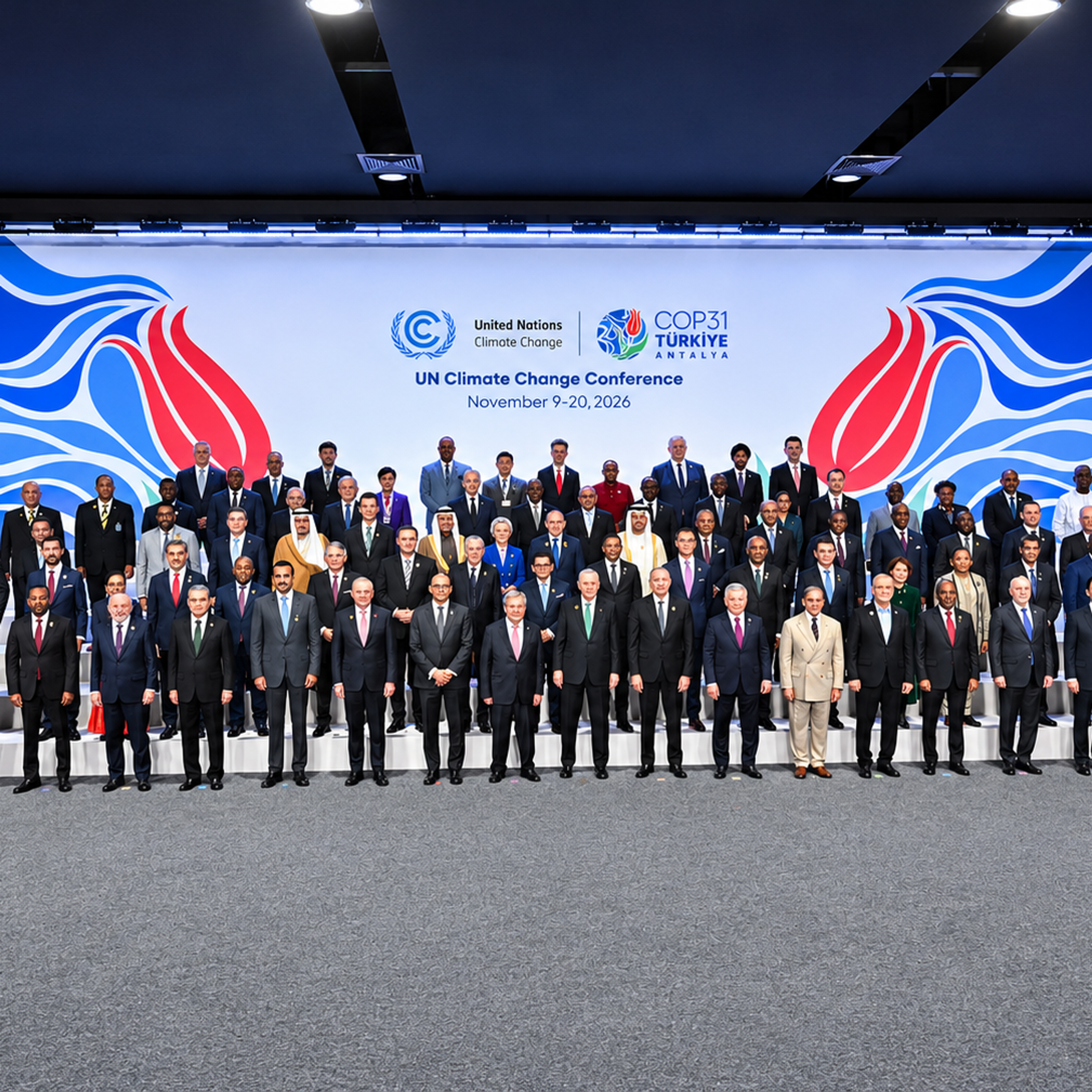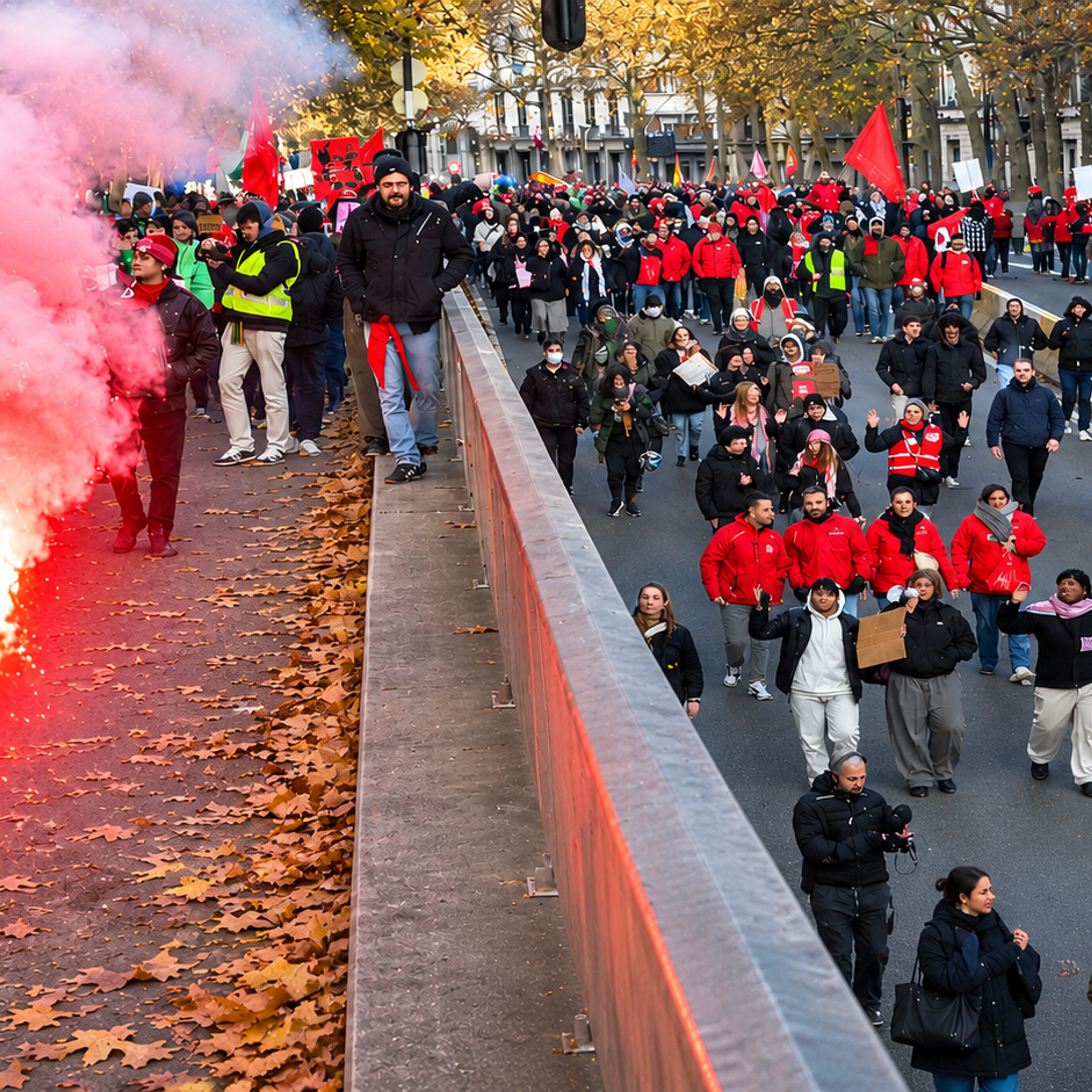
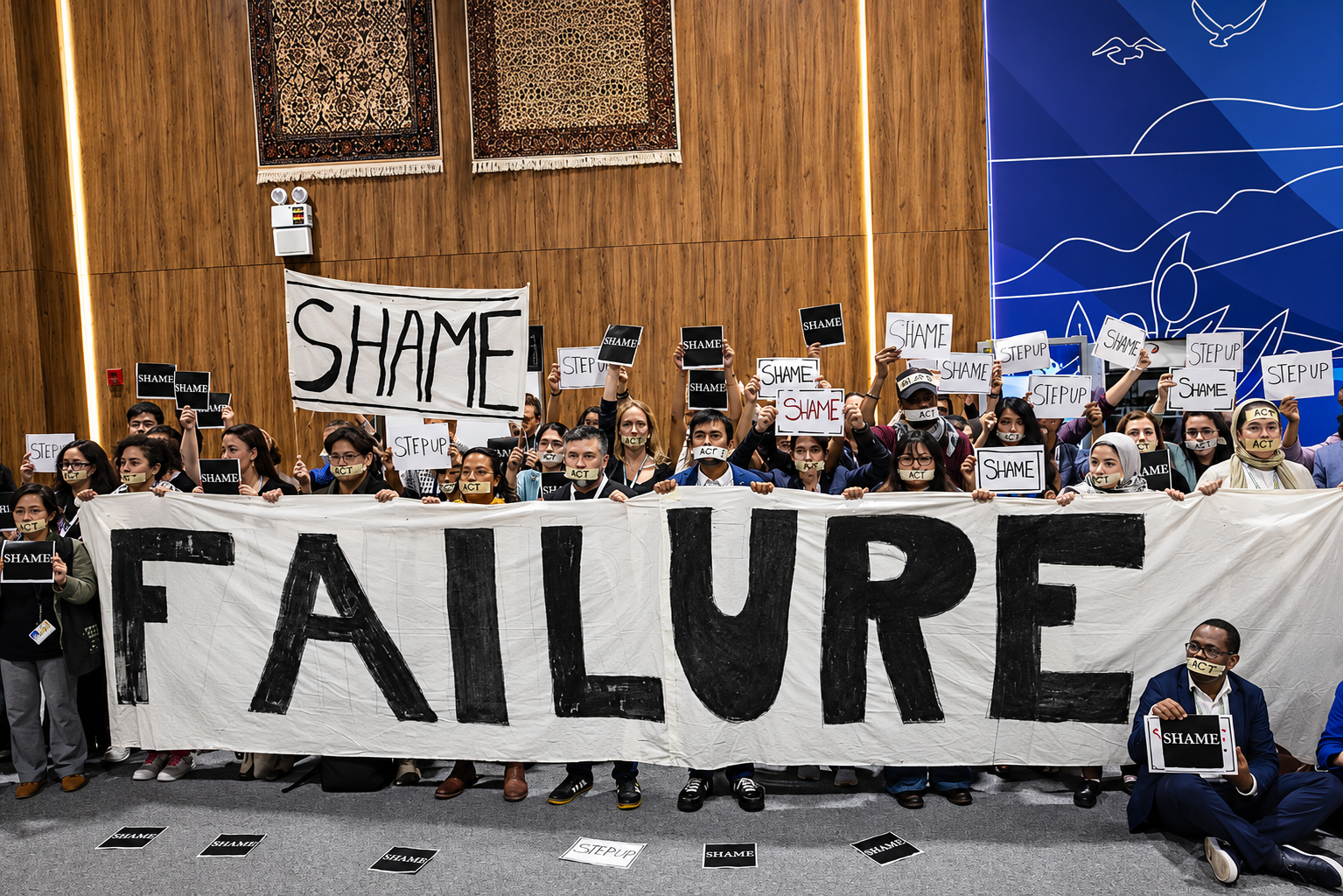
On November 22, 2026, after two days of overtime in Antalya, Türkiye, COP31 ended without adopting its primary political pact, the first such failure since Copenhagen in 2009. The collapse of the proposed Antalya Pact exposed a profound crisis of legitimacy in global climate diplomacy. After three decades of annual summits, the UNFCCC framework appears paralysed, trapped between the demands of island states, fossil-fuel producers and a lack of predictable climate finance.
Negotiators passed discrete technical measures, but the collapse of the main deal raises a fundamental question: is the consensus-based COP process still capable of holding major emitters accountable?
Here is why talks stalled, what the emissions data reveal, how key powers positioned themselves and what this means for COP's legitimacy.
Why did the Antalya Pact fail at the final plenary?
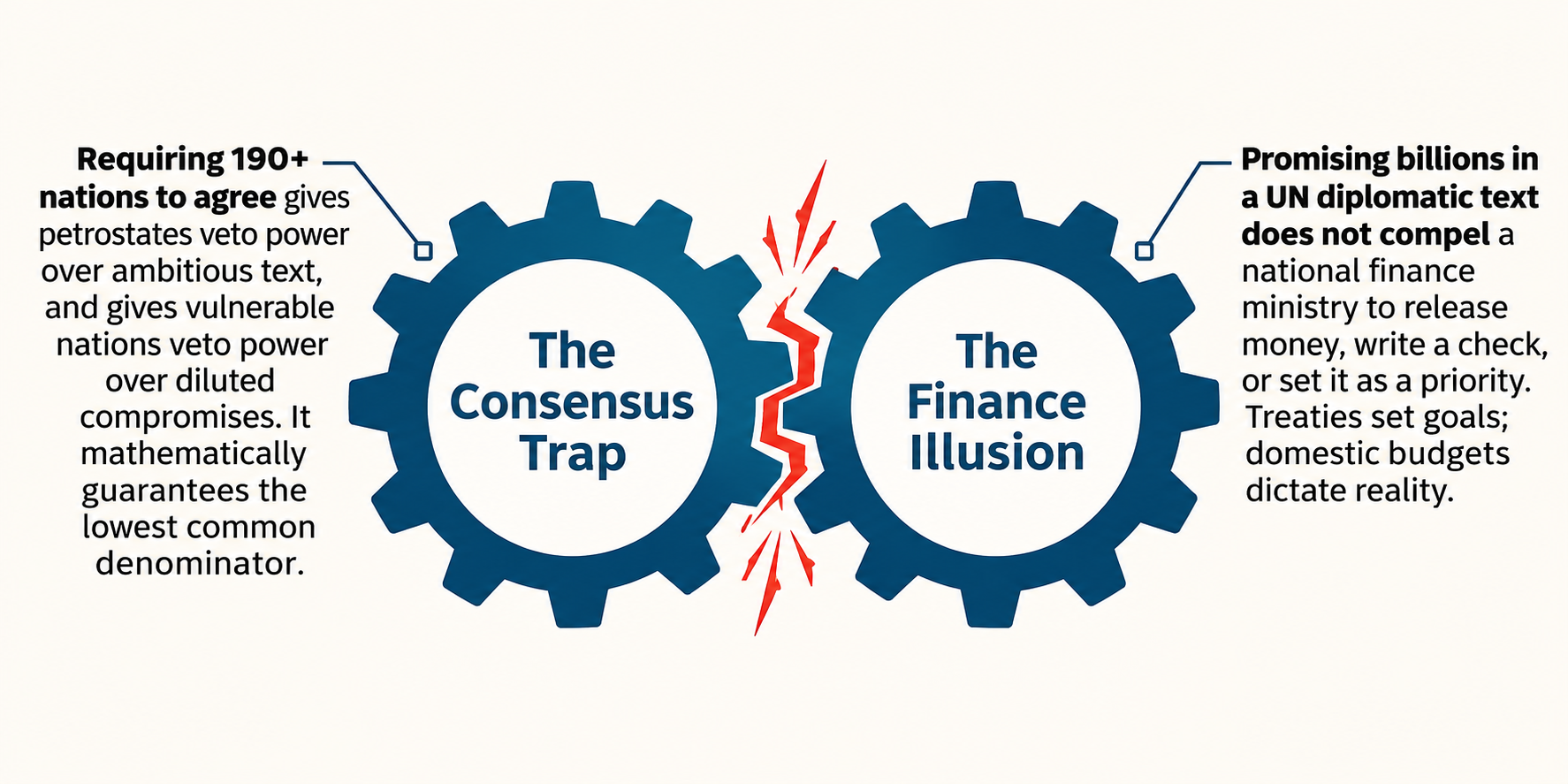
The EU, UK, Norway, Panama, Belize and island states including the Marshall Islands and Vanuatu refused to endorse the final draft. The catalyst was the omission of explicit language on transitioning away from fossil fuels, a core commitment agreed at COP28 in Dubai. Negotiators from the Marshall Islands and Vanuatu noted that in May 2026, 141 governments backed a UN General Assembly resolution, drawn up by Vanuatu, urging that transition. Yet under UNFCCC rules, consensus gives any bloc a veto.
After negotiators stripped all reference to ending fossil-fuel use from the draft, the EU and its allies blocked it. African and Arab groups, by contrast, signalled willingness to accept the draft despite finance reservations in order to preserve an agreement. Presidency sources said Saudi Arabia had accepted a reference to fossil fuels based on earlier COP decisions, but the EU objected over trade provisions. Without consensus, the pact failed.
What were the main battle lines over fossil fuels and climate finance?
Talks split along two fault lines: energy transition targets and financial support.
1. Carbon capture targets vs fossil-fuel timetables
The presidency draft, led by Türkiye’s Minister Murat Kurum and Australia’s Minister Chris Bowen, proposed a voluntary carbon capture target of one billion tonnes by 2035, framed as a collective aspiration. Yesil Gazete and Carbon Brief highlighted a stark imbalance: carbon capture received a target, while any fossil-fuel reduction timetable was absent.
Saudi officials enjoyed regular access to the Turkish and Australian presidents, while island delegations struggled to secure meetings. Türkiye, however, denied bias. OPEC’s secretary general asserted at COP31 that energy security requires all energy sources, and later blamed the EU for the collapse.
2. The disappearing adaptation finance baseline
The second fracture was climate finance. African negotiators, led by Malawi and Ghana, insisted on explicit commitments to triple adaptation finance by 2035, as pledged at COP30 in Belém. African negotiators also wanted a floor of about $120 billion a year by 2035, delivered as grants. That proposed floor of at least $120 billion annually was dropped from a revised draft circulated on 19 November.
COP29 in Baku set a $300 billion annual finance goal by 2035, within a broader $1.3 trillion target. But developing nations noted that without grant funding, vulnerable communities remain exposed. UNEP puts developing-country adaptation needs at $305 billion annually by 2035, against international public adaptation finance of just $28.2-31.7 billion in 2024.
How did host dynamics, lobbyist access and governance erode trust?
Procedural management of COP31 drew intense criticism:
- Late drafts: The presidency tabled its final package in the early hours of Sunday and gave delegations only several hours to object, leaving smaller teams little time to consult capitals.
- Attendance vs negotiators: Carbon Brief’s analysis of UNFCCC lists counted 92,934 provisional registrations. Only 18,812 held party badges, against 16,726 overflow badges and 39,400 staff and other badges.
- Fossil-fuel lobbying: A Kick Big Polluters Out investigation identified 103 polluting corporations and trade groups, 60 of them from the fossil-fuel industry. Thirty-one sat on official national negotiating delegations, prompting demands for conflict-of-interest rules before COP32.
What does the science reveal about emissions and the 1.5°C goal?
Assessments released alongside COP31 by UNEP and the Global Carbon Project contrast starkly with the diplomatic paralysis.
UNEP’s 2026 Emissions Gap Report estimates net global emissions in 2025 at 58.4 GtCO₂e, flat against 58.5 GtCO₂e in 2024 but a 54 per cent increase on 1990 (37.9 GtCO₂e). For 2026, the Global Carbon Project projected a 0.4 per cent fall in fossil CO₂ (to 38.2 GtCO₂), driven by clean power growth and oil disruption from the Iran conflict and the Strait of Hormuz. Including land-use change, total CO₂ emissions rose from 42.8 to 43.3 billion tonnes, confirming that emissions have not peaked.
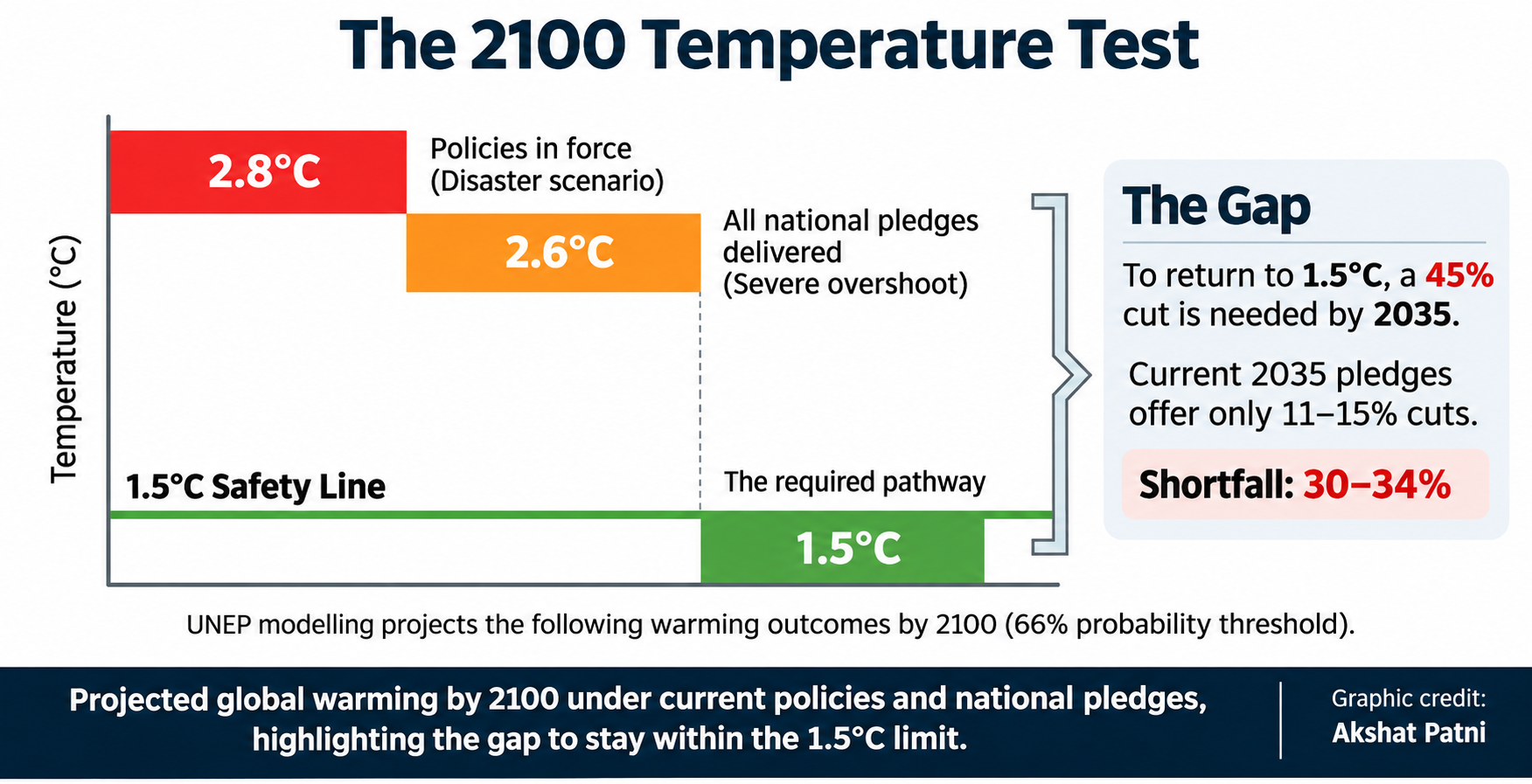
UNEP modelling projects the following warming by 2100 (66 per cent probability threshold):
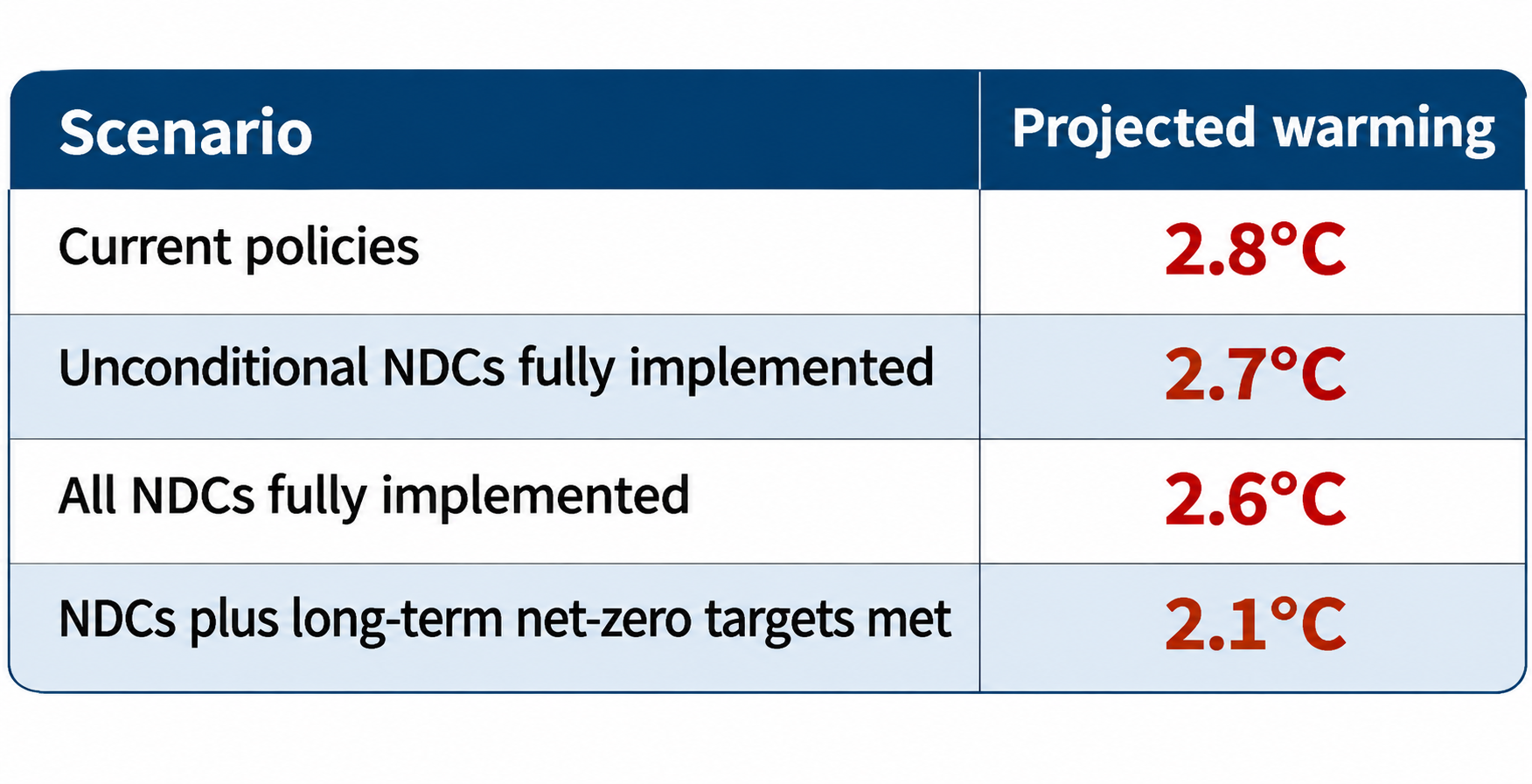
To keep a 50 per cent chance of returning to 1.5°C by 2100 after a temporary peak of 1.7-1.8°C, UNEP says global emissions must fall 45 per cent below 2025 levels by 2035, alongside an 18 per cent cut by 2030 and a 69 per cent cut by 2040.
However, existing national pledges promise cuts of only 11-15 per cent by 2035. That leaves a 30-34 percentage-point ambition gap that diplomats in Antalya failed to bridge.
Where do the major powers stand?
Diverging strategies complicated negotiations further.
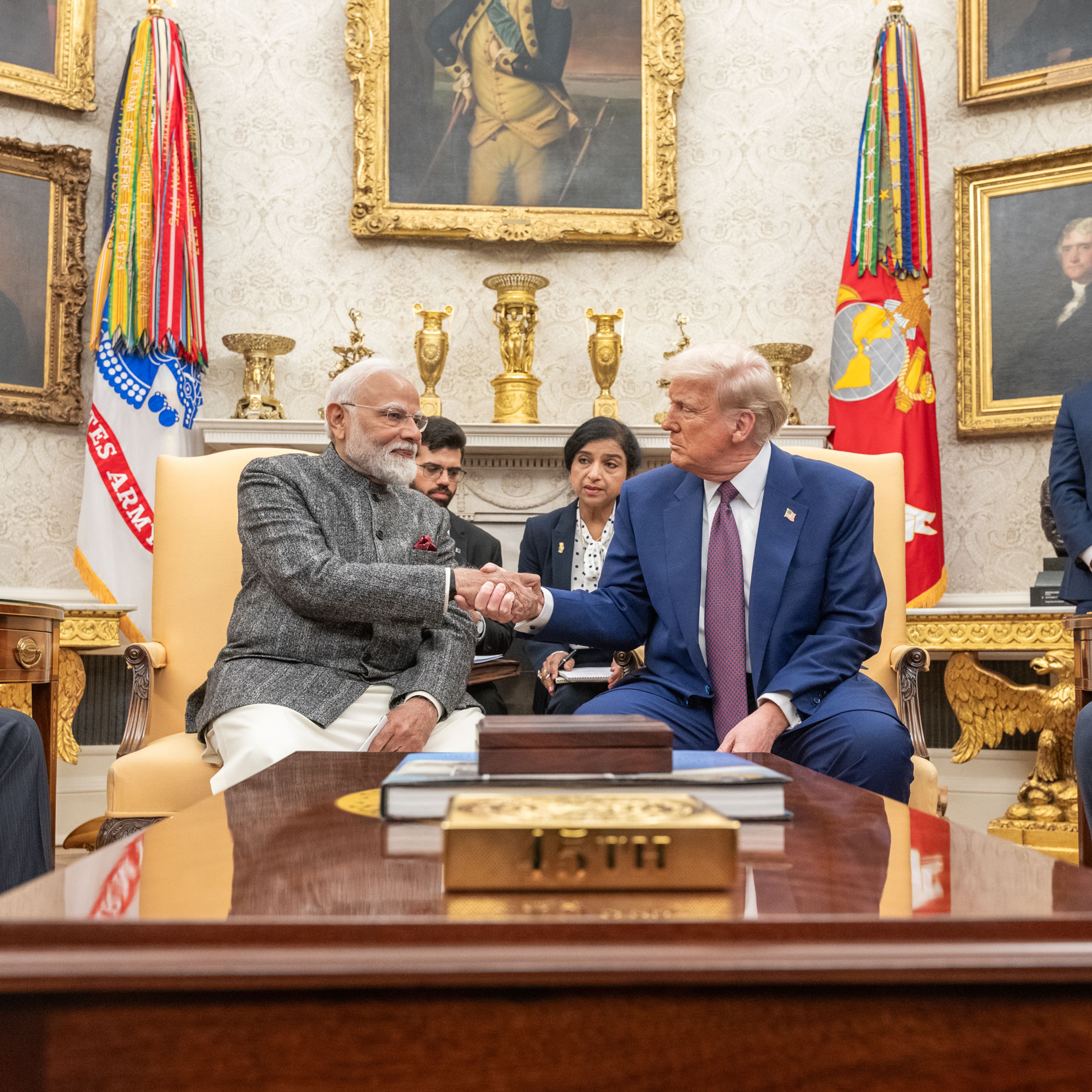
- India (public finance and equity): India defended Article 9.1 of the Paris Agreement, demanding public climate finance and upholding common but differentiated responsibilities. Negotiators highlighted that India’s per-capita emissions stand at about 3 tonnes of CO₂e a year, against about 18 tonnes in the US. India faces a dual mandate: expanding renewables while relying on coal for affordable power.
- China (electrification vs absolute limits): China signed a joint statement with Australia endorsing the voluntary “35 by 35” goal of raising electricity’s share of final energy use to 35 per cent by 2035. Having signalled at the opening plenary that solidarity and multilateralism mattered more than specific problems, China accepted the draft text despite reservations. Analysts note its impact depends on domestic coal trends and peak-emission timelines rather than international pledges.
- United States (federal absence): The US left the Paris Agreement on January 27, 2026, and its withdrawal from the UN Framework Convention takes effect on February 27, 2027. It sent no official delegation to Antalya. Governors and mayors highlighted subnational action but could not replace federal funding or executive bargaining.
Did anything survive COP31?
Despite the pact’s collapse, delegates agreed on 36 agenda items, including:
- Adaptation and just transition: Approved further work on Belém’s 59 adaptation indicators, with a technical task force refining them through voluntary country testing, and a three-year extension of the Just Transition Work Programme to design frameworks protecting workers and regional economies.
- Loss and damage: Delegates reviewed the Loss and Damage Fund, which has $342 million available against $2.8 billion in 119 requests.
Outside the negotiations, UNEP confirmed satellite-verified repairs at 46 major methane sources in 13 countries. Five new repairs in Canada, Iraq, Kazakhstan and Mexico addressed 125,000 tonnes of methane.
Reclaiming the legitimacy of COP: five accountability reforms before COP32
Antalya marks a watershed moment for climate diplomacy. Over 30 years, the summit system achieved structural breakthroughs. Kyoto’s 1997 targets, an average cut of just over five per cent on 1990 levels, were exceeded, with covered countries ending 22.6 per cent below 1990. The 2015 Paris Agreement bent projected warming from nearly 4°C to around 2.8°C. But when consensus rules allow fossil-fuel interests to stall timetables and permit wealthy nations to delete financial baselines, COP's legitimacy comes under severe threat.
To restore international credibility, negotiators must enact five institutional accountability reforms before COP32:
- Annual delivery plans: Emitters’ energy and finance ministers publish 12-month funded sector actions against a dated baseline.
- Predictable grant schedules: Donor finance ministries publish pledged, approved and disbursed grants separately from loans and private debt.
- Early draft disclosure: Host presidencies publish negotiating drafts weeks in advance so small island delegations can consult capitals.
- Verified methane and energy reporting: Regulators and utilities require independent satellite measurement before and after methane repairs and clean power growth.
- Ring-fenced local budgets: National governments allocate direct, verifiable budgets for displaced fossil-fuel workers and climate-hit infrastructure.
The path ahead
Governments arrived in Antalya knowing the size of the shortfall. By 2035, their pledges would cut emissions by 11-15 per cent from 2025 levels. A pathway offering even a roughly even chance of returning to 1.5°C by 2100 requires a 45 per cent cut. After two days of overtime, governments left without a pact that explicitly carried forward the fossil-fuel transition or an agreed dollar baseline for adaptation. Process without progress breeds cynicism. That is the failure COP32 must answer for in Addis Ababa. How much did emissions fall, and how much grant money reached the communities that needed it?