Nearly every commercial flight in Belgium was grounded on Monday (November 23), and large parts of the country’s public transport network were disrupted, as the three main trade union federations staged their eleventh national day of action against the government’s austerity programme. The protest coincided with the most precarious week yet for Prime Minister Bart De Wever’s five-party coalition, which is still without an agreed 2027 budget.
A shutdown of the skies
Skeyes, the state-backed company responsible for Belgian air traffic control, announced that anticipated staffing levels would not allow it to guarantee the safe handling of regular traffic between 7 a.m and 9 p.m, a 14-hour window. Only emergencies and safety-critical flights were to continue. Brussels-Charleroi airport, a major base for the low-cost carrier Ryanair, described the decision as a “last-minute” one and said that it amounted to a “complete shutdown of all the country’s airports for an entire day.” Local media reported that all departures and arrivals at Brussels Airport in Zaventem and at Charleroi were cancelled. Airport and airline operators complained that the notice had been “extremely late”. The Board of Airline Representatives in Belgium, which speaks for about 25 carriers, said the walkout was the 11th strike to affect Belgian airspace in 11 months.
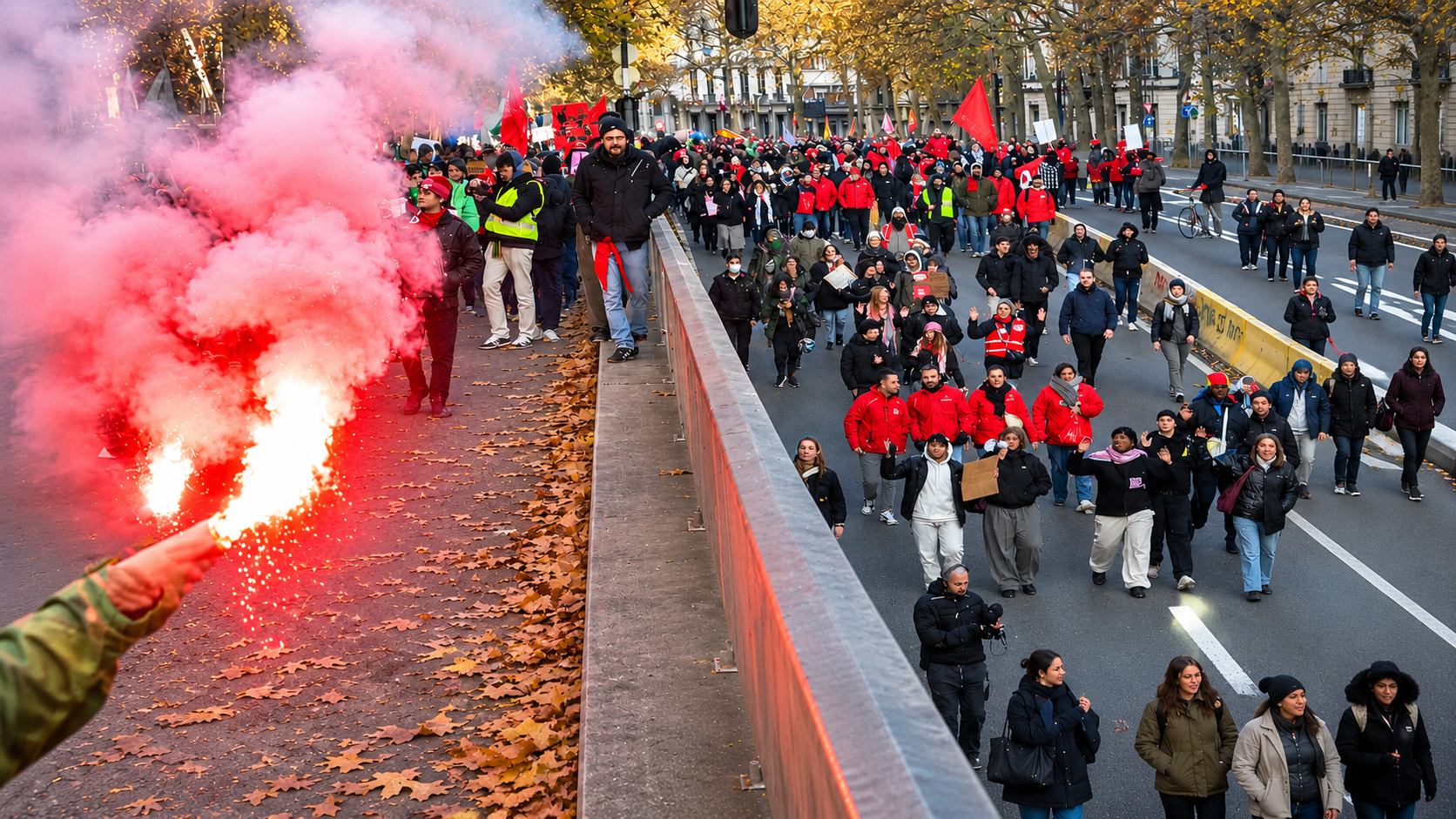
On the ground, the Brussels operator STIB limited its network to two metro lines and a reduced selection of tram and bus routes. The Flemish operator De Lijn said that four in ten of its lines were not running. Refuse collection in the capital was also expected to be disrupted. The national railway operator SNCB did not receive a strike notice, so trains largely ran, although services into Brussels were expected to be crowded. Several thousand demonstrators gathered near Brussels-North station on Monday morning before marching towards the Brussels-Midi area.
What the unions want
The Christian CSC-ACV, the socialist FGTB-ABVV and the liberal union Synova issued a joint call for a “major social mobilisation”. They said that the cost of the budget savings must not be passed on to workers, benefit recipients and public services, and pointed to industrial job losses and falling purchasing power. In a joint statement, the unions said that rent, energy, fuel, transport, school fees and food were all getting more expensive.
The socialist federation had set out three “red lines”: automatic wage indexation, VAT and working hours. It said that it would call a general strike in the week of November 23 if any were crossed. At the previous national march on October 9, CSC general secretary Marie-Hélène Ska said that the unions had jointly submitted proposals worth €21 billion as an alternative route to the €10 billion the government is seeking. That march drew about 30,000 people according to police and up to 50,000 according to the FGTB. Reuters reported that it passed off peacefully overall, but that masked groups later threw projectiles at police and set fires near Brussels Central Station.
The government’s case
De Wever told the public on the eve of that march that painful measures were needed now to avert a spiral of debt and interest costs that would otherwise leave future generations with a heavy bill. He has insisted that he is compelled to make “bold and difficult choices” after his predecessors let the deficit worsen.
The numbers behind that argument are stark. According to the National Bank of Belgium, as summarised by IR Insider, the deficit reached 5.2 per cent of GDP in 2025, well above the EU’s 3 per cent ceiling. Belgium has been under the EU’s excessive deficit procedure since July 2024 and must bring the shortfall below the limit by 2029. Les Engagés leader and Foreign Minister Maxime Prévot warned on November 16 that if the country were plunged into chaos the bill would “not magically disappear” and could grow to about €15 billion.
Ministers also point to public opinion on some measures. When the first programme law was approved, the national news agency Belga cited polling showing majorities in Flanders, Wallonia and Brussels in favour of limiting unemployment benefits to two years. Employment Minister David Clarinval of the MR described that limit as part of the government’s first series of reforms.
The measures at issue
The coalition agreement of February 2025 set out a two-year limit on unemployment benefits, a bonus-malus pension system and a retirement age held at 67. Law firm Crowell & Moring noted that people over 55 with long careers are exempt from the benefit limit. The Employment Office expects about 194,000 people to lose benefits in 2026, according to a report by the Federal Institute for Human Rights, which has repeatedly warned that the reforms put social rights at risk. The 2027 budget talks concern a further €10 billion in savings by 2029, with healthcare cuts and a VAT increase under discussion.
A coalition in crisis
De Wever handed in his resignation on November 2 after overnight talks failed. King Philippe rejected it on November 6 and told the coalition to resume negotiations. De Wever then acknowledged that 2027 would open under a stopgap “provisional twelfths” arrangement, calling it a serious setback. He returned to the palace empty-handed on November 16 and was due at the palace again at 11:30 on Monday for the third time in a month.
The sticking point is the balance between cuts and taxes. Reporting indicates that parties N-VA and the MR favour spending cuts, while Vooruit, CD&V and Les Engagés want €1 billion to €1.5 billion from higher earners. The MR also opposes a VAT rise. Vooruit, the coalition's only left-leaning party, has refused to negotiate on De Wever’s proposal since November 15 and wants a bigger contribution from the wealthy and fewer cuts to health and pensions. Its leader, Conner Rousseau, said that he was deeply disappointed that colleagues had not made the deal fairer. Under Article 46 of the constitution, any new resignation could lead to elections within 40 days, in the middle of the Christmas period.
Belgium has a long tradition of general strikes, dating to 1893, but the defining austerity confrontation was the winter of 1960-61. Gaston Eyskens’s government sought to repair public finances after the loss of the Congo with the “Loi Unique”, and the FGTB’s resistance brought out some 700,000 workers that eventually led to the government’s fall. However, the law was passed by then. The 2014 general strike against Charles Michel’s government, which also included N-VA, likewise failed to stop its programme.
De Wever’s government took office on February 3, 2025, 239 days after the election. Its “Arizona” coalition spans Flemish nationalists, French-speaking liberals, centrists, Christian Democrats and Flemish socialists. A similar impasse in autumn 2025 ended with a €9.2 billion package after a three-day strike, which police figures put at about 80,000 marchers at its October peak. Some demonstrators then carried signs reading “wanted for pension theft”.
Far-right position
Belgium’s far-right party Vlaams Belang’s position is more complicated than simple opposition to cuts. Tom Van Grieken-led Vlaams Belang, which won more than 23 per cent of the Flemish vote in 2024, has attacked the pension reforms for hitting stay-at-home parents and informal carers, and in 2025 labelled the budget deal “an attack on the average Fleming”. It is not, however, a defender of public spending.
Van Grieken has proposed capping state spending at 50 per cent of GDP and called tax rises “unheard of”, saying Flemish taxpayers were already the “most plucked chicken”. He argues that De Wever promised a right-wing government but allied with the socialists, leaving voters feeling betrayed, and he has demanded early elections. Vlaams Belang therefore opposes the form of austerity, meaning higher taxes and pension changes, more than the principle of cutting.
As darkness fell over a country whose skies had been empty since dawn, the strike had once again exposed the central dilemma of Belgian politics: a government that insists the arithmetic leaves it no choice, and a labour movement that insists the burden is being placed on those least able to carry it. Neither side has yet shown it can move the other, and the coalition’s own divisions may prove as decisive as the pressure from the streets.
De Wever must still secure a budget agreement before the end of the year, or else preside over a second consecutive twelve months of stopgap spending. If the talks fail and the King accepts a further resignation, voters could be sent to the polls in the middle of the festive season, an outcome most coalition parties are reported to dread. History offers the prime minister little comfort and the unions even less. The great winter strike of 1960-61 failed to prevent the passage of the austerity law it opposed, yet the government that imposed it soon collapsed. Whether Belgium’s present leaders can enforce their programme and survive politically, and whether the unions can turn eleven days of action into lasting leverage, will be settled over the coming weeks, in the coalition’s negotiating rooms as much as on the streets of Brussels.