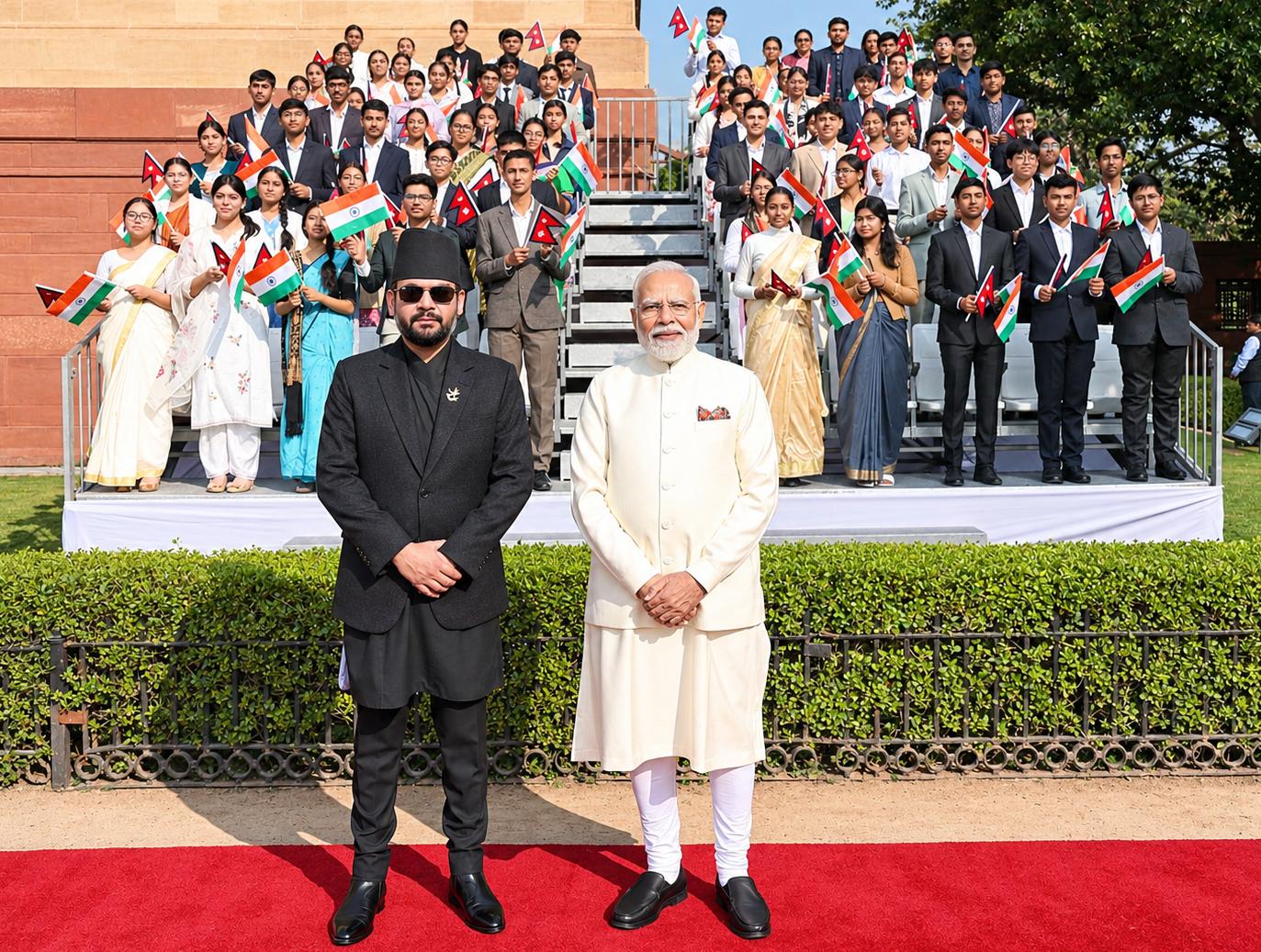
In a sign of a possible thaw in India-Nepal relations, India announced a $1.62 billion (INR 15,000 crore and NPR 24,000 crore) reconstruction and development package for Nepal, alongside a series of agreements and infrastructure initiatives spanning connectivity, energy, trade and education. Prime Ministers Narendra Modi and Balendra Shah concluded bilateral talks at Hyderabad House in New Delhi on November 23, aimed at strengthening ties and deepening economic cooperation. The discussions are expected to provide “political direction” to relations between the two countries, The Indian Express reported.
The two leaders jointly inaugurated a motorable bridge connecting Darchula in Nepal with Dharchula in India's Uttarakhand state across the Mahakali River, also known as the Sharda River in India, and the second phase of the Motihari-Amlekhgunj petroleum pipeline. They also laid foundation stones for an integrated check post at Banbasa, a greenfield petroleum storage terminal in Jhapa and the Lower Arun hydropower project. The leaders also virtually flagged off the Saryu-Kamala Express, a passenger train connecting Janakpur Dham in Nepal with Ayodhya Cantonment in Uttar Pradesh.
Later in the day, India also announced plans to establish an offshore campus of the Indian Institute of Technology Kanpur (IIT-K) and a startup incubator in Nepal, further expanding bilateral cooperation in education, technology and entrepreneurship. IITs are among India’s premier technology institutions and have produced graduates who have gone on to lead major global companies.
Shah, who took office in March, is visiting India on his first official foreign visit. The visit also offers New Delhi an opportunity to establish an early working relationship with Nepal's new leadership at a time when China has been expanding its economic and strategic footprint in the Himalayan nation. Relations between the two neighbours have been under strain for several years over a range of issues, including territorial disputes, political friction, economic disagreements and concerns over sovereignty.
$1.62 billion aid package
Marking a new chapter in bilateral ties, India announced a $1.62 billion aid package for Nepal's post-flood reconstruction and broader development initiatives. The August 26 floods caused extensive damage to infrastructure in the Rasuwa-Bhotekoshi corridor, prompting Kathmandu to seek Indian assistance to rebuild roads, bridges, and other facilities. Nepal has also sought concessional financing to upgrade the Siddhartha Highway, which connects Sunauli with Pokhara, in addition to reconstruction work in areas affected by flooding.
India's aid package could help Nepal address some of its pressing infrastructure requirements while reinforcing India's role as a major development partner. The package forms part of a broader set of agreements and initiatives announced during the visit, reflecting the two countries' efforts to strengthen economic cooperation and infrastructure development.
Connectivity, energy and infra
Connectivity and energy cooperation featured prominently in the bilateral engagement. Among the key initiatives announced was a new cross-border railway link connecting Ayodhya and Janakpur. The railway link is particularly significant given the religious and cultural ties between the two cities, which are associated with the Ramayana. Ayodhya in India is associated with Lord Ram, while Janakpur in Nepal is regarded as the birthplace of Sita, his wife. Improved rail connectivity between the cities could facilitate religious tourism and strengthen people-to-people ties.
Nepal's hydropower potential and India's growing demand for electricity offer opportunities for cross-border energy trade and investment. The 669-MW Lower Arun project is among the initiatives expected to underscore the importance of cooperation in the sector. The Nepal Police Academy in Panauti, an integrated check post and a bridge were also among the projects associated with the bilateral initiatives. The two sides are working to expand cooperation in infrastructure, climate change, disaster resilience, digital connectivity and technology.
Air connectivity remains a sticking point
Air connectivity has long been an issue between the two countries. Nepal has particularly sought additional air-entry routes through Indian airspace to improve connectivity and make its international airports at Bhairahawa and Pokhara commercially viable. Although Nepal has several air-entry routes, international flights are largely confined to the Simara corridor, located in the eastern part of the country. Around 90 per cent of international flights entering Nepal reportedly use the congested Simara corridor. Flights bound for the new airports in western Nepal have to take longer routes, increasing fuel consumption and operating costs for airlines.
India has reportedly proposed allowing aircraft departing from Bagdogra airport in West Bengal to use designated routes through Nepali airspace. The proposal involves Standard Instrument Departures (SIDs), prescribed flight paths that guide aircraft after take-off. Nepal has sought technical details of the proposal and similar arrangements for aircraft departing from Bhairahawa International Airport, located in Lumbini province near the Indian border.
New Delhi has been reluctant to open additional entry corridors, particularly in the western sector, citing security concerns involving sensitive military installations, including the Gorakhpur air base, as well as air-traffic-management complexities. Although the two countries agreed in principle in 2016 to examine additional routes through Janakpur, Bhairahawa and Nepalgunj, the proposals have remained unresolved amid technical assessments and defence sensitivities.
Nepal hopes new entry routes will reduce flight detours, improve international access to Bhairahawa and Pokhara and make the airports more commercially viable. The negotiations also involve reciprocal concessions.
Broader vision for cooperation
The two countries are also working on a 10-point vision document outlining cooperation across economic partnership, connectivity, digital infrastructure, water resources, energy, trade, sports, education and health. The proposed framework is expected to establish longer-term goals and measurable targets for bilateral cooperation, potentially giving the relationship a more structured roadmap for future engagement.
Nepal has also sought India's assistance in developing cricket. Nepal recently concluded the Nepal Premier League successfully and wants to build on its success. Cooperation in technology, startups, capacity-building and digital infrastructure has also emerged as an increasingly important dimension of the partnership. India has been providing scholarships to around 1,500 Nepali students annually and supporting training and capacity-building programmes. Cooperation in AI and digital infrastructure is also being explored, reflecting the widening scope of bilateral engagement.
India remains Nepal's largest trade and transit partner and a major source of foreign investment. According to reported figures, India accounts for around 80 per cent of Nepal's goods exports and nearly a third of foreign investment in the country. Nepal also enjoys duty-free access to the Indian market. Kathmandu has periodically sought to diversify its economic partnerships and reduce vulnerabilities, particularly through engagement with China. Nepal and India have also experienced periodic strains in their bilateral relations.
The relationship has faced friction over territorial disputes involving Kalapani, Lipulekh and Limpiyadhura, as well as Susta, disagreements over the 1950 Treaty of Peace and Friendship, trade-related concerns and differences over water-sharing arrangements. Nepal has also expressed reservations over India's Agnipath military recruitment scheme, which has affected the traditional recruitment of Nepali citizens into the Indian Army.
Shah's visit comes against this backdrop of longstanding sensitivities, making the diplomatic engagement between Modi and Shah significant beyond the immediate financial and infrastructure announcements. The outcome could help set the tone for bilateral engagement in the coming years, particularly if the financial assistance, infrastructure agreements and connectivity initiatives translate into tangible progress on the ground.