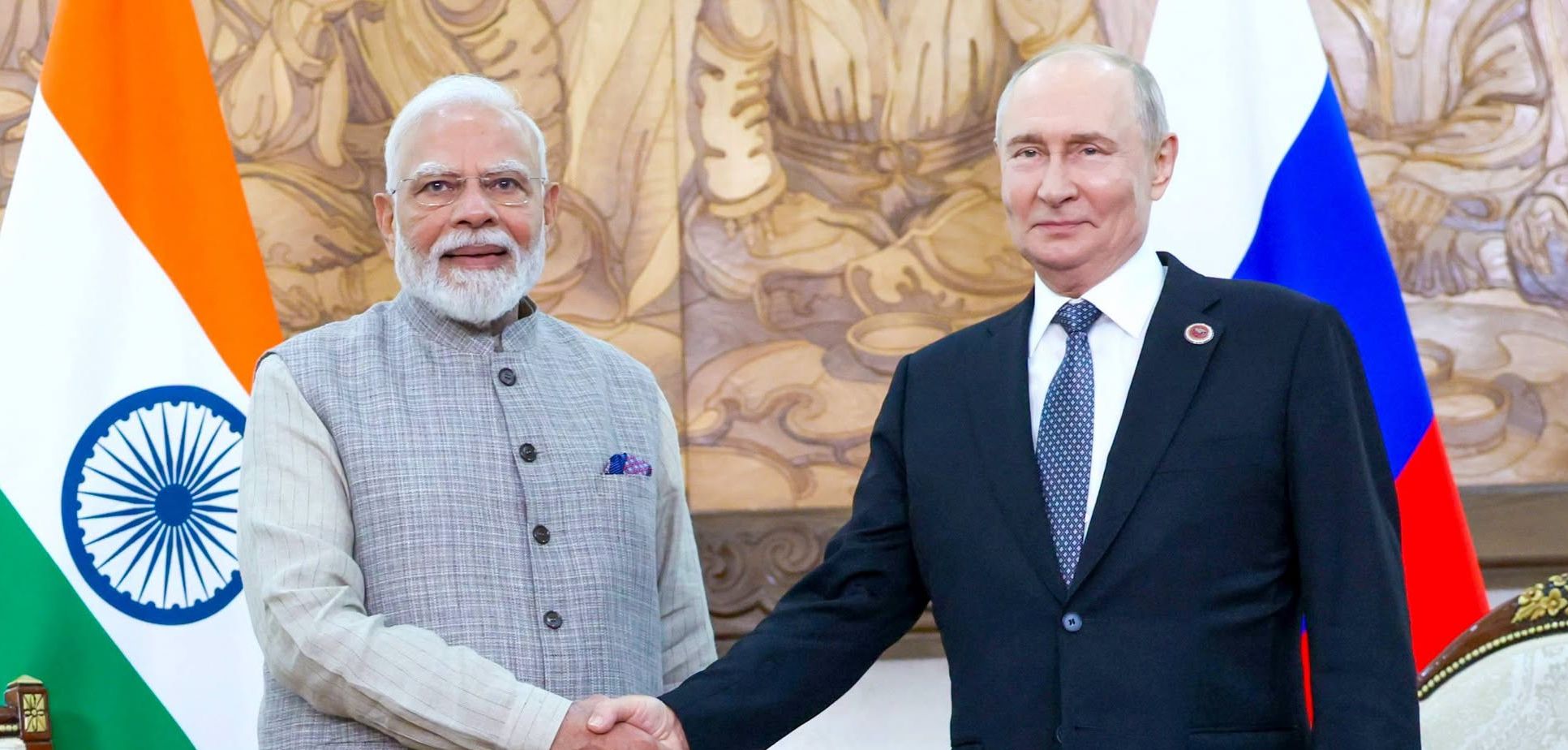
“There are no problems with settlements between Russia and India, I am ready to say that this is one of the most reliable and best-established mechanisms for Russia's payments with other countries,” said Ivan Nosov, head of Russia’s largest financial services company Sberbank in India, in early September. Four years after Western sanctions cut Russia off from the dollar system, his claim appears to be backed by numbers. The rupee-rouble payment mechanism now clears 96 per cent of India-Russia trade, with 90 per cent of transactions settling within ten minutes – a sharp turnaround for a system that nearly collapsed within its first two years.
After the US and EU cut major Russian banks off from SWIFT and dollar clearing following the February 2022 invasion of Ukraine, India needed a way to keep paying for discounted Russian crude without touching Western-controlled banking rails. The Reserve Bank of India revived a rupee-rouble settlement arrangement India and the USSR had used since 1953. Under a July 2022 circular, Indian banks could open Special Rupee Vostro Accounts – essentially rupee accounts held on behalf of Russian banks – so Indian importers could pay in rupees, and Russian exporters, or Indian exporters selling into Russia, could draw on that same pool. In theory, no dollar needed to touch it. In practice, it nearly failed.
The rupee pile-up
The first crisis wasn’t political – it was simple arithmetic. India’s oil-driven imports from Russia jumped from under $10 billion before the war to $61.44 billion in 2022-23, while Indian exports to Russia crawled to just $4.26 billion, leaving a gap of roughly $57 billion. That gap kept widening: $57.2 billion in 2023-24, and close to $59 billion in 2024-25, even as total bilateral trade hit a record $68 billion. Russian crude now makes up over 80 per cent of India’s imports from Russia, and about half of India’s total oil imports.
With so little to buy from India, Russian banks sat on huge unused rupee balances. Foreign minister Sergei Lavrov complained publicly that Moscow had accumulated billions of rupees it could not easily use. “We need to use this money,” he told reporters in Goa in 2023, noting the rupees would first need converting into another currency. Some reports put the stranded rupee pile at the equivalent of $147 billion at its peak; Russia reportedly turned down an earlier Indian offer to let it invest the surplus in Indian bonds and markets.
Three technical problems made things worse. There was no live rupee-rouble exchange rate, so every trade had to be priced via a synthetic two-step conversion – rupee to dollar, then dollar to rouble – adding cost, delay, and the very dollar exposure the system was meant to avoid. The rouble’s sharp crash and rebound in the war’s early weeks spooked banks already wary of compliance risk. And Indian public-sector banks, unsure how far US secondary sanctions might reach, were slow to use the new accounts at all. Russia’s then-ambassador to India, Denis Alipov, admitted as much in 2023, saying “many of the Indian banks are over cautious” and would need time to be convinced the mechanism was safe. “The Vostro accounts have been opened. The mechanism for Rupee-Rouble trade has been established. It is now a matter for the banks to use it. What we see is that many of the Indian banks are over cautious (to use the mechanism),” he said at a conference.
Five fixes that turned it around
It took roughly three years of central-bank diplomacy on five fronts.
Giving surplus rupees somewhere to go. Rupees credited to a Russian account could originally only be spent on Indian goods, so a surplus just sat idle. The RBI closed that gap in stages: an August 2025 circular let banks holding these accounts invest surplus rupees directly in government bonds without separate foreign-investor registration, and an October 2025 follow-up extended this to corporate debt. The RBI also scrapped the need for prior approval to open new accounts, cutting red tape.
A direct exchange rate and payment link. In August 2024, RBI Deputy Governor T. Rabi Sankar led senior bankers to Moscow to work out a market-based rupee-rouble rate, removing the dollar as a middleman. This built on an April 2023 deal between Jaishankar and Russian deputy PM Denis Manturov to adopt SPFS, Russia’s SWIFT alternative, and to link India’s UPI and RuPay with Russia’s payment systems.
Faster confirmation times. Early transactions could take days to confirm because banks had no real-time way to verify payments against each other’s ledgers. Tighter bank-to-bank reconciliation is what Nosov now credits for the ten-minute settlement times – with over half of transactions clearing in under a minute.
Fixing the trade imbalance itself, not just the plumbing. No payment system can fix a problem rooted in what each country actually sells the other. Meeting Lavrov in Moscow in August 2025, external affairs minister S. Jaishankar pressed Russia to open its market wider to Indian goods. “This requires swiftly addressing non-tariff barriers and regulatory impediments,” he said. Russia has cleared 128 Indian seafood-processing units for export, with 32 more pending certification, and both sides signed an economic cooperation programme targeting a more balanced $100 billion in trade by 2030. Where the rupee still can’t move fast enough, banks fall back on routing payments through the UAE dirham.
Widening the rupee’s reach beyond Russia. The RBI has expanded its rupee-settlement network from 18 countries in March 2023 to over 50 today, with reciprocal local-currency deals signed with the UAE, Indonesia and the Maldives. That matters for Russia too: the more places will accept rupees, the easier it is for Russian banks to eventually redirect a surplus rather than hoard it.
Part of a bigger BRICS push
India and Russia are not alone in trying to trade around the dollar. Russia and China now settle almost all of their bilateral trade in yuan and roubles – officials have put the figure above 99 per cent – after building their own SWIFT alternatives following Western sanctions. Brazil and China have gone a similar route: a 2013 currency-swap deal let the two trade directly in real and yuan, and a 2023 agreement extended local-currency settlement to their roughly $100 billion in annual trade, cutting out the dollar as middleman. RBI Governor Sanjay Malhotra described India’s own push in the same terms. “We will continue our efforts to internationalise the rupee…because we do feel that there is a lot of scope for reducing costs,” he said recently when asked about cross-border payments – part of a broader, if still uneven, BRICS-wide drive to settle more trade in members’ own currencies rather than the dollar.
The underlying imbalance has not gone away – India’s trade deficit with Russia is still close to $60 billion, and the rupee remains far from a truly global currency. However, the mechanism has moved from a sanctions workaround that Indian banks were reluctant to touch in 2022 to the default way the two countries settle trade, oil included. Bankers increasingly describe it as durable infrastructure rather than an emergency bypass – and other sanctioned or sanctions-wary economies are reportedly watching closely.