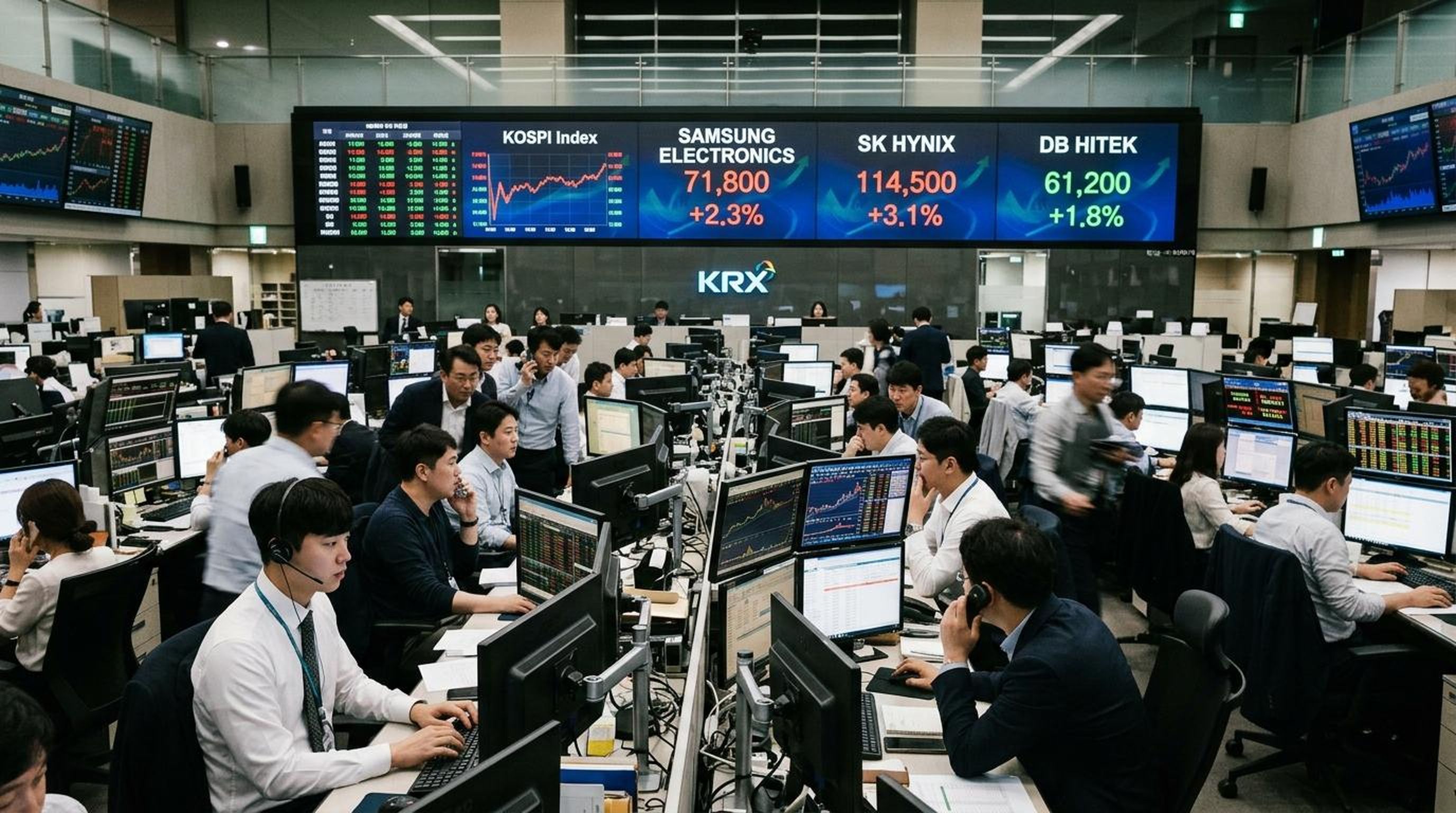
South Korea has suspended trading more frequently in 2026 than at any time on record, deploying everything from market-wide 20-minute circuit breakers to shorter, targeted cooling mechanisms. The extraordinary reversal in South Korean stocks reflects a market whipsawed by the fortunes of artificial intelligence, highlighting the volatility and uncertainty hanging over the global AI trade.
The scale of the swings tells the story. The Kospi, South Korea’s chip-heavy benchmark, surged as much as 116 per cent through late June, riding the AI boom. It has since tumbled as sentiment towards the trade soured, paring its gains for the year to just 17 per cent. Few benchmark indices have soared and fallen so sharply within a single year.
Foreign investors are still heading for the exits. According to South Korea’s Financial Supervisory Service, foreign investors net sold 239.98 trillion won (approximately US$180 billion) worth of South Korean listed stocks between January and October 2026. October alone saw net selling of 25.98 trillion won. The sustained outflow, even after one of the biggest rallies in any major market, shows how quickly confidence in the AI trade can evaporate.
The exodus reflects a combination of profit-taking, concerns about the sustainability of the AI boom and a shift towards safer assets. After the spectacular rally, overseas funds are questioning whether demand for AI memory chips can sustain its momentum, particularly as doubts grow over debt-funded data-centre investments and the durability of semiconductor earnings. Rising US Treasury yields have also made safer assets more attractive, while concerns over currency returns, market volatility and South Korean companies’ shareholder-return policies have added to the pressure. Some investors are consequently shifting capital towards markets such as Japan and Taiwan, where they see more attractive investment opportunities. Reuters has also highlighted how uncertainty over AI infrastructure spending and fading corporate buybacks are compounding the foreign sell-off.
Shawn Oh, head of Korea cash equities at NH Investment & Securities, described the mood to Business Times as thus: “It’s a terrible, terrible year,” he said. “People have this growing sense of fatigue and it feels worse than the 2008 global financial crisis.”
Few precedents for the scale of the reversal
The scale of 2026’s reversal stands out against some of the most dramatic boom-and-bust cycles in major equity markets. Among the closest parallels is China in 2015, when the Shanghai Composite Index surged as much as 60 per cent before wiping out most of those gains. In 2000, as the dot-com bubble burst, the Nasdaq Composite Index went from a 24 per cent gain at its peak to a 39 per cent loss by year-end.
For many market watchers, signs that the Kospi was vulnerable to a sharp reversal were already apparent during its spectacular ascent. Much of the rally was driven by Samsung Electronics and SK Hynix, the twin chipmakers at the heart of the global AI boom. Together, they accounted for nearly 80 per cent of the Kospi’s first-half gains.
Even as concentration risks mounted, retail investors sought to magnify returns by piling into leveraged exchange-traded funds and increasing margin borrowing. The unwinding of those bets is now amplifying the market’s losses, while the sell-off has also triggered a backlash among retail investors.
“When the AI story wobbled, there was simply nobody left on the other side of the trade,” said Maxence Visseau, chief investment officer of Arkevium Capital. “The marginal buyer was a retail investor using leverage, while foreigners were selling month after month.”
Samsung’s stock has lost about half its value since hitting an all-time closing high on June 18, following a nearly sevenfold jump from the end of 2024. SK Hynix is down about 62 per cent from its peak after a nearly 17-fold surge.
George Efstathopoulos, a multi-asset portfolio manager at Fidelity International who oversees about US$3 billion in assets, said the episode carried a wider lesson. “This tells us that a strong fundamental story can still become destabilising when it is combined with leverage, crowded positioning and concentrated exposure to a single global theme,” he said Business Times. He expects a more selective market from here, driven by earnings delivery, free cash flow and shareholder returns rather than multiple expansion alone.
Prices and earnings pull apart
Adding to the uncertainty, one-year forward earnings estimates for Kospi constituents have risen nearly 32 per cent since the end of June, even as the benchmark has tumbled, according to Bloomberg-compiled estimates. Whether the country’s heavyweight chipmakers can deliver and sustain the profits analysts are projecting will increasingly determine the Kospi’s fortunes. That is a test facing other major beneficiaries of the global AI boom as sentiment towards technology stocks falters.
William Bratton, head of cash equities research for Asia at BNP Paribas, said share prices may already be reflecting an earnings deterioration that analysts have yet to factor into their forecasts. “We recognise that South Korean equities are volatile but do not see the market outperforming on a sustained basis against such dynamics,” he wrote in a note.
Investors step back or look elsewhere
The Kospi’s roller-coaster ride has unnerved investors, prompting some to stay on the sidelines. “There’s a certain level of market volatility at which educated guesses turn into blindfolded darts on a blimp,” said Calvin Yeoh, a portfolio manager at Blue Edge Advisors. “For the sake of surviving, I’m just sitting back for now until things calm down.”
Others are taking a more selective approach. Nick Ferres, chief investment officer at Vantage Point Asset Management, is looking to rebuild exposure to South Korea cautiously. Some investors are turning to South Korean stocks with little exposure to AI. Yak Chauwei, chief executive officer of Singapore-based GAO Capital, said that she remains invested in snack maker Orion Corp.
For others, however, the extraordinary swings of 2026 have diminished the appeal of South Korean equities. Visseau recently downgraded his view on South Korea to underweight and increased allocations to India and China.
“The core problem hasn’t gone away,” he said. “The market is still a leveraged bet on AI memory demand and Korea is now clearly out of favour with foreign investors. The index stays hostage to the global chip cycle and AI spending.”