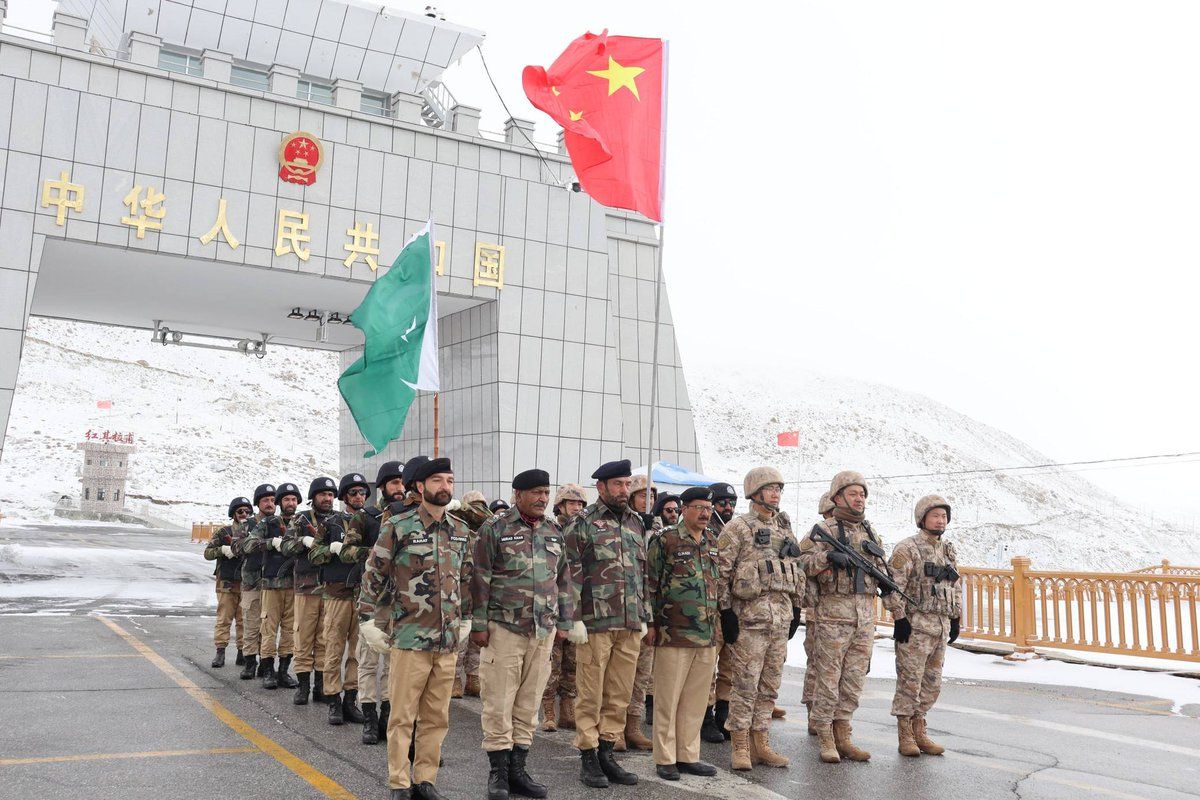
A week after China and Pakistan quietly switched on a border commission, the episode looks less like a bureaucratic formality and more like a pointed signal to Delhi – one timed to test how far India-China détente can stretch before Beijing’s older alliance takes priority.
Pakistan and China convened the inaugural meeting of the Pakistan-China Boundary Joint Commission (BJC) in Islamabad on September 16-17. The body traces back to a 2013 Agreement on the Boundary Management System signed during then Chinese Premier Li Keqiang’s visit to Islamabad – this was a dormant mechanism switched on, not a new pact. Delegations from both foreign ministries signed minutes covering border patrolling, joint surveys, trade flows and cross-border movement, and agreed to reconvene in China. Pakistan and China jointly described the launch as “a vital milestone in further strengthening the Pakistan-China All-Weather Strategic Cooperative Partnership.”
India hit back within hours. Ministry of External Affairs spokesperson Randhir Jaiswal declared, “There is no boundary between Pakistan and China.” He added that “Pakistan has no locus standi to enter into arrangements concerning Indian territory under its illegal and forcible occupation.” Beijing has still not issued a statement distinct from that joint declaration – a silence Delhi’s establishment reads as tacit alignment with Islamabad.
“Any so-called agreement involving territory that is an integral part of India has no legal validity whatsoever,” the Indian foreign ministry said, in language consistent with New Delhi’s long-standing position on third-party arrangements affecting Jammu and Kashmir.
The Indian government went further, summoning diplomatic representatives to convey its objections formally and indicating that it would raise the matter through international channels. Senior officials in New Delhi described the pact as a deliberate attempt by Beijing and Islamabad to consolidate administrative facts on the ground in disputed territory.
The dispute underneath
The frontier that the commission administers runs through Gilgit-Baltistan and the Shaksgam Valley – territory Pakistan ceded to China under a 1963 boundary agreement that India has never recognised. New Delhi’s claim runs back to the 1947 partition, when Jammu and Kashmir’s ruler acceded to India after a Pakistani-backed tribal invasion – a decision Pakistan has disputed through three wars and the 1999 Kargil conflict. India now administers Ladakh directly; Pakistan holds Gilgit-Baltistan and a section of Kashmir valley; China controls Aksai Chin.
For China, stable governance of this corridor protects the roughly $62 billion China-Pakistan Economic Corridor, which runs through Gilgit-Baltistan en route to the port of Gwadar – a core artery of Beijing’s Belt and Road ambitions. But the deeper read is strategic rather than administrative. Delhi-based scholar Jabin Jacob pointed out that the 1963 treaty itself envisioned renegotiation once Kashmir’s status was settled – so activating the commission now, instead of addressing that clause, “should concern India”. Former Pakistani ambassador Husain Haqqani said that Pakistan acts as “China’s secondary deterrent against India.”
That is what makes the week’s fallout worth watching. India and China reached a disengagement understanding along the Line of Actual Control in October 2024 and have since traded senior visits to rebuild trust. A border body activated in disputed Kashmir territory, days into calming down, either miscalculates its cost to the relationship – or was never meant to be quiet at all. A week on, Delhi’s rhetoric hasn't cooled, and Beijing hasn’t moved to reassure it, which may suggest the latter.