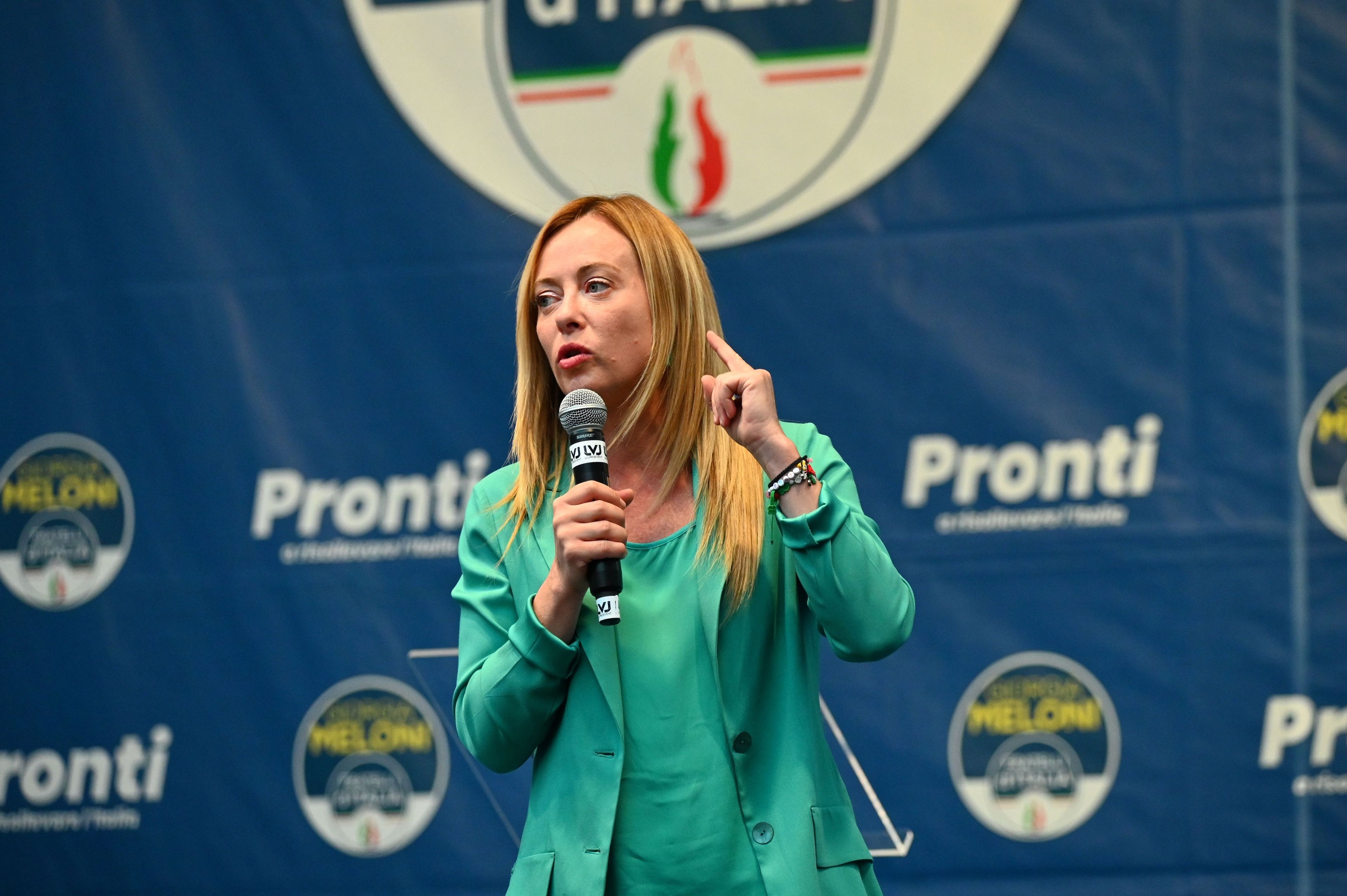
Italian Prime Minister Giorgia Meloni has promised to outlaw burqas and niqabs in the country’s schools and to cap the number of foreign pupils per classroom, as immigration hardens into the defining battleground ahead of Italy’s general election next year.
Meloni unveiled the plans on Sunday (September 20) at a rally of the youth wing of her far-right Brothers of Italy party, declaring in front of a cheering crowd in Rome that parents of foreign pupils “having serious difficulties integrating into the school system” would be required to attend compulsory Italian-language lessons. Addressing what newcomers to the country owed it, she said that anyone settling in Italy must learn its language, understand its culture, and respect its rules, framing this as the only genuine route to being welcomed.
“For us, anyone who comes to Italy and wants to build their future here must learn our language, understand our culture and respect our rules. It is the only serious way to welcome them,” she said at the Gioventù Nazionale national festival in Rome.
The proposals will need to be formally approved by the government before Parliament gets 60 days to ratify them into law.
Crucially, neither the burqa nor the niqab is currently banned outright in Italy. A 1975 law merely forbids helmets or garments that obstruct identification without good reason, and a 2008 ruling clarified that full-face coverings could still be worn for religious or cultural reasons provided the wearer’s identity could be verified when required. It is this legal grey zone that Meloni now wants closed. Her coalition partner, the anti-immigrant League, has already tabled a bill this year that would ban such garments except at sporting events or places of worship.
On the classroom cap, Meloni did not explain how her proposal would differ from the existing rules: Italian law already limits foreign pupils to 30 percent of any class or school, even though such students currently make up only around 12 percent of overall enrolment – a discrepancy that has left commentators asking what problem the new pledge is actually meant to solve.
Politics behind the pledge
The timing is hardly incidental as Meloni now leads Italy’s longest-serving government since the Second World War, but she faces a serious threat from her own flank: the National Future party, positioned even further to the right than Brothers of Italy, has been surging in the polls since February and called for a schools burqa crackdown as early as July. By moving onto that territory herself, Meloni appears to be attempting to out-flank a rival that is squeezing her from the far right rather than the centre.
This is consistent with a pattern that has defined her premiership and that of Europe’s wider nationalist right: immigration, Islam and cultural identity repeatedly recast as questions of security and belonging. Meloni’s government has already drawn criticism over hardline migration measures and offshore asylum-processing deals, and allied hard-right movements across the continent – from France’s National Rally to Germany’s AfD – have built their platforms on similar anxieties about Muslim dress, mosque funding and “parallel societies”, often deploying the language of secularism or national values to justify restrictions that fall disproportionately on Muslim women.
Echoes of France – and India’s Karnataka
Italy is not the first European country to legislate on what Muslim women wear. France banned conspicuous religious symbols, including headscarves, in state schools in 2004, and went further in 2010 by prohibiting full-face veils in all public spaces – moves its governments defended as upholding laïcité, the republic’s strict brand of secularism, but which critics said singled out Muslim women and pushed some further to the margins of public life. Two teenage girls were expelled from a school in Mulhouse within weeks of the 2004 law taking effect, an early sign of how divisive its enforcement would prove.
India has seen its own, strikingly similar version of this campaign that is now morphing into a global propaganda. In 2022, authorities in the southern state of Karnataka, then governed by the Hindu-nationalist Bharatiya Janata Party, effectively barred hijab-wearing students from classrooms after a pre-university college’s ban triggered protests and counter-protests, with Hindu students turning up in saffron shawls in response. Schools across the state shut for days, some students and even teachers were made to remove their headscarves and burqas at the gates, and dozens of pupils were suspended for demonstrating. Karnataka’s BJP chief at the time defended the move by warning against the “Talibanisation” of education – something that is being equated by the far-right as “separatism” now used by Meloni’s allies in Rome.
These episodes trace a recurring script in which debates over a small, often symbolic minority practice come to stand in for much larger anxieties about national identity, secularism and who truly belongs. Whether Meloni’s latest pledge becomes binding law will depend on parliamentary arithmetic in the months ahead, but as a political signal, it has already done its work.