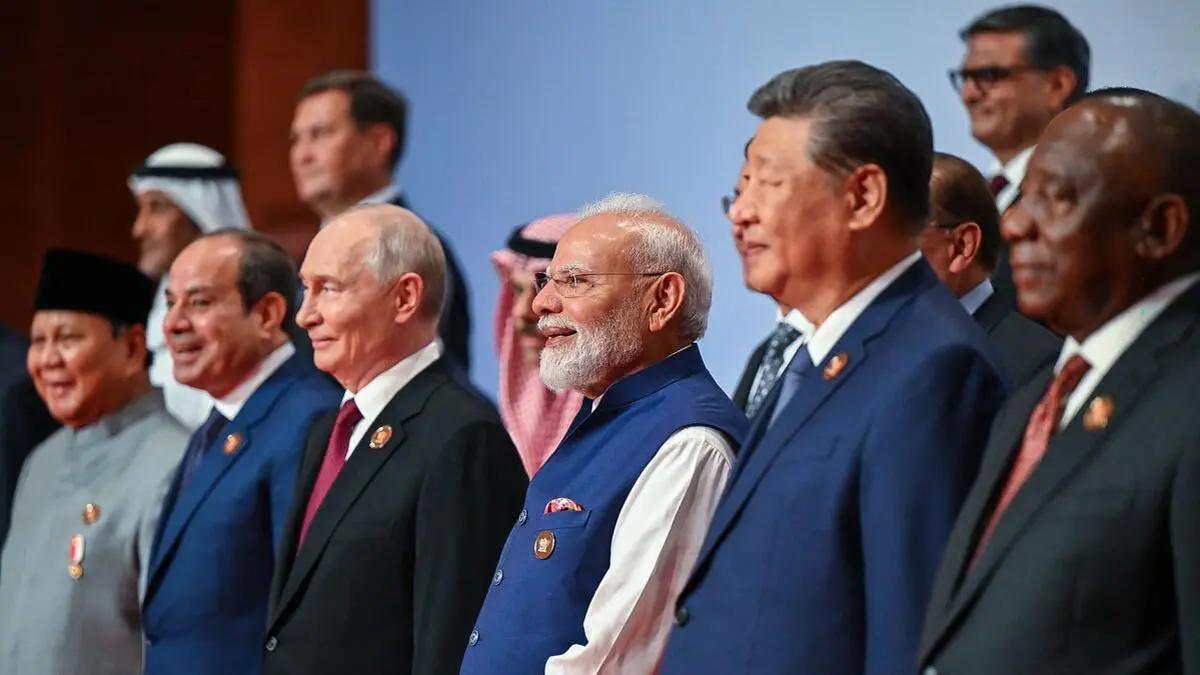
India has diplomatically pushed back against the United States Congress’s newly passed Russia-Iran sanctions law, making clear through a Ministry of External Affairs (MEA) statement on Thursday (September 17) that it will not be pressured into abandoning its energy relationships with Moscow and Tehran. Although it stopped short of open confrontation with Washington, the carefully worded pointed statement can be seen as New Delhi’s clearest signal yet that it does not intend to give up Russian crude or its residual economic links with Iran, whatever the United States legislates.
“The Government of India has noted the passage of the Sanctioning Russia and Iran Act in the US Congress. We are monitoring further developments on this matter,” the MEA said, adding that India “remains firmly committed to ensuring energy security for its 1.4 billion people” through “diversified sourcing and on the basis of evolving market dynamics.”
The ministry went further, noting that the implications of the legislation “for not just the bilateral relationship but also the international energy market have been very clearly articulated by the Indian side” with “various US interlocutors” in recent months. The government added that India “will work closely with Indian trade and industry bodies to deal with the implications of these developments.”
Even as US lawmakers were finalising the bill this week, India remained the largest buyer of discounted Russian oil, with Kpler data showing New Delhi importing roughly 2.08 million barrels a day of Russian crude in August – about 45 per cent of its total oil purchases – a dependence that has persisted despite three years of Western sanctions aimed at starving the Kremlin’s war chest. The Global Trade Research Initiative has calculated that India imported US$40.8 billion worth of Russian crude in 2026 alone, nearly a third of its overall crude bill, even as New Delhi separately held on to a hard-won American sanctions waiver to keep running Iran’s Chabahar port – a project it has repeatedly defended as vital to its connectivity with Afghanistan and Central Asia.
A Global South Assertion?
India’s response has come barely four days after it hosted the 18th BRICS Summit in New Delhi on September 12-13, where Indian Prime Minister Narendra Modi welcomed Chinese President Xi Jinping, Russian President Vladimir Putin and Iranian President Masoud Pezeshkian for a gathering that projected, at least symbolically, a united Global South.
The leaders unanimously adopted the 140-paragraph New Delhi Declaration, which trade researchers have interpreted as a rebuke of Washington’s trade and sanctions policy: the declaration condemns unilateral tariffs and coercive economic measures with a discriminatory impact on civilian populations, while also calling for restoration of the World Trade Organization’s paralysed appellate mechanism – a clear dig at US obstruction since 2019. Notably, and in keeping with the bloc’s cautious diplomatic register, the declaration never named the United States or President Donald Trump even once but signalled clearly in more ways than one.
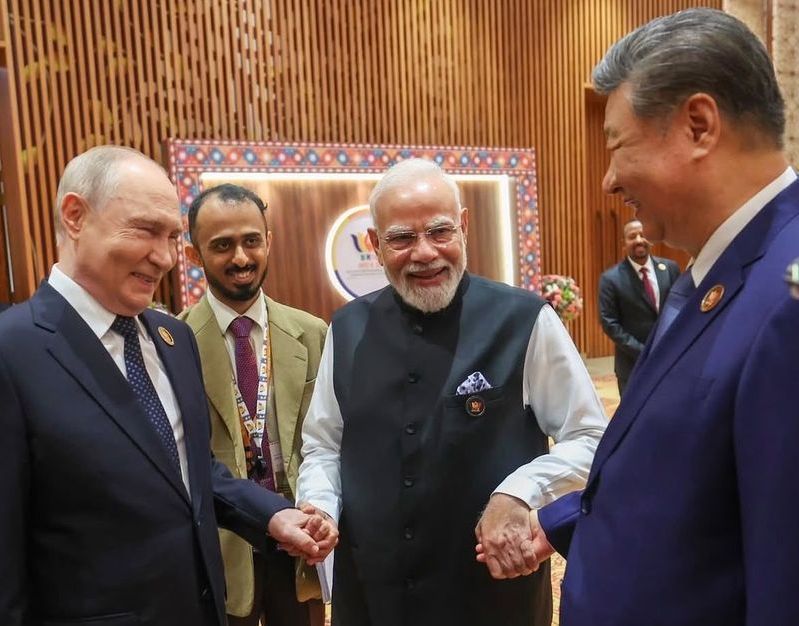
The summit gave Russia and Iran a stage to vent openly. Putin, addressing the BRICS Business Forum on September 11, acknowledged that Russia had become the world’s most sanctioned country but insisted the pressure had “strengthened national sovereignty,” citing a cumulative GDP growth of 10.3 per cent between 2023 and 2025; at the leaders’ summit itself he went further, accusing nations “accustomed to thinking in colonial categories” of using tariffs, sanctions and “brute force” to contain emerging economies.
Similarly, arriving in New Delhi on September 12 for the first visit by an Iranian president to the subcontinent in eight years, Pezeshkian declared that “Iran has successfully stood against Israel and the US,” and wrote on social media that “our people can’t be bullied into submission. Iran won't surrender.” His remarks came soon after Trump had claimed Iran would have “wiped out Israel and the Middle East”, had Washington not struck first. Both leaders used the New Delhi platform to cast dollar-denominated sanctions as instruments of coercion, even as they courted wider sympathy, including from Europe, for their defiance of Washington.
Beijing’s parallel track with Tehran
China, for its part, has been laying its own groundwork to keep Iranian trade flowing regardless of what Congress in Washington decides. Foreign Minister Wang Yi, who met his Iranian counterpart Abbas Araghchi in Beijing on September 10, called for Tehran and Washington to return to dialogue while stressing that shipping through the Strait of Hormuz must be restored. China has for years maintained that it “firmly opposes illegal unilateral sanctions against Iran” – a position Wang has now effectively operationalised through trade structures that bypass US financial oversight altogether.
What the new US law actually does
The legislation that prompted India’s statement, the Lindsey O. Graham Sanctioning Russia and Iran Act of 2026, cleared the House of Representatives on September 16 by a vote of 262-159, after having already passed the Senate 86-11 in August. Named for the Republican senator who spent more than a year building bipartisan support before his death in July, the bill now goes to President Trump’s desk, where he is expected to sign it. Its central mechanism empowers the president to impose tariffs of up to 100 per cent on the top five purchasers of Russian oil or gas – a list that, according to the Senate text, includes China, India, Slovakia, Hungary and Azerbaijan – along with sanctions on Putin’s government, Russian oligarchs and financial institutions. The law does, however, carve out an exemption for countries importing less than 15 per cent of their gas from Russia and taking “significant steps” to cut back, and it gives the president discretion to waive sanctions on a national-interest certification to Congress.
India’s terse statement, the BRICS’ optics in New Delhi, and Beijing’s quiet sanctions workarounds for Tehran point to a Global South that is becoming markedly more willing to push back against the economic uncertainty unleashed by Trump’s tariff wars and by Washington’s parallel military and sanctions campaigns against Russia and Iran.
India has stopped short of any language that could be read as defiance, choosing careful diplomatic phrasing over confrontation. However, its refusal to commit to cutting Russian purchases, paired with a BRICS declaration that takes aim at unilateral tariffs, sanctions and carbon-border levies, indicates that New Delhi, Moscow, Beijing and Tehran are converging, however unevenly, on a shared resistance to a Washington-centred economic order.