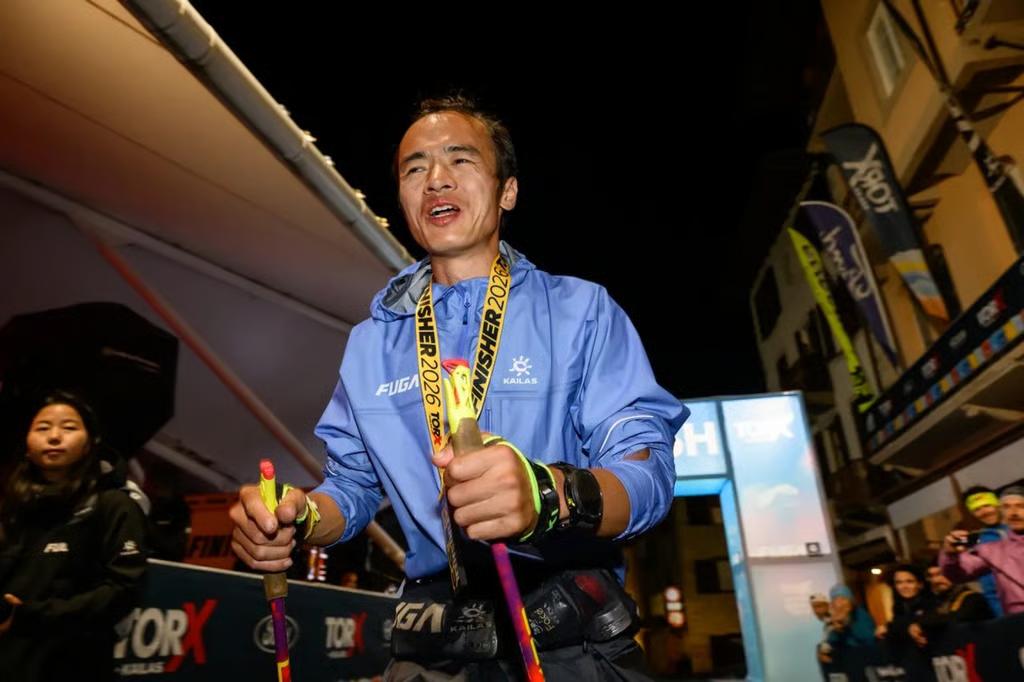
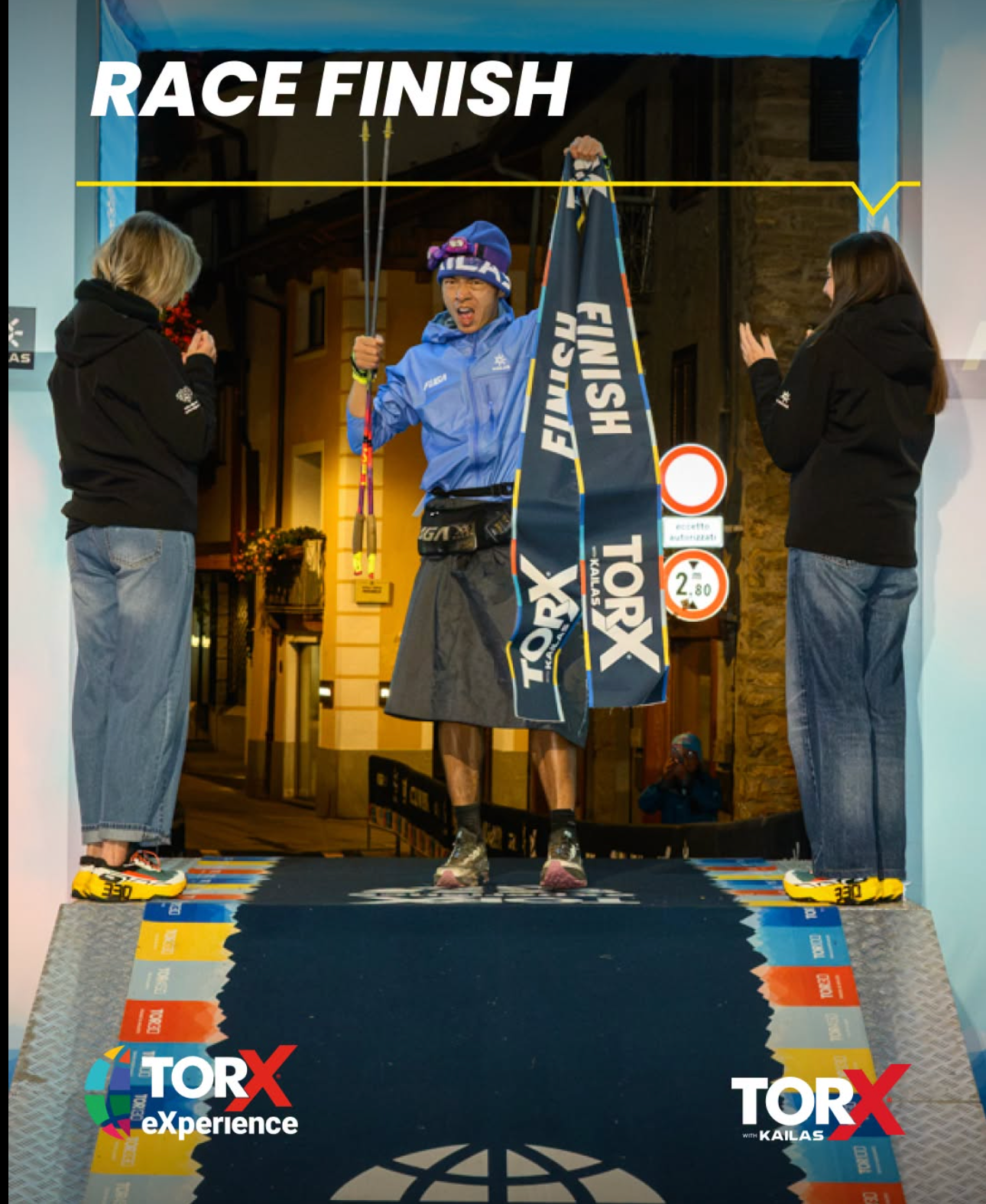
Zhao Jiaju has written himself into ultramarathon history, becoming the first Asian athlete to win the Tor des Géants after he crossed the finish line in Courmayeur, Italy, in a course-record 65 hours, 55 minutes and 22 seconds on Wednesday (September 16). Organisers and sponsor-issued releases have logged the mark as a new course record; as with most trail-running “fastest known times”, although such splits are typically treated as provisional until the race organisation and bodies such as the International Trail Running Association formally ratify them in the weeks after an event.
Racing under bib No 1, the 31-year-old from Guizhou province also became first Chinese athlete to reach the podium in 16 editions of the race, let alone win it – the previous best Chinese finish was sixth place, by Wei-Qiang Zhang, only last year.
A field stacked with ultrarunning royalty
The TOR330, as the flagship race is formally known, drew a stacked elite field. Zhao’s sharpest challenger was Switzerland’s Jonathan Schindler, who exploited a stop by Zhao at Gressoney – the same checkpoint where Zhao’s own race had ended in 2025 – to briefly seize the lead, before eventually finishing second in 66:55:06. Germany’s Katharina Hartmuth completed a remarkable podium, claiming third place overall and the women’s title in 67:10:09 – a time that slashed almost 12 hours off the previous women’s course record. All three medallists finished within one hour and 15 minutes of each other, after nearly 66 hours of racing.
Zhao’s countryman Xingzhi Bai also featured near the front early on, briefly sitting second behind Zhao. The men’s field also carried the shadow of France’s François D'Haene, a multiple Ultra-Trail du Mont-Blanc and Western States champion who won the race in 2024, and Italy’s Franco Collé, the most decorated Tor des Géants champion with three victories and a course record of his own that stood until Victor Richard lowered it to 66:08:22 in 2025 – the mark Zhao has now bettered by 13 minutes.
Hartmuth’s run was itself a record-breaking sequel. She had already held the women’s course record from her 2024 victory, in 79:10:40, meaning she has now improved her own mark by close to 12 hours in the space of two years – a leap that, combined with finishing third overall, underlines how sharply the women’s competitive standard at the race has risen.
The “fragmented sleep” gamble
Zhao’s tactics centred on what his team has described as a “fragmented sleep” strategy. Having covered the first 150 km in around 24 hours, Zhao only made his first checkpoint stop after 35 hours and 42 minutes on the move, and even then spent just 50 minutes there – changing clothes, eating and sleeping for roughly 20 minutes – before pushing on. Rather than banking longer blocks of sleep, as Schindler did during the race’s first half, Zhao subsequently opted for repeated 10-minute power naps at aid stations through the remaining nights.
Sports scientists say such micro-naps are a deliberate trade-off. Research into ultra-endurance events has found that even 24 to 30 hours of sleep deprivation measurably slows reaction time and impairs decision-making, while a broader review of sleep strategies among ultra-endurance athletes identifies short, strategic napping as the single most effective countermeasure for staving off the cognitive fog that builds during multi-day races, since brief naps ease acute “sleep pressure” without requiring the many hours needed for full recovery. The trade-off, physiologists note, is that fragmented sleep of this kind never allows the brain to reach the deeper, restorative stages of sleep, so the benefit is temporary and the fatigue keeps accumulating in the background.
Researchers who have studied Tor des Géants finishers specifically have documented widespread hallucinations and even episodes of “sleep-running” among sleep-starved competitors during the race’s third and fourth nights, concluding that racers enter “an intermediate state of consciousness between waking and sleeping” akin to dream-like hypnagogic imagery. Previous finishers have variously recounted seeing moose, octopuses and frogs materialise out of the darkness along the trail – a hazard organisers and support crews take seriously enough to insist exhausted runners stop and rest before continuing.
It is against that backdrop that Zhao’s disciplined, tightly rationed napping stands out. Instead of banking on a single long sleep or pushing on with none at all, he found a middle path that kept him lucid enough on the technical descents to overhaul his rivals. After the 203 km mark, he leveraged his strength on technical night and downhill sections to reclaim the lead for good, extending clear of Schindler and Hartmuth over the final climbs of Col Champillon, the Bosses ridge and the Malatrà pass.
Riding a boom in Chinese trail running
Zhao’s win has come out of a Chinese context which has seen endurance sports rising phenomenally in recent years. It shows a rapid ascent for a runner who has spent recent years collecting domestic and regional titles, including becoming the first Chinese winner of Spartan Race Super in 2018, the first Chinese men’s champion of the Mount Fuji Ultra Marathon in 2023, and a four-time winner of China’s Chongli 168 Ultra-Trail, where he broke his own course record again as recently as July.
In his autobiography, Wang Qian Pao – published in English as Run – Zhao has recalled an unlikely start to that career: working as a food delivery rider in Hangzhou around 2014, and choosing to run his rounds on foot rather than cycle them, treating the job as paid long-distance training. The mileage that he built up ferrying orders through the city laid the groundwork for him to turn professional in 2017.
That last race is itself a marker of how far the sport has travelled in China. Chongli 168, held in a former Winter Olympics venue in Hebei province, drew a record 12,000 participants from more than 20,000 applicants at its tenth-anniversary edition this year, up from roughly 3,000 entrants as recently as 2019 – part of a broader surge that has seen trail running go from a niche pursuit to a trending fitness subculture on Chinese social media, with major international brands competing to sponsor events and athletes.
Zhao himself prepared for this year’s Tor by arriving in Europe a month early to acclimatise, using a shorter race at the Ultra-Trail du Mont-Blanc festival as a warm-up – the kind of methodical, internationally minded build-up that is increasingly available to elite Chinese ultrarunners as the domestic scene professionalises.
Why the Tor des Géants carries such prestige
Conceived in 2009 and first held in 2010, when 310 runners from 17 countries set off from Courmayeur, the Tor des Géants circles Italy’s Aosta Valley on a single, unbroken 330 km loop with roughly 24,000 metres of elevation gain, crossing 25 alpine passes above 2,000m and skirting the region’s four “giants” – Mont Blanc, the Matterhorn, Monte Rosa and Gran Paradiso. Competitors have up to 150 hours to finish, with no mandatory rest stages and no prize money on offer; the reward is simply the right to call oneself a “Géant”, in a race with a finish rate of only around 60 per cent. That combination of scale, self-sufficiency and sheer attrition has made it one of the sport’s most revered “XXL” tests, spawning a wider TORX race series and even inspiring the creation of America's Tahoe 200.
The race’s history includes tragedy as well as triumph. The 2013 edition was marked by the death of Chinese runner Yang Yuan, who fell during a rainy first night, a loss commemorated with a cairn along the course. Zhao’s victory 13 years later marks the first time an athlete from Asia – and the first non-European – has stood atop the Tor des Géants podium, a result his team has framed as a landmark moment for Chinese trail running heading into next year’s race.