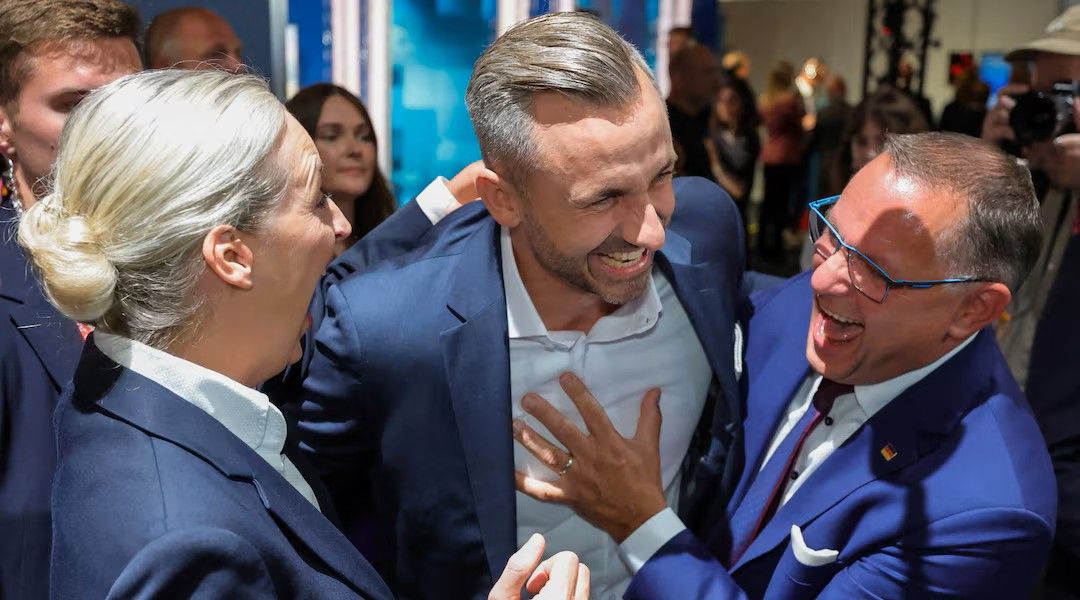
Sunday’s election in Saxony-Anhalt, one of Germany’s poorest states, has cracked open the “firewall” mainstream parties have maintained against the Alternative for Germany (AfD) for over a decade – and could reshape German politics for years to come. The AfD won 43.9 per cent of the vote and 39 of 83 seats, putting it within reach of governing, either with the five-seat Sahra Wagenknecht Alliance (BSW) or with individual lawmakers from other parties willing to break ranks.
The result surpassed even the AfD’s own expectations and dealt a heavy blow to Germany’s two traditional powerhouses. The ruling Christian Democratic Union (CDU) slumped to a distant second on 17.2 per cent and 15 seats; the Social Democrats (SPD) managed just 9.3 per cent and eight seats. The Greens and the Left held roughly 8-9 per cent each, while the free-market FDP failed to clear the five per cent threshold to stay in parliament.
This isn’t the AfD’s first brush with power. It had already emerged as the largest bloc in Thuringia’s 2024 election on 32.8 per cent, only to be locked out when the CDU, BSW and SPD formed a minority coalition on 44 of 88 seats – one short of a majority, and reliant on the Left’s votes to keep the AfD from power.
This time was different. The party went into election night confident of a breakthrough, having reportedly trained more than 200 handpicked candidates for civil-service roles and signalled that uncooperative civil servants would be sidelined into posts where they “can't harm the government's agenda”.
Why other parties shun the AfD
German politics runs on coalition-building. Smaller parties – the FDP, the Greens, even the newly formed BSW – have all joined governments led by rivals at one point or another. The AfD is the exception, branded “far-right” and “pro-Kremlin” by the rest of the establishment and treated as untouchable in coalition talks. (The Left faced a milder version of this stigma before the AfD, though never under a formally named policy.)
Its platform explains why. The party has promised a “remigration offensive” to deport migrants, closer ties with Moscow – including reviving school exchanges with Russia – and a ban on rainbow flags in schools. Its family policy advocates a €2,000 “baby welcome grant” for each of a family’s first two children and €4,000 for every child after that, while its education plans would dial back the focus on Germany’s Nazi past, ending what it calls the postwar “guilt cult”.
Why Saxony-Anhalt tipped first
Saxony-Anhalt is emblematic of the economic struggles still shadowing the former East Germany: population decline, an ageing workforce, incomes trailing the west. Largely rural and losing its young people to migration, the state has proven fertile ground for a party channelling frustration over immigration and the economy.
The AfD’s vote share more than doubled from 20.8 per cent last time, while turnout climbed to a record 77 per cent, up from 60 per cent in 2021 – suggesting the surge reflects mobilised non-voters as much as converted ones.
What happens next?
The AfD fell three seats short of the 42 needed for an outright majority but remained in pole position. The most realistic path runs through the BSW, which has rejected the firewall outright. Leader Sahra Wagenknecht declared on X that the firewall policy had failed a Saxony-Anhalt public looking for new leadership – signalling openness to governing with the AfD. Politico has separately reported the AfD is courting individual CDU MPs.
Should that arrangement hold, AfD lead candidate Ulrich Siegmund would become state premier – the biggest breach yet of the firewall strategy.
Ripples across Europe
The result puts Chancellor Friedrich Merz under immediate pressure and hands Europe’s populist right a rallying point. It may force the CDU to rethink how it engages with the AfD’s rising support without formally abandoning the firewall, while pushing migration, energy and Germany’s Russia-Ukraine policy further up the agenda. Should the AfD enter government, its ministers would also gain seats in the Bundesrat, extending its reach well beyond Saxony-Anhalt.
Reactions split along ideological lines. French officials called it part of a populist wave the continent must resist, while Poland’s foreign minister Radosław Sikorski flagged how close the AfD came to an outright majority as a troubling signal, given its stance on Russia, Ukraine and EU borders. Hungary’s far-right former prime minister who recently lost the national elections Viktor Orbán, by contrast, hailed the result as the start of a broader European turnaround, telling supporters to “buckle up”.
The concern in European capitals isn’t really about one German state government – it’s what a stronger AfD could mean for Berlin’s future positions on migration, Ukraine, Russia and European integration.