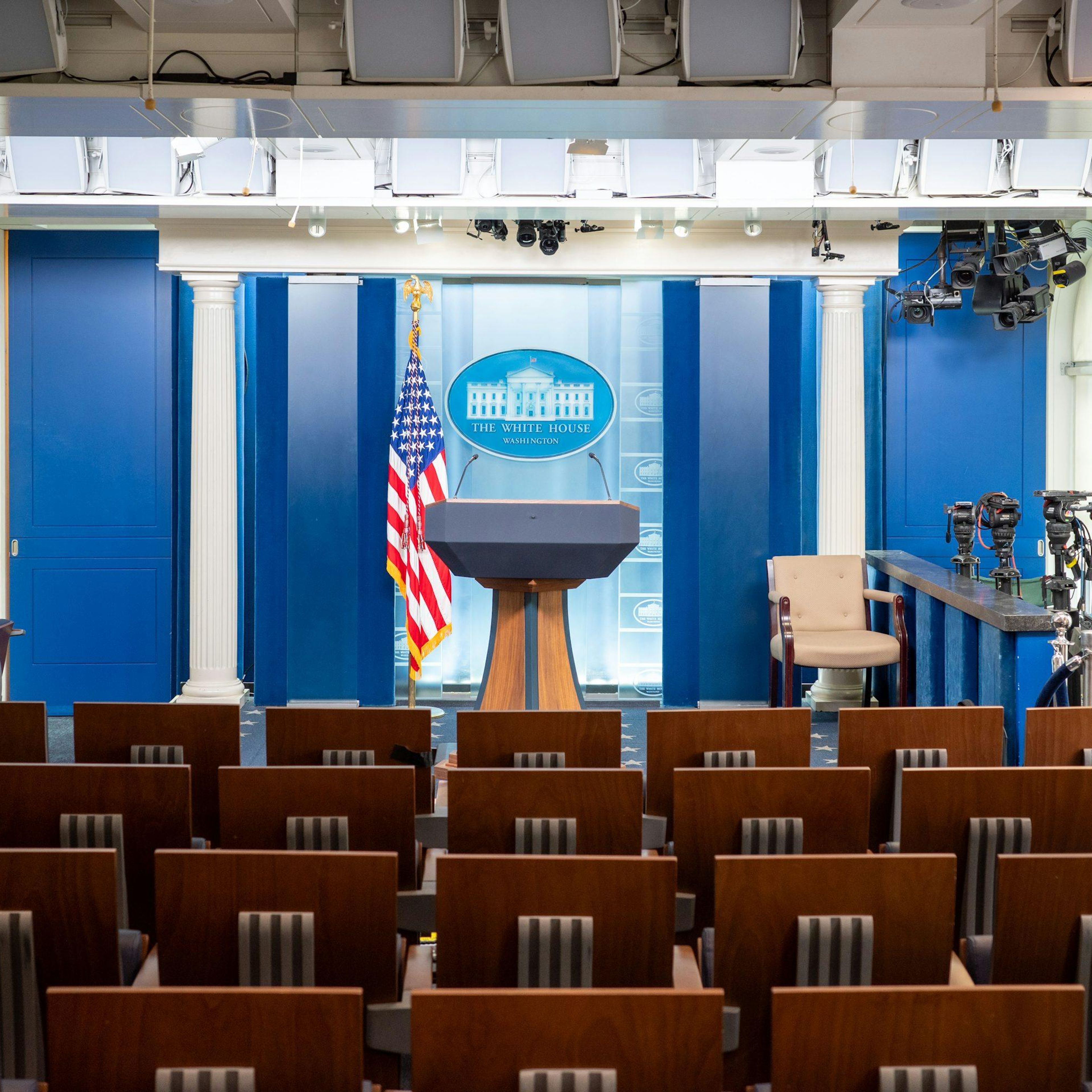
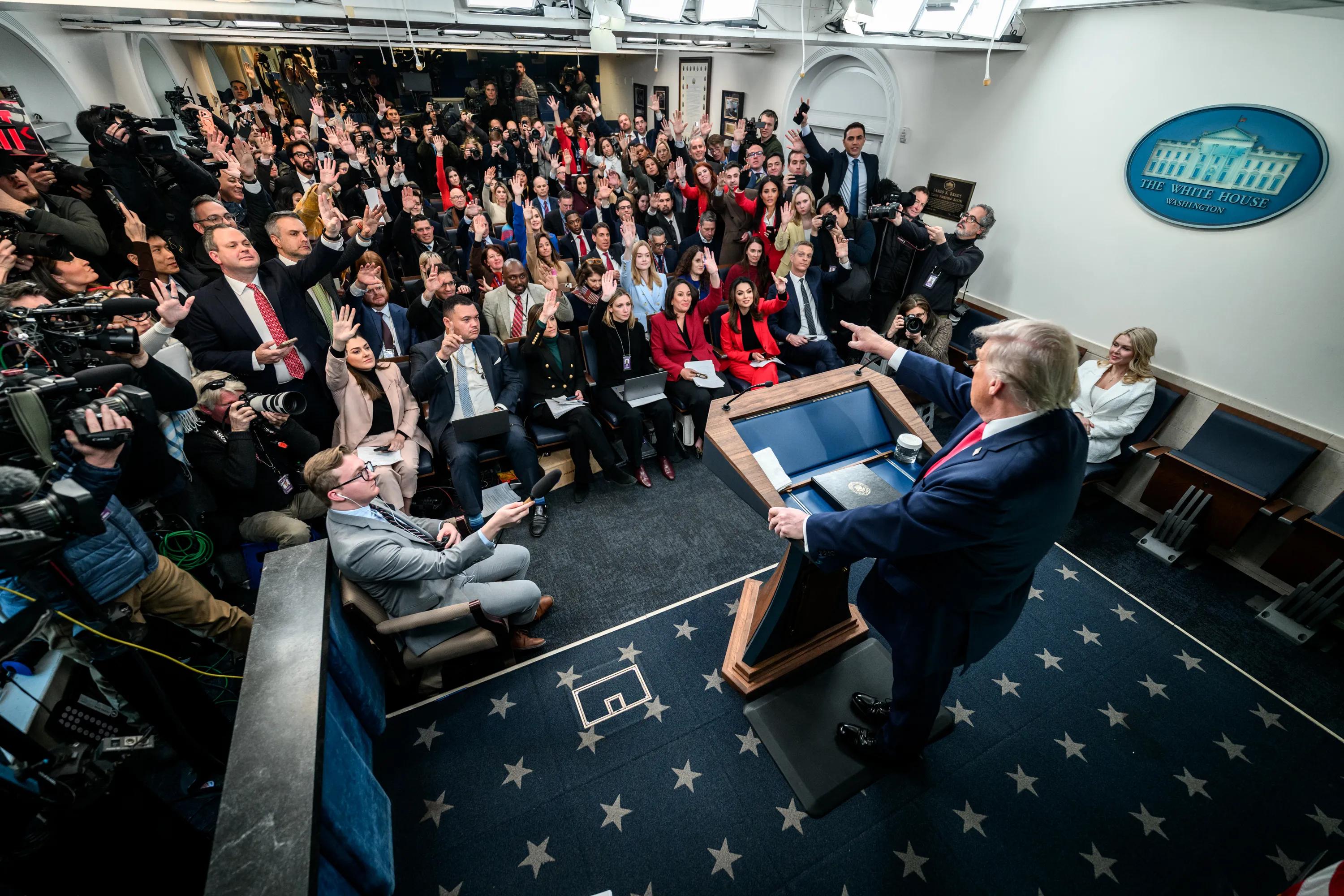
A stand-off between the Trump White House and three major news organisations escalated into a full-blown press-freedom crisis this week, with CNN, MS NOW and Politico suing the administration over a ban on their journalists, and much of the rest of the US television press corps refusing to cover the president in solidarity – even as the White House rolled out its own round-the-clock streaming channel to bypass them altogether.
How it started
US President Donald Trump announced the ban on September 18 in a Truth Social post accusing the three outlets of publishing “FICTION and LIES”, and warning that “Other Fake News Media Outlets” would follow. Asked about it later that day in the Oval Office, he said: “I don’t have to let them into the people’s house.”
The following morning, reporters from all three outlets – Akayla Gardner of MS NOW, Betsy Klein of CNN and Cheyenne Haslett of Politico – were turned away at the gates and had their hard passes confiscated by a secret service officer. MS NOW said in a statement it would take “any and all steps necessary to defend our First Amendment rights.” CNN called the move “an illegal assault” on its constitutional rights.
On September 21, the three outlets filed a federal lawsuit in Washington, D.C., naming Trump and several senior officials as defendants. In a joint statement announcing the filing, they said they had notified the administration that morning they were suing to defend the principle that “the government does not decide what the press reports or publishes.”
The suit itself goes further, arguing the ban amounts to unconstitutional viewpoint discrimination: “This ban could not be a more direct assault on the First Amendment,” the filing states, adding that the outlets and three named reporters were barred in disregard of due-process guarantees.
The case was assigned to US District Judge Timothy J. Kelly – a Trump appointee who, notably, is the same judge who ordered the White House to restore CNN correspondent Jim Acosta’s credentials during a near-identical dispute in 2018. A hearing was set for Wednesday.
Legal and press-freedom experts were quick to back the outlets. Jameel Jaffer of Columbia’s Knight First Amendment Institute called the ban "pretty clearly unconstitutional.” The Freedom of the Press Foundation said that it was hard to imagine a starker case of the government “banning news outlets from the People’s House for criticising the government.”
Solidarity spreads through the press corps
The dispute widened dramatically on Monday when the White House pulled CNN from its scheduled slot running the television pool – the rotating arrangement in which one network gathers footage of the president and shares it with all others. Rather than let another outlet simply take CNN’s place, the whole TV pool consortium refused to step in.
Notably, the announcement came not from a Trump critic but from friedly Fox News’ Washington bureau chief, Bryan Boughton, acting chair of the pool consortium, who told members “the TV pool will not be covering events designated as pool coverage” of the president – a striking show of cross-network unity that left Trump effectively unmiked during a White House event later that day.
The White House’s answer: its own channel
Rather than back down, the administration leaned into the fight. On Monday evening it launched “Trump TV: The Essentials Station”, a 24/7 YouTube livestream promoted on the official White House site as a way to watch “the Trump Administration’s biggest moments all in one place.” Its inaugural broadcast was archival footage of a Trump speech at Mount Rushmore from July.
In a post on X promoting the launch, the White House declared that it was a direct line to the administration past the traditional press: “Not every big moment has made it on your TV, now it can.” Deputy assistant to the president Kaelan Dorr described it on X as “a livestream of the Administration’s greatest hits, unfiltered.”
Trump, for his part, used Truth Social to dismiss the lawsuit, labelling the outlets as “Fake News” while taking a swipe at Politico’s past government subscription payments and MS NOW’s former branding as MSNBC.
The episode revives a fight that first flared during Trump’s first term, when CNN successfully sued to restore Acosta’s press credentials after the White House stripped them over a contentious press-conference exchange – a case the administration lost on due-process grounds. Legal scholars say this dispute is, if anything, more clear-cut: rather than targeting one reporter over a specific incident, the ban applies to entire news organisations over their general coverage, which First Amendment experts argue is a textbook case of viewpoint-based discrimination that the government is generally barred from engaging in once it has opened press access to journalists broadly.
The creation of a White House-run media channel has drawn its own criticism, with commentators describing it as a step toward state media – content produced, curated and distributed by the government itself, positioned as a substitute for independent coverage rather than a supplement to it.
An authoritarian playbook, with precedent elsewhere
Branding unfavourable coverage of “fake news” and then moving to restrict the journalists who produce it is a pattern that press-freedom groups have tracked well beyond Washington. In Turkey, President Recep Tayyip Erdoğan has for years combined defamation prosecutions, terrorism-related charges and pressure on media ownership to sideline critical outlets, helping make the country one of the world's leading jailers of journalists. Hungary’s Viktor Orbán took a subtler route, starving independent outlets of state advertising revenue while allies folded hundreds of formerly independent titles into a single pro-government conglomerate, KESMA. In Russia, Vladimir Putin’s government has used “foreign agent” and “fake news” laws to drive independent outlets into closure or exile, criminalising reporting that strays from the Kremlin’s line on the war in Ukraine and other subjects.
India offers the closest parallel to this week’s dispute. The Press Information Bureau’s Fact Check Unit, set up to flag “fake, false or misleading” government-related content for takedown, was condemned by the Editors Guild of India and opposition politicians, calling it “draconian, anti-democratic and unacceptable” – for handing the government itself the power to define what counts as misinformation about its own conduct. India’s Supreme Court stayed the unit’s operation in March 2025 on free-speech grounds, a legal check that mirrors the one CNN, MS NOW and Politico are now seeking from a US federal court.
What distinguishes the American case, for now, is the court system’s track record of independence – a 2018 precedent already exists, and it went against the White House. Whether that holds this time is what Wednesday’s hearing will begin to test.