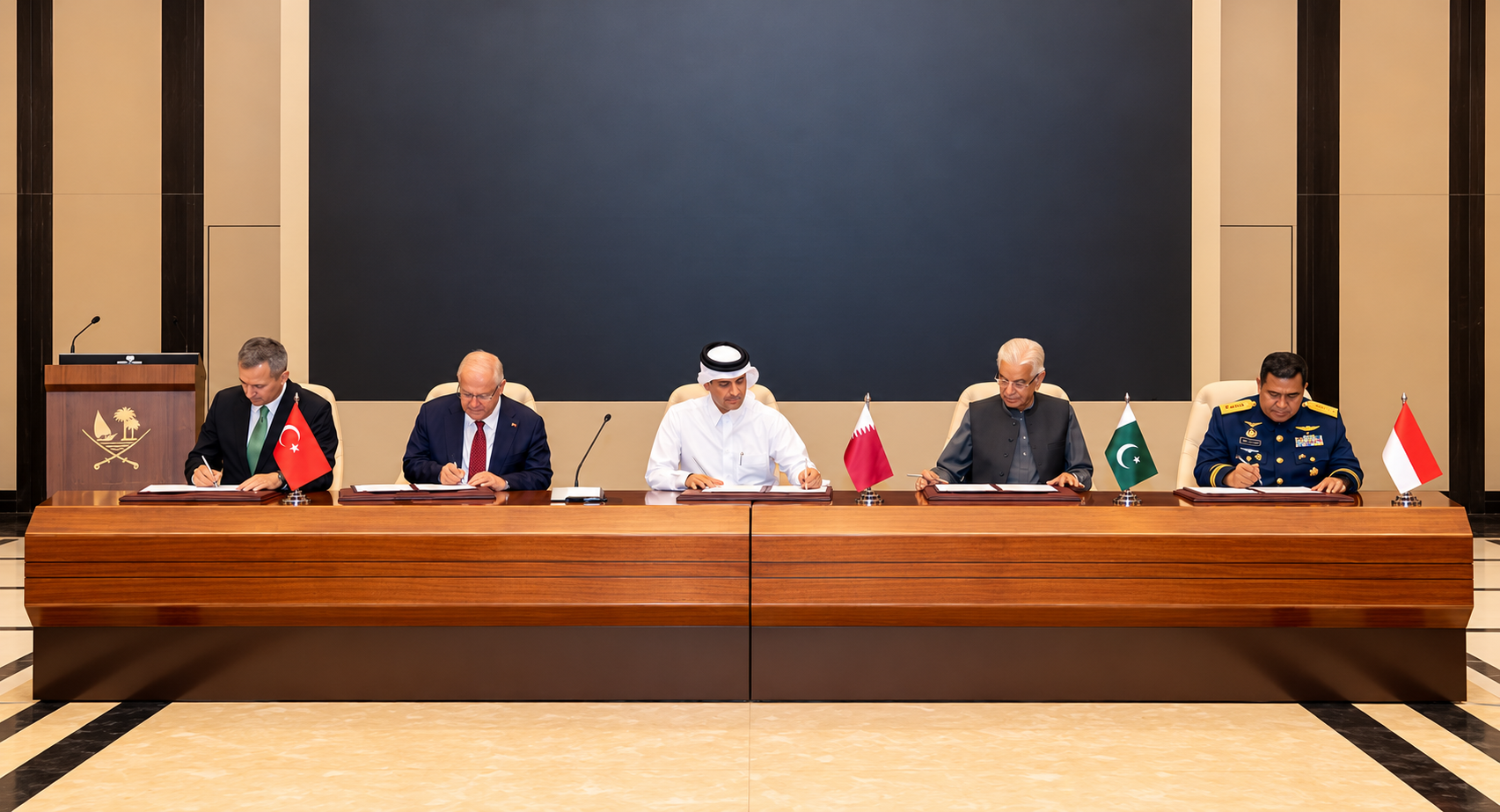
Four Muslim-majority states spanning the Gulf, the Levant and Southeast Asia have signed a joint defence-industrial pact in Doha. It is the clearest sign yet that countries rattled by the US-Israel war on Iran are building security ties that do not run through Washington.
The Badr memorandum of understanding, signed on Wednesday (October 21), commits Qatar, Turkiye, Pakistan and Indonesia to cooperate on weapons manufacturing, military training and research. According to Turkiye’s defence ministry, the pact that was signed between defence ministries of the four countries will let them combine their production strengths to meet the needs of allied and friendly nations. The signatories were Turkiye’s Yaşar Güler, Pakistan’s Khawaja Asif, Qatar’s Sheikh Saud bin Abdulrahman Al Thani and Indonesia’s Deputy Defence Minister Yusuf Jauhari. Turkish officials said they expected the accord to turn the four countries’ complementary capabilities “into concrete projects”. Unlike the Mecca pact signed in August, Badr contains no mutual-defence clause.
Why it matters
The deal arrives eight months into a war that began on February 28 with US and Israeli strikes on Iran. Pakistan brokered a ceasefire in April, but President Donald Trump declared it “over” in July. As Al Jazeera reports, no concrete peace agreement has since emerged. Analysts it quotes say that gap is pushing governments to diversify their suppliers and partners. Arda Mevlutoglu, a defence analyst at Mergen Analytical Strategies, said the recent conflicts had exposed the risks of depending on foreign suppliers, technology restrictions and supply-chain disruption.
Each partner brings something different. Turkiye has one of the world’s more advanced defence industries and the technology to match. Pakistan and Indonesia offer factory capacity, skilled labour and large domestic markets. Qatar brings capital and demand, or what Albert Vidal of the International Institute for Strategic Studies called “financial depth”.
Building on existing ties
Badr consolidates relationships that were already growing in pairs. Qatar and Turkiye signed a defence-industry memorandum in October 2025, and Qatar’s investment arm, Barzan Holdings, secured procurement contracts worth about $2.2bn with Indonesia’s defence ministry at the DIMDEX exhibition in January. Indonesia and Turkiye are jointly building the Kaplan MT tank, and Al Jazeera reports that two of four ships in a Pakistan-Turkiye naval project are being built at Karachi Shipyard. Burcu Ozcelik of the Royal United Services Institute described the logic as streamlining separate deals into a more structured “networked hub” instead of renegotiating each one.
A web, not a bloc
Badr should not be read as an alliance. It sits beside the Mecca Joint Defence Agreement, which Saudi Arabia, Turkiye and Pakistan signed on August 7. Under that treaty, an armed attack on one is treated as an attack on all. The three later created a permanent secretariat in Saudi Arabia, and in October they agreed to deploy forces to the kingdom after Houthi attacks. Pakistan’s defence minister had warned that any spillover from Yemen would make the pact “operational”. Mevlutoglu sees a division of labour: Mecca provides “collective deterrence”, while Doha could provide “the industrial and technological foundations”. His wider conclusion is that a network of arrangements from the Gulf to Southeast Asia is emerging “rather than a single formal alliance”.
Qatar’s motives are especially pointed. Israel struck Hamas leaders in Doha in September 2025, even though Qatar hosts Al Udeid, the largest US base in the region. That episode showed that hosting American forces does not guarantee protection. Hedging is not abandonment, though. Mevlutoglu cautioned that Qatar is unlikely to abandon its US relationship, and that Turkiye seeks technological independence “within NATO, not autonomy from it”. The Week notes that Pakistan still depends heavily on China for equipment, so Badr diversifies its sources of supply without ending that reliance.
Three questions remain open. Memoranda are not contracts, and none of the reporting identifies funded projects. Indonesia has no pact beyond Badr, so its place in this web is purely industrial. And rivals, notably India, will watch closely how Pakistan gains from access to Turkish technology.