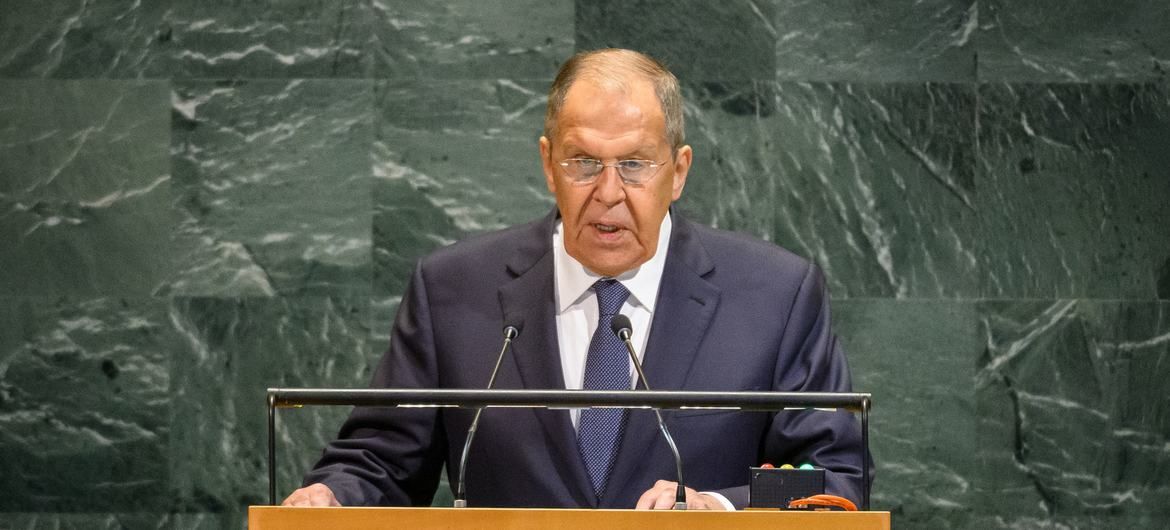
Japan on Monday (September 28) rejected Russia’s accusation of “militarisation”, two days after Foreign Minister Sergey Lavrov made clear to the UN General Assembly that Moscow will veto permanent Security Council seats for Tokyo and Berlin.
Chief Cabinet Secretary Minoru Kihara told a press conference that Lavrov’s remarks were “factually incorrect”. He said Japan had used its right of reply, the assembly procedure that lets a state answer remarks about it on the spot, to set the record straight. Deputy UN ambassador Mikanagi Tomohiro had answered Lavrov at the close of the session, describing Japan as peace-loving and saying democracy and human rights underpin its every decision.
Lavrov spoke on Saturday (September 26) in New York, at the 81st General Assembly. He said that a reformed Security Council “cannot provide any extra seats” to Japan or Germany, which he accused of taking the “path of militarisation” and, according to Japanese reports, of revanchism. He cited last year’s 80th anniversary of the Allied victory in the Second World War and the Nuremberg trials. Both countries were defeated Axis powers, and Moscow’s wartime context is central to its case against them.
Interestingly, Lavrov, Russia’s foreign minister since 2004, described Japan in 2005 as an obvious candidate for a permanent seat if the council were expanded.
The stakes are high because the council is the UN’s most powerful body. Its five permanent members, Britain, China, France, Russia and the United States, can each block any resolution, while ten elected members serve two-year terms without a veto. Calls for reform have grown amidst accusations that the council failed to prevent recent conflicts, including Russia's invasion of Ukraine, largely because of those vetoes.
Tokyo says its post-war constitution, which renounces war as a sovereign right, constrains its military posture. Moscow, however, points to the build-up since. In December 2022 Japan adopted a five-year strategy to double defence spending to about two per cent of GDP, a level it says it reached in the 2025 fiscal year. It has also been acquiring long-range missiles capable of striking distant targets, a break from its post-war principle of using force only in self-defence. The government insists the steps are strictly defensive.
In June 2023, Russia’s State Duma passed a bill renaming its September 3 commemoration the Day of Victory over militaristic Japan and the End of World War II. Moscow had already been describing Japan’s defence build-up as militarisation.
Russia’s threat carries weight as amending the UN Charter to add permanent seats needs a two-thirds vote of the 193-member General Assembly, or 129 states. It must then be ratified by two-thirds of members, including all five permanent members, which gives Moscow an effective veto. Smaller states are also usually wary of entrenching the privileges of larger powers.
Japan lobbies with Germany, India and Brazil as the G4 group, which argues that the council should reflect today’s world rather than that of 1945. The permanent five are split on its bids. Washington backs permanent seats for Japan, Germany and India. Britain and France have supported the group’s bid. China has long been cold towards Japan, citing wartime grievances, and has previously implied it would back India only if Delhi did not tie its bid to Tokyo’s.
Russia’s own position has shifted. Moscow has said that it supports India and Brazil, and wants African representation, so its opposition is aimed at Western-aligned states rather than the G4 as a whole.
The goodwill that Russia had with Japan until the last decade has gone, and relations have deteriorated sharply since Russia’s full-scale invasion of Ukraine in February 2022. Japan joined Western sanctions and has given Kyiv substantial financial and humanitarian aid. In March 2022, Moscow suspended peace-treaty talks over the Kuril Islands, a chain off Hokkaido known in Japan as the Northern Territories. Soviet forces seized the islands at the end of the Second World War, and Japan still claims the southernmost four. Analysts widely read Russia’s objection as geopolitical antagonism rather than a principled stance on UN reform.
Kihara said that Japan would keep working for Security Council reform with a broad range of countries. Tokyo has served 12 times as a non-permanent member, most recently for two years through 2024, and has long sought a permanent seat.