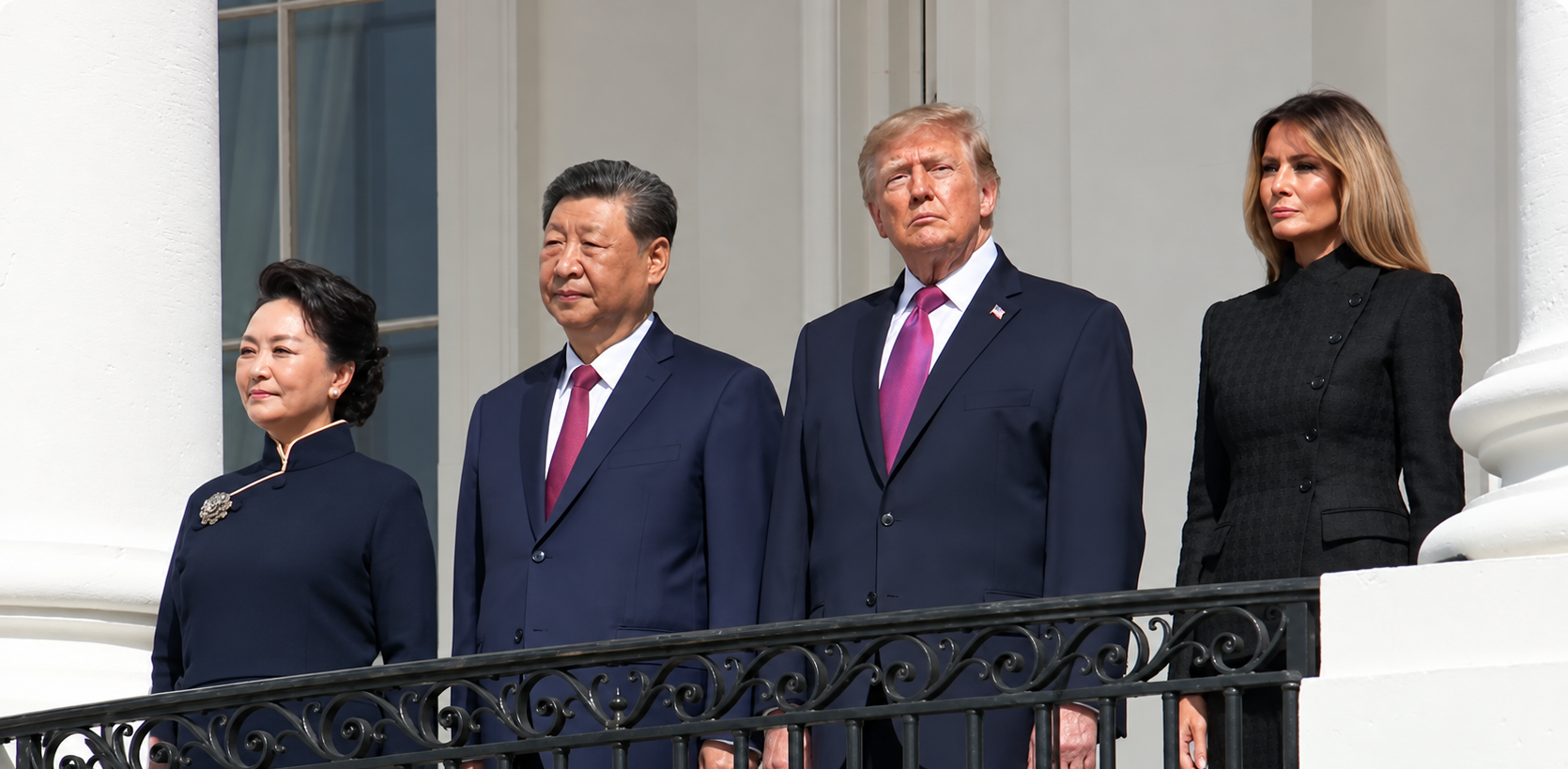
Donald Trump and Xi Jinping wrapped up their second summit of the year at the White House on Thursday (September 24) having extended their trade truce by two months, but the warmth on display could not disguise the fact that trade, Taiwan, artificial intelligence and the risk of military confrontation between the world’s two largest powers remain as unresolved as ever.
Xi’s visit – his first to Washington in roughly a decade – began on Wednesday evening when Trump and the First Lady, Melania Trump, personally greeted Xi and his wife, Peng Liyuan, on the tarmac at Joint Base Andrews, a courtesy no US president had extended to a visiting leader at that base in eleven years. Treasury Secretary Scott Bessent used the moment to announce that the two governments had agreed to prolong the trade arrangement struck at last October’s Busan summit, pushing its expiry from November 10 to January 10, 2027.
A choreographed welcome, a guarded meeting
Thursday’s formal proceedings included an arrival ceremony, a military review and a walk across the South Lawn taking in the White House’s new helipad, before the leaders sat down for a bilateral session that lasted a little over an hour, closed to the press barring a brief window for Chinese photographers. As the meeting broke up, Trump’s parting words to Xi were simply, “Great meeting, thank you.”
In his arrival remarks, Trump called the relationship a “truly great friendship” and said that the two countries could work towards a better future together. Speaking through a live translator, Xi, however, appeared to be be more calculative and told Trump that both nations “stand to gain from cooperation and will both lose in confrontation”, and that their rivalry “should be kept within bounds” – describing it as “a race of catching up with one another, not a wrestle.” In a separate written statement issued by the Chinese embassy, which made no mention of trade, Xi asserted the same point that China and the US “should be partners, not rivals.”
The Thucydides Trap, again
The most pointed moment came when Xi invoked the “Thucydides Trap” – the theory, coined by the Harvard scholar Graham Allison, describing how war can erupt when a rising power challenges an established one. Xi asked whether the two countries could “overcome the ‘Thucydides Trap’ and establish a new paradigm” for relations between major powers, a reference that he had first used at their Beijing summit in May and has now repeated twice this year.
Strategic studies professor Phillips O’Brien and the former US ambassador to Russia, Michael McFaul, both commented that Xi’s repeated invocation of the phrase was a pointed signal that he sees China as the ascending power and the US as the one in decline, rather than a simple call for cooperation.
Where the two sides split
Beyond the diplomatic language, real divergence emerged on several fronts. On artificial intelligence, Xi argued that both nations “have both the capability and responsibility to develop and manage AI” so that it remains under human control – a position at odds with Trump’s own push to rebrand advanced systems as “superintelligence”. Xi also proposed regular military-to-military dialogue and stronger crisis-prevention mechanisms between the two militaries, viewing them as necessary guardrails for a rivalry neither side intends to abandon.
On Taiwan, Xi urged Washington to handle the issue with “prudence” and called for opposition to Taiwanese independence, language consistent with Beijing’s established position. There was no public indication that the Trump administration intended to shift its own long-standing formulation in response, and neither leader’s public remarks suggested any new ground had been broken on the island’s status.
The trade truce: extended, not settled
The two-month extension gives both economies breathing room rather than resolution. Bessent disclosed that Beijing had met one commitment from the original Busan-era deal – purchasing an agreed 25 million tonnes of American soybeans – but was lagging on a separate pledge to buy $17 billion in other US agricultural goods, a shortfall that now carries over into the next round of negotiations. Left untouched in public remarks were China’s export controls on rare earth minerals, on which Washington remains heavily dependent for advanced manufacturing and defence production, along with US restrictions on advanced computer chips sold into China and Beijing’s ties to Iran, which have irritated the Pentagon.
The Council on Foreign Relations had predicted before the summit that this would be “the second of four meetings in 2026 between the leaders”, unlikely to produce a major breakthrough – a forecast that held. One China analyst, speaking anonymously ahead of the visit, described the underlying relationship as a “managed stalemate”, in which both governments use the truce’s predictability to prepare for their next round of competition rather than to settle their differences. Nothing to emerge from Washington this week disturbed that reading.
Why it matters
For markets and businesses on both sides of the Pacific, the extension avoids an immediate return to the triple-digit tariff levels that rattled supply chains through 2025. But it also confirms that the fundamental contest between the two powers – over technology, military posture and Taiwan – remains firmly in place beneath the cooperative rhetoric. Xi’s repeated references to a theory built around the inevitability of great-power conflict, delivered inside the White House itself, were a reminder that both leaders are managing a rivalry that they expect to outlast any single trade deal.
Xi’s three-day visit, which also included a state dinner, concludes on Friday. With the new truce deadline set for January 10, both capitals now have a little over three months to convert this week’s carefully staged goodwill into something more durable – or to prepare for the same negotiation to resume once the clock runs out again.