In the 20 months since President Donald Trump returned to office, his administration has approved $21.6 billion in arms deals for Israel — a pace that outstrips even the wartime spending of his predecessor and has come, deal after deal, with Congress's normal review process set aside. By comparison, the Biden administration committed more than $17.9 billion in military aid and arms sales to Israel between October 2023 and early 2025, according to a study by Brown University's Costs of War project cited by The New Arab.
What distinguishes the current run of sales is the repeated use of emergency authority under the Arms Export Control Act — a provision historically reserved for rare circumstances, allowing weapons to be sent out without seeking lawmakers' approval. However, Congress has never actually blocked a sale to Israel, but the administration has increasingly not bothered to ask.
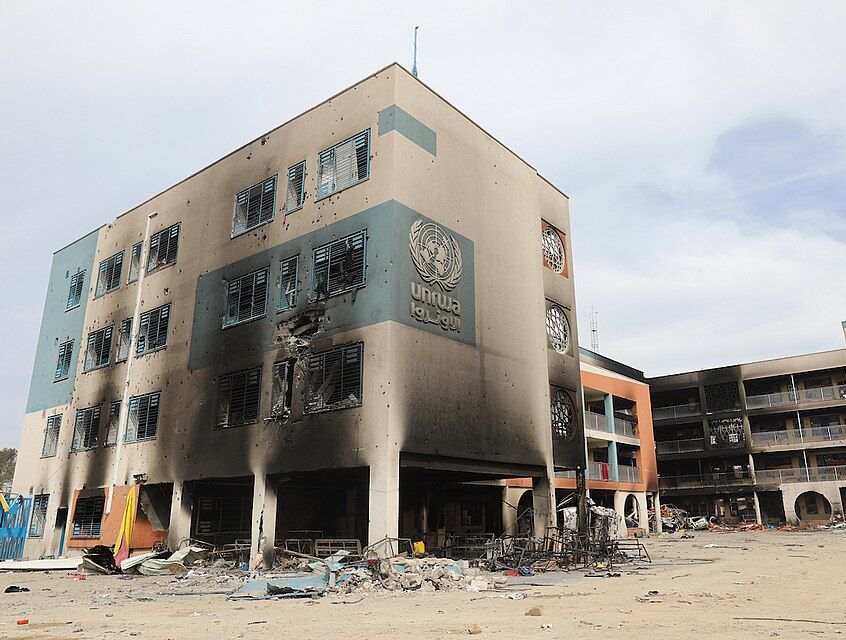
Israel’s continuous campaigns have killed and maimed thousands of Palestinian civilians, including children. According to Gaza's health ministry, at least 73,651 Palestinians have been killed and 174,575 wounded since the war began on October 7, 2023. Some UN bodies have considered these numbers credible while Israel disputed them.
Early reversal
That pattern was set within days of Trump's inauguration. Reversing a Biden-era hold imposed over fears the munitions would be used on crowded areas of Rafah, Trump ordered the release of a stalled $2.04 billion shipment of 2,000-pound bombs. “We released them today,” he told reporters aboard Air Force One, adding that Israel had "paid for them" long ago. The gesture set the tone for what followed: a series of packages framed by the administration as simply honouring past commitments, but which critics say has stripped away what little friction previously existed.
That friction disappeared almost entirely by February 2025, when the State Department notified Congress of a $7.4 billion package of bombs, guidance kits and Hellfire missiles -- informing, rather than consulting, the relevant committees. Rep. Gregory Meeks, the top Democrat on the House Foreign Affairs Committee, called the move “yet another repudiation” of Congress's oversight role. This complaint recurred almost verbatim through the following year.
Buildup accelerates
The sales kept coming at a rhythm largely dictated by the region's escalating conflicts rather than any legislative calendar. A $510 million tranche of precision guidance kits followed the U.S.-Israeli strike on Iran in June 2025, intended to refill stocks drawn down during the fighting. By January 2026, the administration had cleared a much larger $6.67 billion package built around 30 Apache attack helicopters — enough to double Israel's fleet — alongside thousands of armoured vehicles, underscoring a shift from replenishing munitions toward hardening Israel's long-term offensive capacity.
The clearest break with precedent came in March 2026, a week after the U.S. and Israel opened a joint air campaign against Iran. Secretary of State Marco Rubio invoked formal emergency powers — not just informal fast-tracking — to push through roughly $650 million in bombs without any congressional review at all, the first time the second Trump administration had done so. Meeks said the move undercut the administration’s own claims of readiness for the war: “This is an emergency of the Trump administration's own creation.” The State Department, for its part, maintained the sale served “the foreign policy and national security” interests of the United States, the standard justification it has now invoked for a fourth straight deal.
Two months later, with the fighting paused under an uneasy ceasefire but the drone threat from Iran unresolved, Rubio used the same authority to approve $992.4 million for 10,000 laser-guided APKWS rocket systems — a comparatively cheap counter-drone weapon that officials have pitched as a cost-effective alternative to firing multimillion-dollar interceptors at inexpensive Iranian drones.
Running tally
Seen together, the deals trace an arc from crisis management to institutionalised urgency: what began as a one-time reversal of a Biden policy has become a standing method of doing business, with "emergency" sales now a matter of routine rather than exception. The New Arab put the total value of deals announced so far at $19.2 billion, rising to $21.6 billion once the latest $2.8 billion notification is finalised - with at least half of that sum funded not by Israel's own purchases but by U.S. taxpayers through military aid. The outlet also said the weapons supplied over the period were used in the Gaza genocide.