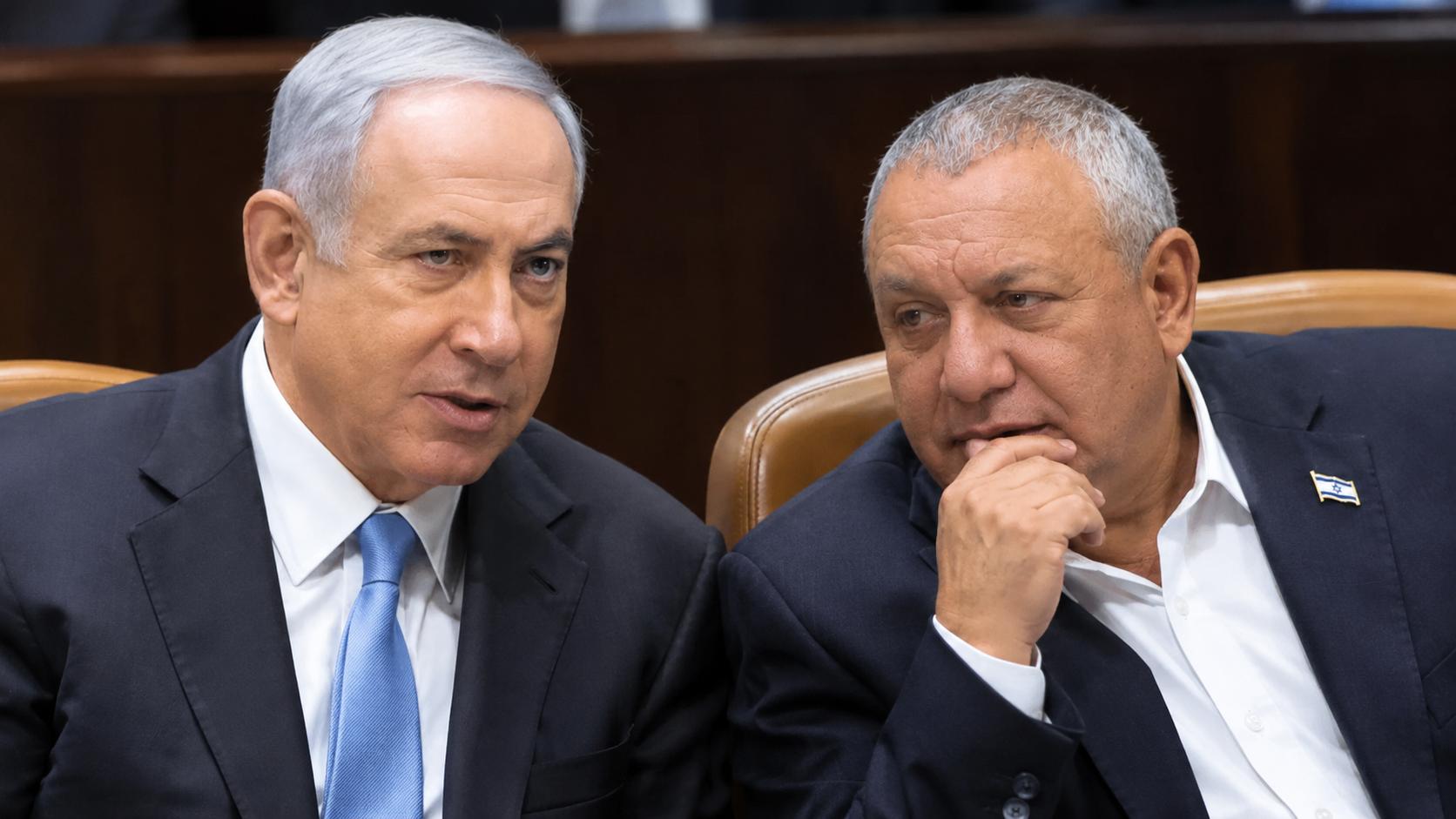
Caretaker Israeli Prime Minister Benjamin Netanyahu and Yashar leader Gadi Eisenkot began talks on Sunday (November 29) on forming a national unity government, after Netanyahu offered to let Eisenkot serve first as prime minister under a power-sharing arrangement. The meeting took place in Tel Aviv. Eisenkot's Change bloc fought the election promising to unseat Netanyahu, but it now has little room to manoeuvre. Among the four Change parties, Naftali Bennett's B'Yachad has insisted that Eisenkot stay open to a unity government with Netanyahu, so the bloc does not have to depend on Arab parties. Bennett has urged bloc partners to explore such a government, with Eisenkot serving first as prime minister. Without Bennett's 12 seats, the Change bloc has no realistic path to forming a government. To understand why, it helps to see how the blocs stand in the Knesset, the Israeli parliament.
Knesset numbers
Israel held its parliamentary election on October 27, with Netanyahu's right-wing bloc and Eisenkot's Change bloc as the main contenders. Amid the war in Gaza, Arab-Israeli voters turned out in heavy numbers, and Arab parties won a record number of seats.
The Knesset has 120 seats, and any bloc needs 61 Members of Knesset (MKs) to form a government.
Netanyahu's right-wing bloc won 53 seats: Likud (27), Otzma Yehudit (7), United Torah Judaism (UTJ, 7), Shas (6) and Religious Zionism–Zehut (6). This is the core of the outgoing government, down from the 64 seats the coalition won in 2022.
The opposition Change bloc won 48 seats: Yashar (21), B'Yachad, led by former prime ministers Naftali Bennett and Yair Lapid (12), The Democrats (8) and Yisrael Beiteinu (7). Most of these parties have ruled out relying on Arab parties.
Arab-led parties won a record 19 seats: Joint List (11) and Ra'am (8). They sit outside both Zionist blocs, and Jewish parties have long shunned them as coalition partners. The Arab parties say they are ready to back the Change bloc. Together with Arab parties, the Change bloc would have 67 seats, but only if it relies on them, which most Change parties reject.
What Netanyahu proposes
Netanyahu has been in power, in several stints, for nearly two decades, and he faces criminal cases, so losing power is a serious matter for him. He has also portrayed the Arab parties as traitors, and almost all Jewish parties agree that depending on Arab MKs is unacceptable. Netanyahu has therefore been demanding that Eisenkot's Yashar join a national unity government. Eisenkot has refused to serve under Netanyahu.
Eisenkot has been open to forming a government with the support of Arab MKs, but B'Yachad, the second-largest party in the Change bloc, has opposed that prospect. Bennett is against serving in a Netanyahu-led government, but he is open to a unity government in which Eisenkot would be the first prime minister. Netanyahu has now softened his position and offered to serve as the second, rotational prime minister, and Bennett is pressing Eisenkot to join. Netanyahu's party and Eisenkot's had earlier failed to agree on who would lead.
The Change bloc had hoped to attract the ultra-Orthodox parties, Shas (6 seats) and UTJ (7 seats), which are unhappy with Netanyahu for not exempting Haredi Jews from military conscription. At least UTJ showed some willingness to join the Change bloc. Had UTJ backed it, Eisenkot could have relied on the moderate Arab party Ra'am, which won 8 seats and wants peaceful coexistence with Jews. Ra'am leader Mansour Abbas declared Hamas a terrorist organisation on November 28, meeting a core demand of Eisenkot. Yisrael Beiteinu chief Avigdor Liberman has also said the Change bloc could form a "clear Jewish government".
Netanyahu's Offer, Bennett's Push
Eisenkot has firmly opposed serving under Netanyahu. He has also opposed several of the prime minister's positions, including the war on Iran, settler violence and curbs on the judiciary. He got a Yashar MK elected Knesset speaker with the help of Arab parties. Several thousand overseas Israelis travelled home to vote against Netanyahu, and many are demanding that the Change bloc form a government with Arab MKs' support. Eisenkot's opposition to Netanyahu held for some time. However, UTJ and B'Yachad's insistence that he consider Netanyahu's offer now leaves him with few options.
The pressure is mounting from within the bloc. Bennett has warned that Netanyahu will face consequences if he stalls efforts to form a unity government led first by Eisenkot, while Netanyahu has vowed to remain Likud leader and to topple any government formed without him. Eisenkot, for his part, had earlier dismissed Netanyahu's call for talks without preconditions as another ploy.
The talks also face major obstacles. Eisenkot's bloc claims Netanyahu is demanding a full four-year term and no inquiry into the October 7 attack. The Change bloc has a parliamentary majority, but no government, and it has put repealing the judicial overhaul laws ahead of setting up an October 7 inquiry. Eisenkot has also refused to consider a coalition with Itamar Ben-Gvir, though Netanyahu has signalled he could drop Ben-Gvir from the talks. Meanwhile, Liberman and Yair Golan of The Democrats have drawn a red line against joining a unity government led by Netanyahu.
Netanyahu's right-wing bloc has 53 seats, so Bennett's defection would give him a majority (53 + 12 = 65, against the 61 needed).