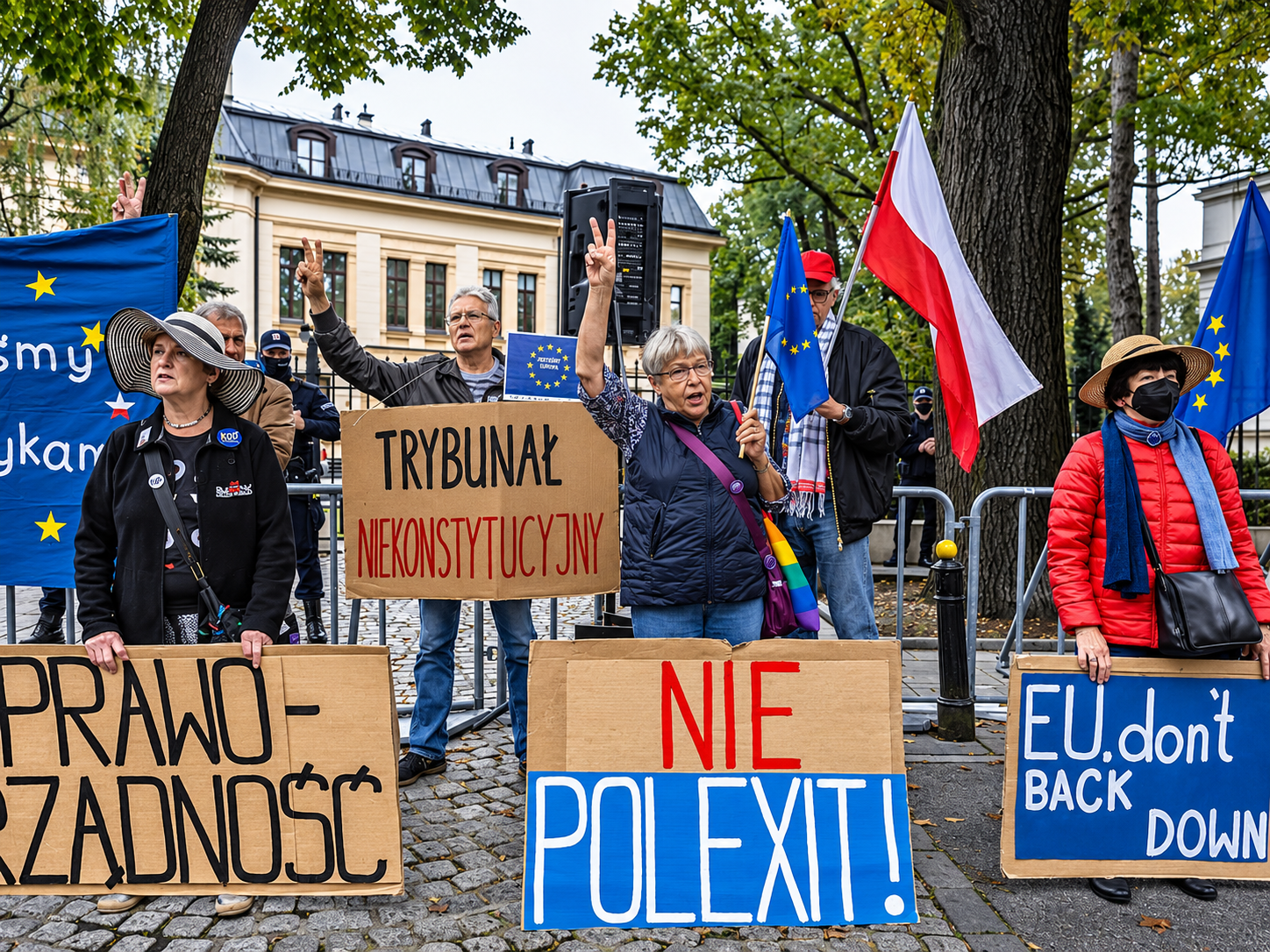
Poland, a frontline NATO state and a major hub for Western weapons bound for Ukraine, has spent five days in an open constitutional confrontation. It began on Friday (October 30), when police surrounded the Constitutional Tribunal, the court that decides whether Polish laws comply with the constitution. As they did so, a group of government-backed judges announced that the court’s president, Bogdan Święczkowski, had been suspended and that they were now in charge.
His allies called it a coup. The government called it the restoration of the rule of law. Many legal experts, including some with no sympathy for Święczkowski, doubted that the method was lawful. A crunch meeting of the court’s judges is now scheduled for Tuesday, and its outcome will show whether the court can function at all. No result had been reported at the time of writing.
What happened
Much of the anger stems from the timing. On Friday, President Karol Nawrocki was flying to Senegal for a state visit. In Warsaw, a judge named Anna Korwin-Piotrowska declared that she had suspended Święczkowski and his deputy, Bartłomiej Sochański, for one month, and the court’s website was changed to say so. Police said that they entered the premises after incidents outside, including the throwing of dangerous objects at officers. Early reports also said that three protesters were detained.
According to the court’s spokeswoman, Weronika Ścibor, seven judges elected by parliament this year were escorted in by officers of the State Protection Service, which answers to the interior minister. She said that they came through a gate leading from the prime minister’s chancellery, avoiding the main entrance where protesters had gathered. Święczkowski was stopped by police from entering the grounds, after his supporters had cut through a fence with a power tool.
Prime Minister Donald Tusk defended the move on social media. “Restoring the rule of law is our obligation,” he wrote. Jarosław Kaczyński, leader of the opposition Law and Justice party (PiS), warned outside the court: “From today, Poland becomes a police state.” He urged the president to come home. Nawrocki did as he ordered his plane back, declaring: “At a moment like this, the President must be in Poland.”
The weekend
Saturday, at about 1 a.m, Nawrocki went straight to the tribunal. Video shared by Maciej Berek, a Tusk ally and one of the new judges, showed the president pushing past Korwin-Piotrowska at the door. Inside, he told the judges: “You are not judges of the Constitutional Tribunal.” Korwin-Piotrowska replied that they were. The two sides then disputed what happened at the door. A presidential aide accused the judges of breaching the head of state’s inviolability, while Berek said the president had barged into her with great force. Justice Minister Waldemar Żurek called Nawrocki’s behaviour shameful and urged prosecutors to look into it, though the president enjoys immunity.
On Saturday, at about 5 a.m. Nawrocki left. A statement read on his behalf by his chief of staff spoke of a “forceful takeover of a constitutional body”, and he called urgent talks with parliamentary parties.
Even on Saturday afternoon, the talks produced no breakthrough. Two of Tusk’s junior coalition partners took part: the centrist Poland 2050 and the centre-right Polish People’s Party. Poland 2050’s leader, Szymon Hołownia, said the night’s events brought shame on Poland, though he also criticised Święczkowski and argued that fixing the court by force would worsen its decline. The Left party refused to attend, and Tusk’s own Civic Coalition stayed away.
That very evening, Tusk gave a televised address. “I am certain that the Constitutional Tribunal will function as it should,” he said. He also declared that on some issues there could be “no compromise”, and accused Nawrocki of intimidating judges. Hundreds of protesters gathered for a second night.
The fallout spread to diplomacy by Monday. Poland’s ambassadors to China and Romania had quit, and the envoy to the United Nations, Krzysztof Szczerski, became the third. All three were former advisers to Andrzej Duda, Nawrocki’s PiS-aligned predecessor. Kumoch, the ambassador to China, said he acted out of conscience. Foreign Minister Radosław Sikorski suggested that the trio had quit at the urging of the president. Tusk, for his part, wrote that “the president recognises the lawfully elected judges because the constitution prescribes it.”
Who’s who: a primer for readers new to Poland
Poland is a parliamentary democracy with a split executive, and the split is the root of the problem.
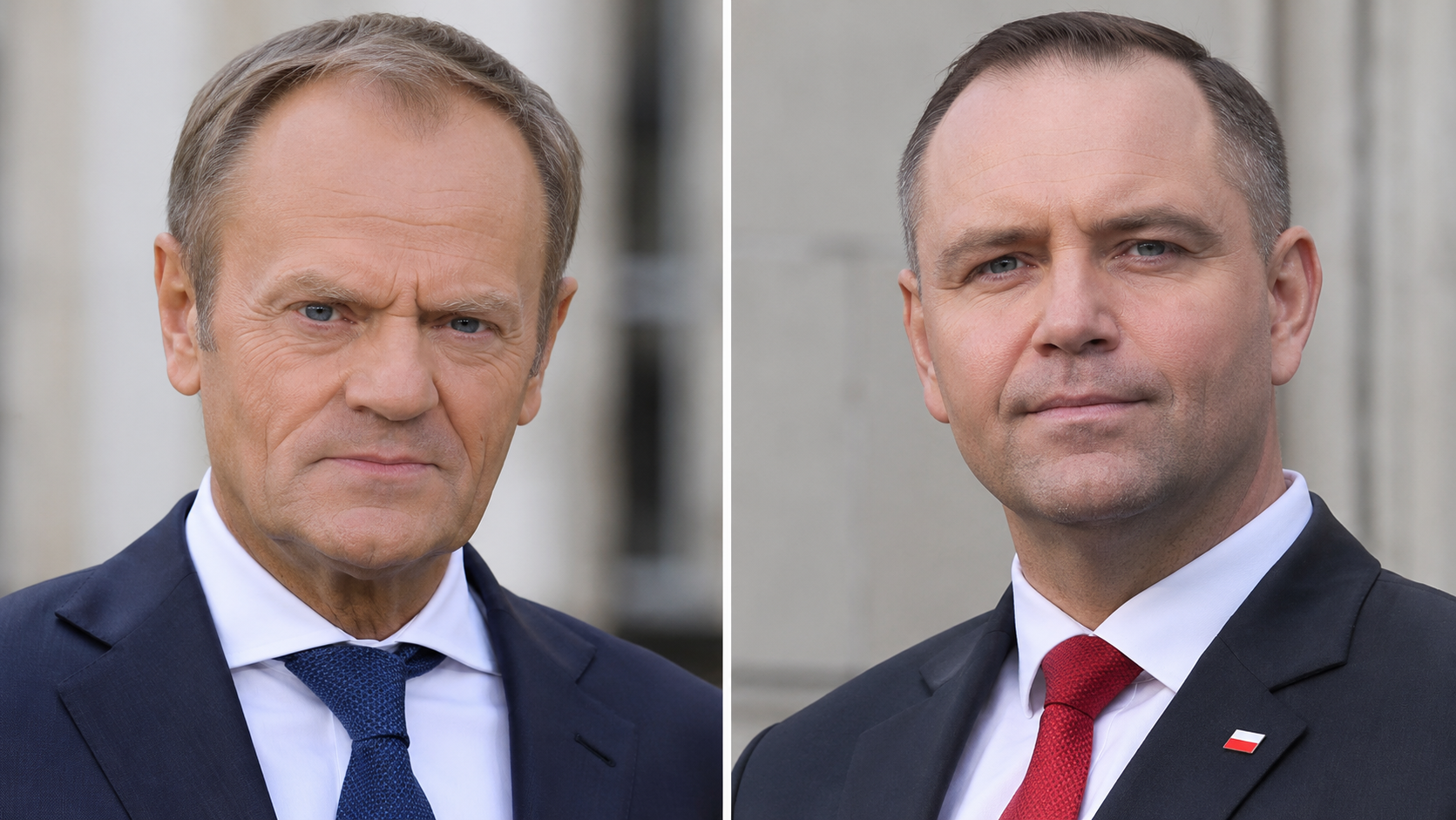
Donald Tusk is a centrist and former president of the European Council. He has been prime minister since December 2023, leading a broad coalition from the centre-right to the left that controls the Sejm, parliament’s powerful lower house. He is strongly pro-EU.
Karol Nawrocki is a conservative historian and amateur boxer who won the 2025 presidential election with 50.89 per cent of the vote, backed by PiS. Donald Trump made clear that he wanted him to win. The Polish president is not a figurehead: he can veto laws and must swear in judges.
The Constitutional Tribunal has 15 seats. A full bench requires at least 11 judges, according to Polish Radio. A separate rule, a quorum of 10, applies to its general assembly.
Why: how Poland got here
The roots go back to 2015. The then-governing centrist coalition overstepped its powers by filling two seats prematurely. PiS, newly in power, then refused to accept those appointments, and its own nominees subsequently went on to gain a majority on the court. Critics at home and abroad argued that the tribunal no longer met the standards of an independent body established by law.
When Tusk’s coalition returned to power in 2023, it declined to recognise the court’s legitimacy, partly because three of its judges were unlawfully appointed under PiS, and has ignored its rulings. This year, it began filling the vacant seats and has now chosen eight judges, which on paper gives its nominees a majority.
But Polish law requires judges to take their oath “before the president”. Nawrocki has sworn in three of the eight, two of them on April 1, but has refused the other five, citing doubts about how they were chosen or their qualifications. The five held their own ceremonies in parliament. Święczkowski, who served in the previous PiS government, would not let them take their seats, even after the European Court of Human Rights ordered him to. He argued that the Strasbourg court had no such authority.
The court was deadlocked: the president would not swear the judges in, and the chief justice would not seat them. For weeks, PiS supporters had camped outside the building to stop what they feared the government would try. On Friday, the speculation turned into reality.
The legal dispute
Even Święczkowski’s critics doubt the method. Marcin Matczak, a leading constitutional scholar who opposed PiS’s judicial changes, said: “I never thought I’d end up defending him.” He argued that the suspension had no sound legal basis. The statement on the court’s website cited a provision of the law on ordinary courts, which the justice minister oversees but which does not govern this tribunal. Matczak’s own post points to a different pair of provisions, so even the exact legal basis is contested.
Przemysław Rosati, head of the Polish Bar Council, questioned both the legal basis and whether Korwin-Piotrowska had the authority to take over. She calls herself the longest-serving judge, a claim based on her judicial career since 1995, not her time on this court. She justified the suspension by accusing Święczkowski of blocking judges from taking their posts and of overseeing irregularities in how cases were assigned. The government’s case rests on the first charge.
Some experts defend the move. EWTN reports that, while many doubt she had the power, others argue it can be justified as “higher constitutional necessity”.
The stakes at home and abroad
Poland holds a parliamentary election next year. Tusk’s Civic Coalition is seen to be ahead in the polls but may struggle to form a majority, and that the crisis has pulled the fragmented hard right closer together. “It’s not a conflict about the tribunal, everything is at stake,” Anna Materska-Sosnowska, a political scientist at the University of Warsaw, told Reuters.
Outside Poland, the effect could be significant. A Tusk defeat could shift Warsaw closer to the Trump administration and away from the European mainstream. The US ambassador, Tom Rose, said that it was not his place to interfere but voiced concern for Poland’s stability. The European Commission said that it was closely monitoring events and that Polish authorities must ensure the tribunal can function in line with the constitution and EU law. Brussels withheld billions of euros from Poland during PiS’s years in power over its judicial changes, and the money has flowed again under Tusk. Economists at the bank PKO BP warned that a prolonged dispute could raise institutional risks and hurt Poland’s creditworthiness.
There is also talk of a way out. Poland 2050’s leader Hołownia has backed a plan to replace the entire bench, an idea the right-wing Confederation and the left-wing Razem have long pushed, according to EWTN. Poland’s bishops have appealed for dialogue, warning of a deep crisis of the state.
What happens next
The immediate test comes on Tuesday. Korwin-Piotrowska has called a general assembly of the tribunal’s judges for 15:30. Its stated purpose is to adopt the court’s 2027 budget, though it could also take up the justice minister’s request to strip Święczkowski of his immunity from prosecution. It needs a quorum of 10 of the 15 judges, and the arithmetic is difficult. Only the eight judges elected by the current parliament are expected to attend. The daily Rzeczpospolita reported that none of the judges seated before it will come, according to EWTN, and Święczkowski has said he will boycott what he calls a gathering of “usurper judges”. Even if the assembly goes ahead, local experts expect PiS to reject its decisions. Meanwhile, Korwin-Piotrowska has published figures showing 1,171 cases pending before the tribunal.
Beyond Tuesday, the likeliest outcome is prolonged paralysis, with two camps each claiming the court and neither able to run it. Tusk’s side says the dispute could be solved without changing the constitution if the president simply recognised the judges chosen by the Sejm. Nawrocki’s camp hopes the crisis will erode Tusk’s parliamentary majority.
The test for Poland is whether it can restore a functioning court without the means of restoration themselves breaking the rules. Both camps claim to be defending the constitution.