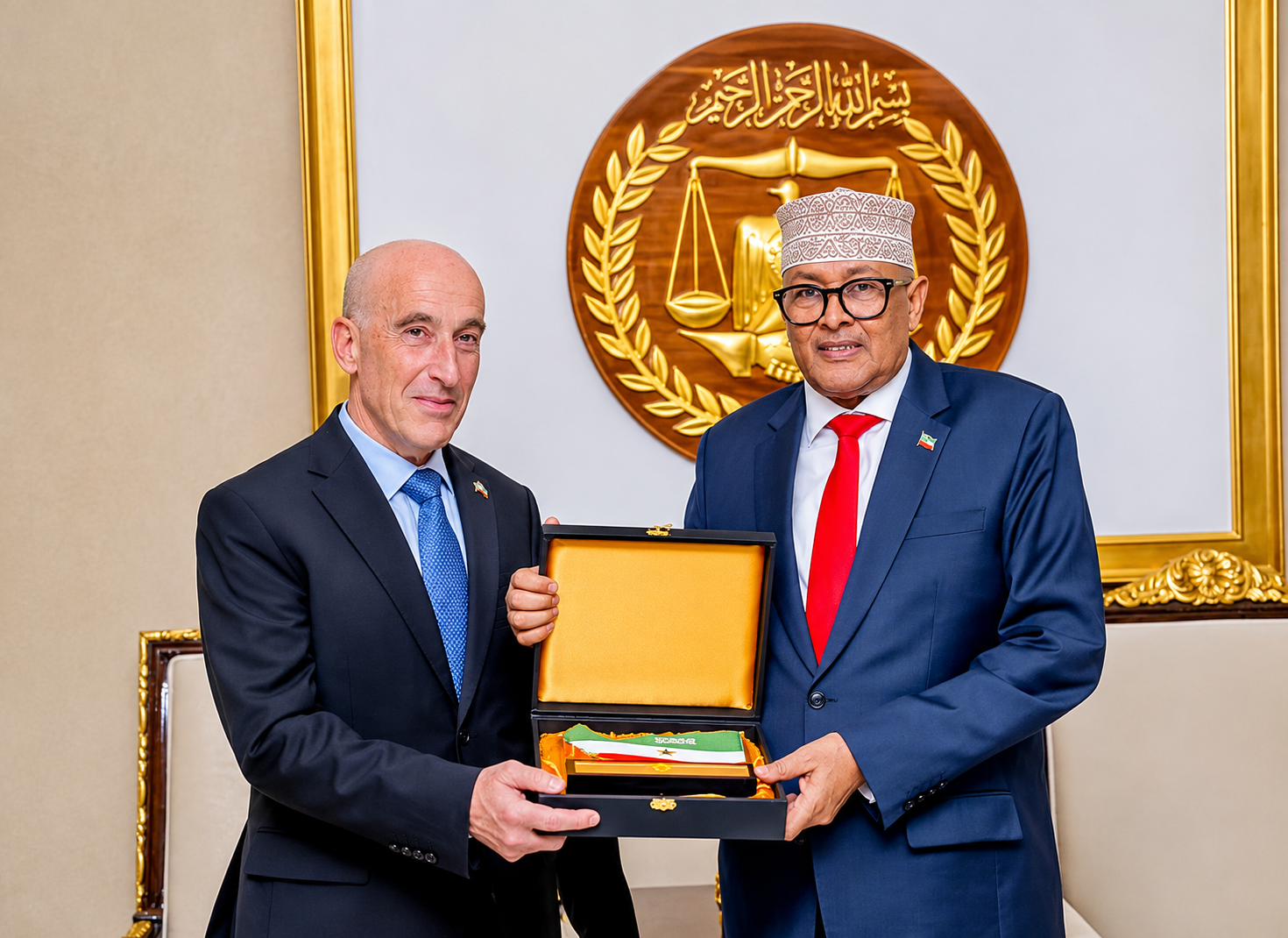
Israel has installed its first ambassador in Somaliland, turning the only recognition the territory has ever won into a working diplomatic relationship just as war in Yemen threatens the Red Sea shipping lane across the water.
Michael Lotem presented his credentials to President Abdirahman Mohamed Abdullahi, known as Cirro, at the Presidential Palace in Hargeisa last week. A cornerstone was then laid for a permanent Israeli embassy, Israel’s Foreign Ministry said on Sunday (November 1). Lotem is the first diplomat from a UN member state to be formally accredited to Somaliland. Abdullahi called it a “historical day.”
The ceremony has come at a time when Somalia, which claims the territory, accuses Israel of coveting a Red Sea naval base. Somaliland’s government says no base talks have been held, though it has signalled it is open to hosting one.
Somaliland, and why recognition matters
Somaliland is a former British protectorate that declared independence from Somalia in 1991 and has governed itself since. Somalia, the African Union, the Arab League and the Organisation of Islamic Cooperation all treat it as part of Somalia. The AU’s Peace and Security Council has called for Israel’s recognition to be revoked immediately. Ethiopia signed a deal in December 2024, brokered by Turkey, reaffirming Somalia’s territorial integrity after reportedly offering recognition in exchange for sea access.
From recognition to permanent embassy
Israel recognised Somaliland on December 26, 2025, with Prime Minister Benjamin Netanyahu saying the move was made in the spirit of the Abraham Accords. Foreign Minister Gideon Sa’ar visited Hargeisa in January 2026, and Somaliland named Mohamed Hagi its first ambassador to Israel in February. Lotem was named in April, initially as a non-resident envoy. Hagi presented his credentials to President Isaac Herzog on May 18, the anniversary of Somaliland’s 1991 declaration of independence.
In June, Abdullahi made the first visit to Israel by a Somaliland president. He signed a Strategic Cooperation Declaration with Netanyahu and opened Somaliland’s embassy in Jerusalem. Sa'ar described the exchange of ambassadors as fulfilling the agreement reached at recognition. “Israel is determined to advance and solidify its relations with Somaliland,” he said.
Red Sea is the prize
Somaliland is located in the Gulf of Aden, across the water from Yemen and close to the Bab al-Mandeb strait, the passage between the Red Sea and the Indian Ocean. The strait has become a war zone. In September, Houthi forces seized the island of Perim and the port of Mokha. Yemen’s government launched a counter-offensive on October 4. On October 9, UN envoy Hans Grundberg told the Security Council that “Yemen has slid back into full-scale war.” Fighting has intensified on the Yemeni side of the strait in recent weeks.
Other powers are already in Somaliland. The UAE operates Berbera port through DP World, a shipping and port management company. Ethiopia, which is landlocked, wants sea access, and Turkey is entrenched in Mogadishu, Somalia’s capital. Some analysts argue that Israel’s real objective is the Red Sea rather than Somaliland itself. Abdullahi made the same point from the other side, telling the ceremony that Somaliland's position around the Red Sea and Gulf of Aden gives the partnership regional and international significance.
The base question
Security ties are the most sensitive part of the relationship. During Abdullahi’s June visit, Israeli Defence Minister Israel Katz said that the two sides had cooperated “under the radar” for years in activities that will remain secret, and that Israel now wanted to take that cooperation to a new level.
Somaliland’s line, on the other hand, has been more careful. In February, its minister of the presidency told AFP that he could not rule out an Israeli military presence. Bloomberg and Swedish public radio later reported on Israeli plans for a military installation near Berbera, the country’s economic capital. Others have pointed to an Israeli intelligence presence at Berbera airport and extensive new construction there by the UAE, though none of it has been confirmed publicly. Abdullahi has since said no talks have been held, while indicating Somaliland would give access if Israel or the United States asked.
The Houthis have warned of the consequences. Two days after Israel’s recognition, Yemen’s Houthi leader, Abdul-Malik al-Houthi, called it a “hostile stance” and said: “We consider any Israeli presence in Somaliland a military target for our armed forces.” He later said he was serious about the threat. An Israeli base would sit directly across the Gulf of Aden from the Houthis, and because Berbera is Emirati-run, a strike there could hit Emirati interests too. Liban Yusuf Osman, a former Somaliland deputy foreign minister, warned in January that “recognition brings visibility, and with it visibility brings vulnerability.”
Somalia, US and a crowded field
Somalia condemned the recognition as a violation of its sovereignty, a position shared by the African Union, the Arab League and the Organisation of Islamic Cooperation. President Hassan Sheikh Mohamud told Sky News this week that Israel’s interest is the Red Sea, not Somaliland’s independence. “Israel wants the Red Sea, that is the only reason,” he said, alleging that Israel wants a naval base there.
Washington’s State Department report to Congress in June reaffirmed US recognition of Somalia’s sovereignty and territorial integrity, including Somaliland, while pledging a “positive, constructive relationship” with Hargeisa. President Donald Trump had earlier said the US was in no rush to follow Israel. On October 12, at a rally in Ohio, he called Somaliland “a totally different country” from Somalia, which prompted celebrations in Hargeisa. He, however, resisted from announcing any policy change.
Hargeisa has been looking for a second recognition. It has set its sights on the UAE, Ethiopia and India. Ethiopia has stopped short of formal recognition. The UAE has not recognised Somaliland, but it declined to condemn Israel’s move on its own. Mogadishu retaliated in January by cancelling its defence and port deals with the UAE.
What recognition has not delivered
For Somaliland, the gains are real but narrow. The country could expand cooperation in agriculture, water, health and technology. What it has not won is the wider recognition that would make Israel's decision a turning point rather than an outlier.
Public opinion in Hargeisa is mixed. Many assumed the West would follow Israel’s lead, but that did not happen, while religious voices have warned that aligning with Israel could strain internal cohesion. In business circles, stakeholders tend to see official recognition as a route to investment.
The embassy cornerstone makes the relationship harder to reverse. Whether it also makes Somaliland a more exposed player in the Red Sea’s rivalries, without a second capital to share the risk, is the question the next few months will start to answer.