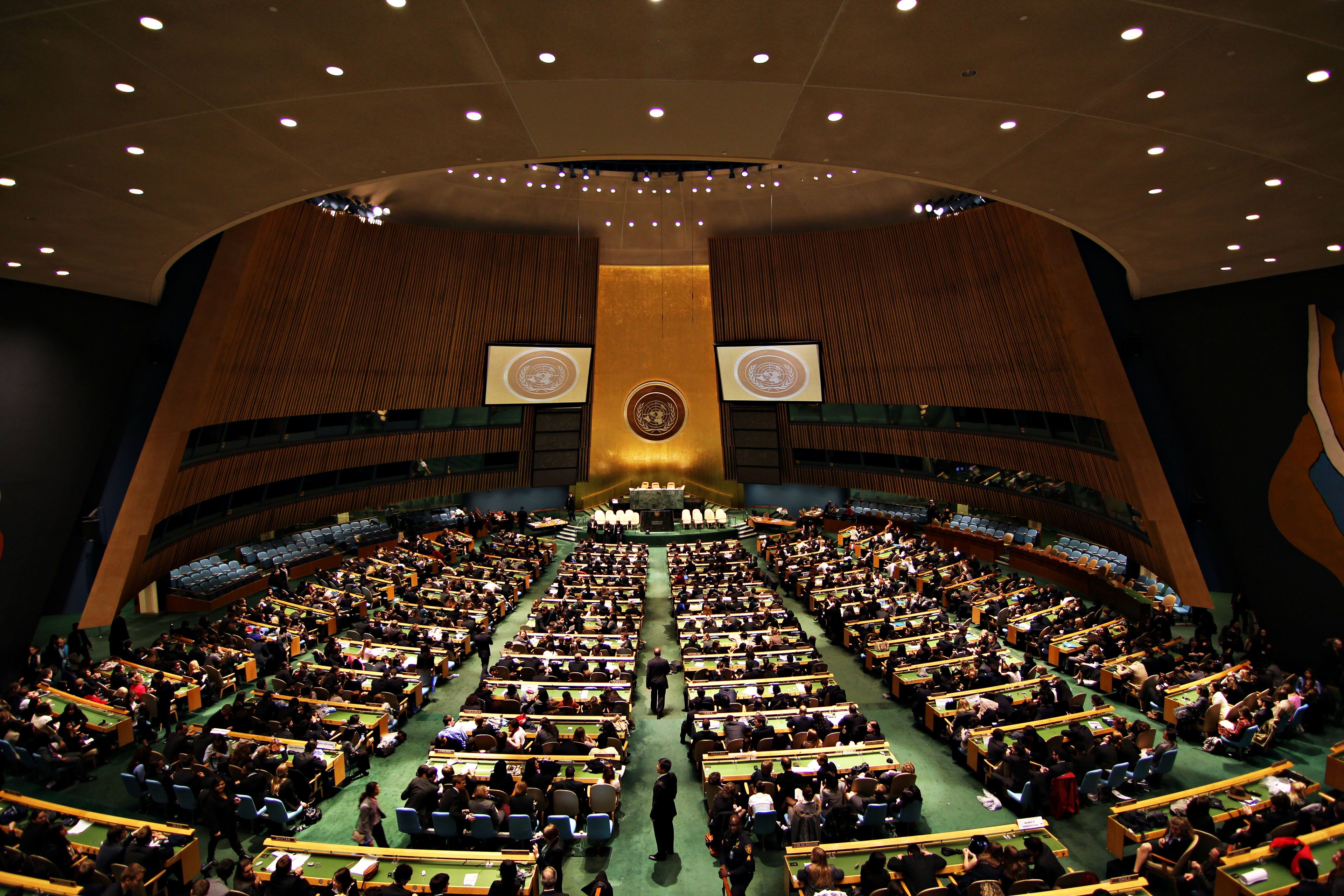
India on Wednesday (October 28) voted for a UN General Assembly resolution urging the US to end its embargo on Cuba. The vote came as Cuba reels from a severe energy crisis, worsened by a US fuel embargo imposed after the rendition of Venezuela’s president to New York, and as President Donald Trump says the US will “take care of Cuba” on its way back from Iran. The resolution passed 130 to 17, with 25 abstentions, a day after US and Cuban officials clashed on the Assembly floor and Washington expelled a Cuban diplomat.
India’s position
Soumya Nair, a Counsellor at India’s Permanent Mission to the UN, said the Assembly has repeatedly called for an end to the embargo and rejected laws with extraterritorial effects that adversely affect other states’ sovereignty. “India reiterates the Assembly’s call to all states to refrain from promulgating and applying, and to repeal and invalidate, such laws and measures in conformity with their obligations under the Charter of the United Nations and international law,” she said.
India’s commitment to multilateralism, she added, is rooted in the belief that challenges are best addressed through dialogue and diplomacy. “It is in this spirit that India hopes that the embargo will be lifted at the earliest to help create an environment that would enable the people of Cuba to participate more fully in international cooperation and pursue their legitimate development aspirations,” she said.
Citing a UN Secretary-General report, Nair said Cuba’s health system faces shortages of over 60 per cent of essential medicines, and food production has declined by more than 50 per cent in five years. “The restrictions on fuel exports to Cuba have also aggravated the country’s ongoing energy crisis. The shortages have disrupted essential services, including healthcare, education, water supplies, food distribution, and transportation,” she said.
India’s stand follows a strongly worded statement in July, during the Assembly’s debate on agenda item 38, “Necessity of ending the economic, commercial and financial embargo imposed by the United States of America against Cuba.” Eldos Mathew Punnoose, a Counsellor at the mission, told the Assembly on July 10: “As the world’s largest democracy, India regards multilateralism as an article of faith.” He joined others in calling for an end to embargoes that “constrain the full enjoyment of economic and social development by the populations of affected countries, particularly women and children.”
He cited Secretary-General reports on the embargo’s effect on Cuba’s development, including progress towards the Sustainable Development Goals. He recalled that world leaders, in adopting the 2030 Agenda in 2015, urged states to refrain from unilateral economic, financial or trade measures not in accordance with international law. Cuba’s healthcare expertise, which let it respond effectively to COVID-19 at home and abroad, “deserves recognition”, he said. “India hopes that the embargo will be lifted at the earliest,” he said, urging people-to-people contacts and an environment “free from sanctions and embargoes.”
The floor clash
Unprecedented scenes unfolded in the Assembly hall on Tuesday, October 27. While US Ambassador Mike Waltz was addressing the Assembly on Cuba, Cuban Foreign Minister Bruno Rodríguez Parrilla and other Cuban diplomats rose from their seats and walked to the podium to confront him. “Mr. President, this individual needs to back away from this podium. He is not going to intimidate me in the United States of America like he tries to intimidate political prisoners,” Waltz said. Assembly President Khalilur Rahman suspended the session.
Waltz later said Cuba’s “rulers” were enjoying “luxury watches, Rolexes, yachts, mansions, and even private islands” while their people starved, and that the Cuban delegation had responded by “pounding their desks, screaming across this chamber, storming the podium” and “even assaulting an American diplomat”. He said this violated the Host Country Agreement. “If you lay a hand on an American diplomat in this body, there will be consequences,” he said.
He said Richard Tur de la Concepción, a first secretary at Cuba’s UN mission, would be expelled, that Secretary of State Marco Rubio had approved the move, and that the diplomat had shoved and tried to assault an American diplomat. Cuba has lodged a complaint with Secretary-General António Guterres about an American diplomat on Waltz’s staff, and its mission wrote to him expressing deep concern. A week earlier, Waltz had a similar exchange with his Cuban counterpart outside a US-hosted panel with Cuban dissidents and former prisoners.
On the day of the vote, Waltz rejected the premise of the debate. “There is no blockade,” he said, citing more than $876 million in US exports to Cuba in the first eight months of 2026, including $230 million in fuel for eligible private businesses, plus shipments from Canada, Spain, Mexico, China, Russia, the European Union and UN agencies. Cuba’s wealth had “changed hands” from ordinary Cubans to a ruling elite, he said, and a vote against the resolution was “the only thing standing between the communist kleptocratic regime and another propagandistic victory at the expense of the Cuban people.”
Rodríguez answered with an on-screen counter of the embargo’s cost since the debate opened: more than $22.9 million. He blamed it for infant mortality doubling and tens of thousands of delayed or cancelled surgeries, and said the US, “in the hands of a plutocracy”, had no standing to talk about democracy. “What Cuba demands is to be left in peace,” he said. “Cuba is not a threat, the blockade is.”
Shrinking support
Last year the resolution passed 165 to seven, with 12 abstentions. This year’s result is 35 fewer votes in favour, with votes against up from seven to 17 and abstentions from 12 to 25. Colombia, Paraguay, Argentina, Ecuador and Costa Rica voted with the US, while Germany and Italy, which had backed the resolution before, abstained. Cuba accused Washington of threatening countries with tariffs and visa restrictions to change their votes.
“I am satisfied that so many countries now, including major economies like Korea, Germany and others, have shifted their position,” Waltz told reporters. General Assembly resolutions are not legally binding, and only the US Congress can lift the embargo, but they are widely read as a gauge of world opinion.
Background
This was the 34th vote since 1992, when 59 countries backed the resolution, three opposed it and 71 abstained. Support peaked at 191 votes in 2015 and 2017, during and just after the thaw under President Barack Obama, who restored diplomatic relations with Cuba in July 2015. The US abstained for the first time in 2016. That thaw has since been reversed.
The conflict dates to Fidel Castro’s 1959 overthrow of a US-backed government and his alignment of the island with the Soviet Union. The embargo began in 1960, after Castro’s revolution toppled Fulgencio Batista and nationalised properties belonging to US citizens and companies. It was later widened, notably by the Helms-Burton Act of 1996. This year’s resolution names that law, whose extraterritorial reach affects companies and individuals in other countries, and says tougher measures applied since 2017 have reversed the easing of 2015 and 2016.
Pressure has sharpened this year. In late January, Trump threatened tariffs on any country that supplies oil to Cuba, effectively cutting off fuel to the island. The result has been widespread power outages that disrupt cooking, water, phone and internet services. Havana estimates the embargo cost it a record $8.08 billion between March 2025 and February 2026. Last week Trump again raised the possibility of military intervention, saying the US would “take care of Cuba” on its way back from the Iran war. Washington says the sanctions are needed to upend what it calls a “corrupt dictatorship.” Cuba has persistently defied the US, and has denied these allegations as propaganda.
With the margin narrowing and tensions rising, India’s position is being tested more openly than at any time in recent years.