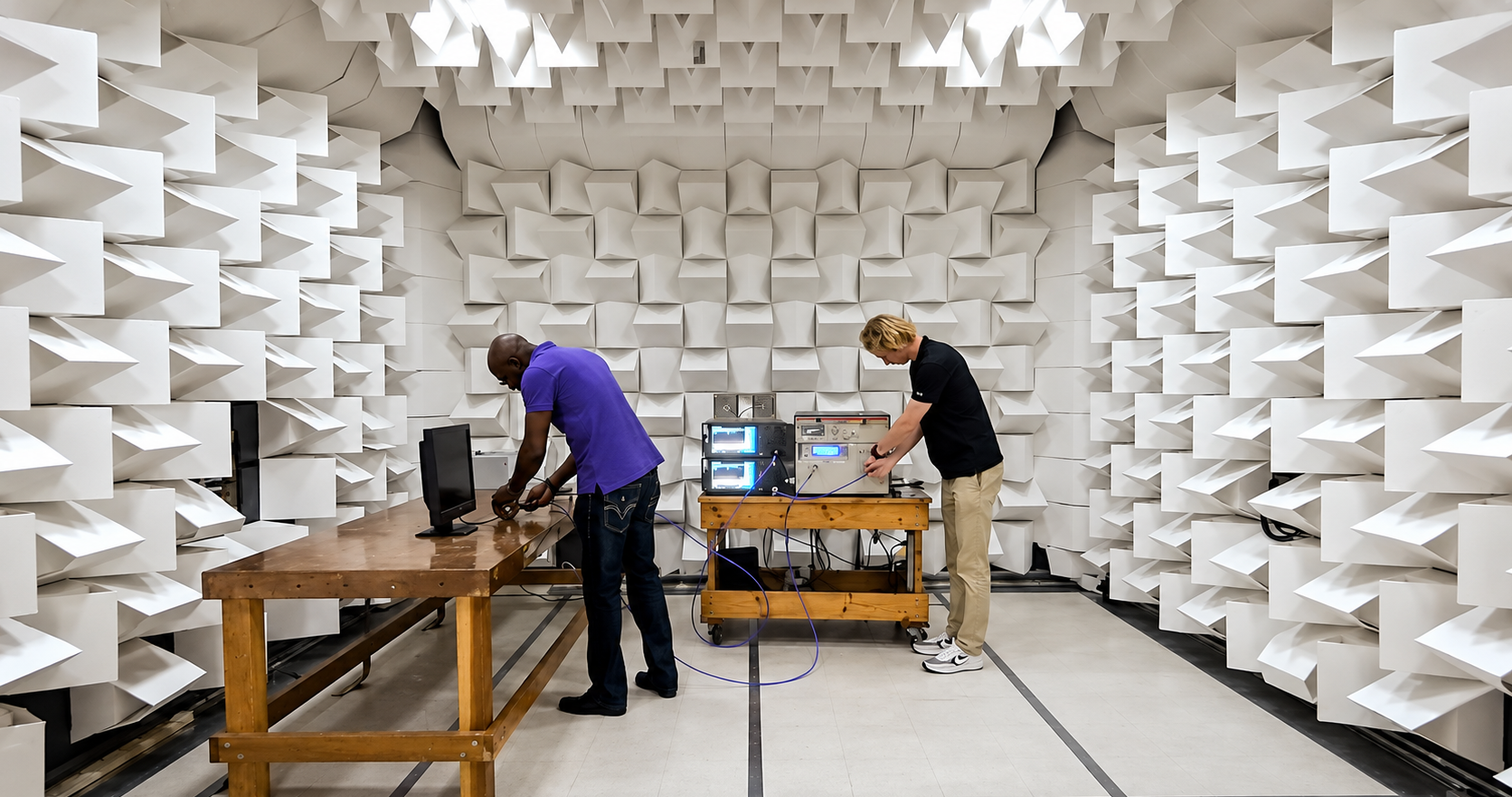
The United States has moved to bar Chinese laboratories from testing electronic devices intended for the American market, escalating its technology restrictions on Beijing weeks before US President Donald Trump is expected to meet Chinese President Xi Jinping at the Asia-Pacific Economic Cooperation (APEC) summit in the southern Chinese city of Shenzhen.
The US Federal Communications Commission (FCC), which regulates communications equipment, voted on Thursday (October 29) to prohibit testing laboratories and certification bodies based in China and other economies that lack a mutual recognition agreement, under which countries accept each other’s product testing, or a reciprocal trade agreement with Washington.
The decision could have far-reaching implications for global manufacturers, as more than 80 per cent of electronic devices bound for the US are tested at facilities in China, according to the FCC. Labs in the US tested fewer than four per cent. The FCC also streamlined approvals for devices tested in American labs or in countries it does not consider national security risks.
FCC chairman Brendan Carr said the move was part of the Trump administration’s effort to reshape America’s economic and trade relationships.
“This is consistent with President Trump’s broader effort to restore balance and fairness with respect to America's dealings with foreign nations,” Carr said. “We are only allowing test labs to be based in the US or in reciprocal economies.”
The restrictions take effect in December 2028, giving American laboratories more than two years to expand capacity and prepare for additional demand. The FCC has retained the authority to remove other foreign laboratories from its approved system before then.
The decision builds on rules introduced last year targeting laboratories owned or controlled by entities deemed national security threats, which cost 32 testing facilities their FCC recognition.
Asked about the transition period, Carr stressed that the agency would keep scrutinising foreign testing facilities. The two-year window did not mean the FCC “would look the other way over the next two years,” he said.
“There’s a reason why those 32 were identified and moved out of the system,” Carr said. “If there are others like the 32, or similar to 32, then they will similarly be moved out of the system before these new reciprocity rules take place.”
Carr argued that laboratories in China could exploit their role in the certification process to introduce security vulnerabilities into products entering the American market. He alleged they could use their “privileged position” to allow “insecure gear into the US market, disrupt communications networks or even steal intellectual property.”
“Some of those labs themselves were linked or controlled by or tied to the PLA [People’s Liberation Army, China’s military], so not necessarily the most trustworthy," Carr had told TBPN, a technology-focused online network, in August.
Announcing Thursday’s decision, Carr said: “Today, we go a step further and restore reciprocity to the FCC’s equipment authorisation programme.”
Immediately after the development, Beijing criticised the plan. After the FCC first proposed it in April, Chinese foreign ministry spokeswoman Mao Ning said China firmly opposed the US “overstretching the concept of national security.”
FCC commissioner Anna Gomez backed the two-year implementation period, calling it a “good, responsible, balanced deadline.” She said the agency needed to address national security concerns without imposing excessive costs on manufacturers or restricting consumer access to electronic products.
“I think it’s important that we act. But we also need to balance that with ensuring that we don't have such huge costs and that consumers can't get access to their devices.”
Wider US technology crackdown
The FCC has become one of the Trump administration’s most active agencies in restricting Chinese technology, even as other departments, including the US Commerce and Treasury departments, have taken a more restrained approach.
Under Carr, the regulator has pursued a two-pronged strategy: targeting individual Chinese companies while expanding restrictions across entire product categories and tightening controls over technology supply chains.
On October 22, the agency blocked two devices, a dashboard camera and a wireless video transmitter, that contain chips made by HiSilicon, a subsidiary of Chinese telecommunications giant Huawei Technologies. It was the first time the FCC had used new rules covering components made by companies on its national security list. The FCC argued the products were “designed for the surveillance market.”
In July, it announced restrictions on new foreign-made robots and power inverters, citing national security threats and supply chain vulnerabilities. The curbs apply to all foreign producers but are seen as aimed mainly at China. In its notice on robotics, the FCC warned: “The networked capabilities of advanced robotic systems create extensive vulnerabilities and vectors for attacks that can manipulate the data and physical operation of the advanced robotic system.”
The agency has also targeted China’s telecommunications sector. On April 30, it advanced a proposal to stop three major Chinese state-owned operators, China Mobile, China Telecom and China Unicom, from running data centres in the US. Further restrictions on new models of consumer routers followed in May. In October 2025, it also sought to prevent Hong Kong-based carrier HKT International, a subsidiary of PCCW and an affiliate of China Unicom, from operating in the country.
Carr has defended the restrictions by arguing that “CCP [Chinese Communist Party]-controlled entities that pose national security risks to our country cannot connect to our telecom networks.”
The measures follow a broader crackdown launched in December 2025, when the FCC expanded import restrictions across several sectors, including a sweeping ban on new foreign-made drones that hit China’s DJI, the world’s largest drone maker.
Beijing-Washington technology tensions
China, too, has begun responding to Washington's restrictions. In August, Beijing tightened export controls on drones and related technologies bound for the US, imposed sanctions on US testing companies, including Arizona-based Compliance Testing LLC, which it accused of helping the FCC, and launched its first national security investigation linked to foreign trade, into imported office printers and copiers.
The latest FCC decision adds another front to the tit-for-tat technology measures, which come on top of an already crowded field of tariffs, export controls and blacklistings of each other's companies.