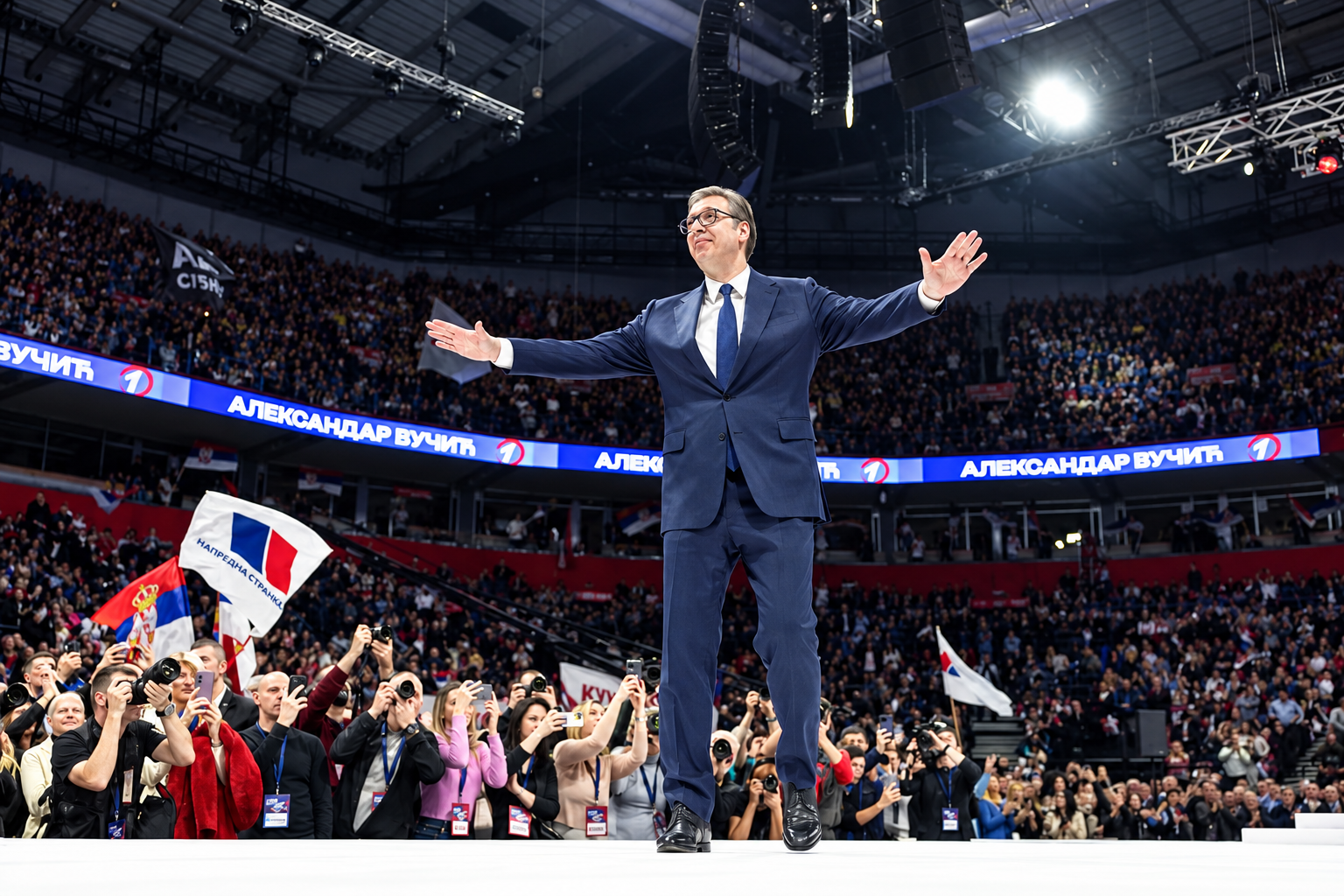
Serbia votes on Sunday (October 25) in a snap parliamentary election that will show whether a protest movement started by university students can defeat Aleksandar Vucic at the ballot box. Vucic resigned as president last month to lead his ruling coalition’s list and run for prime minister, staking his political future on a result that opinion polls cannot call.
The election will fill all 250 seats of the National Assembly. If neither side wins a majority of 126, minority and smaller parties could prove decisive. The outcome will also shape Serbia’s balance between Russia and the European Union, with decisions on Russian gas, a sanctioned oil company and arms exports awaiting the incoming cabinet.
Canopy collapse became a political crisis
The vote traces back to November 1, 2024, when a concrete canopy at the Novi Sad railway station collapsed, killing 16 people. Protesters blamed the disaster on alleged corruption and failures of government oversight, and the anger did not fade. Students and lecturers held a vigil at Belgrade’s Faculty of Dramatic Arts on November 22, 2024, and blocked traffic. A clash with drivers gave the movement fresh momentum. Online photographs later identified some of the motorists as officials of Vucic’s Serbian Progressive Party (SNS).
Students then began blockading university faculties. They demanded the release of documents on the station’s renovation, accountability for attacks on protesters, an end to the prosecution of detained demonstrators and more funding for public universities. The authorities said they had met the demands, a claim the protesters disputed. Under pressure, Prime Minister Milos Vucevic resigned in January 2025 after another attack on students, but the protests continued.
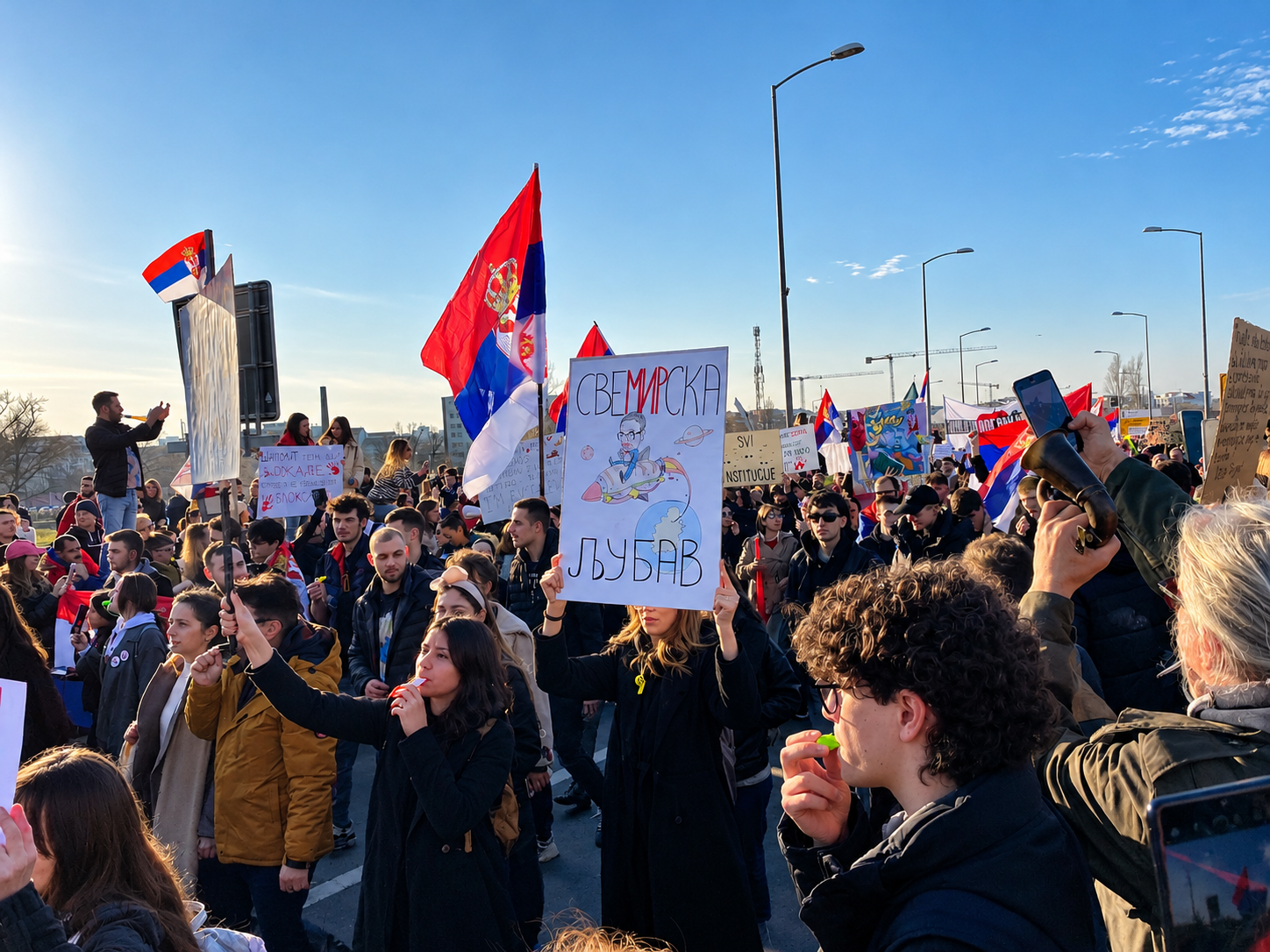
A rally in Belgrade on March 15, 2025, drew an estimated 275,000 to 325,000 people, according to the monitoring group Arhiv javnih skupova. Parliament elected a new government under Djuro Macut in April, yet the students kept demanding early elections. Vucic dissolved parliament in September, more than a year ahead of schedule; the regular vote would have been held in late 2027. As the campaign began, the movement shifted from mass rallies to door-to-door canvassing. Student List activists reported visiting 170,000 households in 20 days.
Presidency to the prime minister’s race
Vucic resigned as president on September 27; he was barred from seeking a third presidential term. Analysts read the move as an attempt to carry his political strength into parliament, where he would keep executive power if he wins. He now leads the “Aleksandar Vucic – United Serbia” list, built around the SNS and presented as its prime-minister candidate. The Socialist Party of Serbia, led by Ivica Dacic and a longstanding SNS partner, is running separately under the “Factor of Stability” banner.
Vucic accuses foreign organisations and intelligence services of financing the protests and says outside actors want to remove him from power. He has also accused Western governments of wanting to install politicians who would follow their instructions. The protesters present their movement as a home-grown response to the Novi Sad disaster and to what they describe as corruption in public life. Their campaign slogan is “Serbia or Mafia.”
Students, established opposition and the right
The main challenger is the “Student List – Students Are Winning”, which emerged from the protests and includes lecturers, professionals and public figures. The movement has refused to build a conventional party structure. Analysts describe its list as ideologically diverse, united mainly by opposition to the government and a campaign against corruption. Several opposition parties, including the Democratic Party once led by former President Boris Tadic, back the students.
Others are also in the race but they are running alone. Marinika Tepic and Zdravko Ponos head “European Serbia”, which favours aligning with EU foreign policy. Milos Jovanovic leads “Authentic Right”, which opposes both EU membership and sanctions on Moscow. National minority lists are also on the ballot. This is the first national contest since the protests began, and it will test whether street power converts into votes.
Tight race and conflicting polls
The polls paint a muddled picture, and the gaps seem to track when and how each survey was conducted. Ipsos, published October 22 and covering 3,624 respondents between October 20 and 22, put Vucic’s coalition at 47.4 per cent, the Student List at 40 per cent and Dacic’s Socialists at 3.2 per cent. A telephone survey by the political magazine Nova srpska politicka misao, published October 20, with 1,050 respondents interviewed between September 25 and October 5, showed the opposite order among decided voters: the Student List at 44.5 per cent and Vucic's coalition at 42.7 per cent. An online survey for Nacija TV, published October 21, found an almost even race at 42.9 and 42 per cent. An earlier Faktor Plus survey in September had Vucic's coalition at 48.6 per cent and the Student List at 37.1 per cent.
Analysts say undecided voters, whom Serbian commentators call “neutrals”, could decide the outcome. A narrow result would put a premium on the smaller lists, whose seats could determine who can assemble a majority.
The final days
The campaign has been tense. Thousands lined Belgrade’s streets on Wednesday to greet students who had marched into the capital, with the marches aiming to reach rural areas that are Vucic’s traditional strongholds. At a Student List rally, Jugoslav Gasic told the crowd: “We are putting an end to 14 years of humiliation, chaos and betrayal.” Vucic, for his part, vowed at a rally: “There will be no more politics in schools and at faculties.” A few hours before resigning, he told CNN that if the opposition won, he would acknowledge the result and congratulate his opponents that same evening.
AP reported that the close race fuels fears of incidents if both sides declare victory after polls close. It also cited a report noting more than 100 violent incidents during the campaign. Vucic told state broadcaster RTS that foreign powers and unidentified people in Serbia plan to stir unrest on election night. Al Jazeera quoted analyst Stamenkovic as saying, “There is every reason to expect election day itself to be highly contentious.”
Where the parties stand on the EU, NATO and Russia
The groups challenging Vucic are split on foreign policy. The Student List has said it would keep Serbia's refusal to sanction Moscow. Its representative Jovo Bakic has proposed a referendum on EU membership and opposed joining NATO. “European Serbia” backs sanctions on Russia, a position advocated by Tepic. Jovanovic opposes EU membership and sanctions, while Socialist representative Snezana Paunovic backs accession but criticises the bloc's current policies.
Vucic says Serbia wants EU membership while preserving an independent foreign policy. In an interview with the Russian journalist Ksenia Sobchak, he said European leaders regularly press him on sanctions: “We are not sitting on two chairs; our only chair is Serbia.” He has also said he would not allow Serbia to be drawn into a war with Russia, which he believes the EU is preparing for.
On Kosovo, which declared independence in 2008, Belgrade still regards the territory as part of Serbia, as do Russia, China and some 90 other countries. SNS-led governments refuse recognition while taking part in EU-mediated talks with Pristina, and the Student List also rejects it. A May memorandum from the list called Kosovo an integral part of Serbia and urged a negotiated settlement within the Serbian Constitution and international law. On Republika Srpska, former president Milorad Dodik has urged Serbian citizens living there to vote for Vucic's coalition, while the students have sought support there without a detailed policy.
Brussels and the stalled accession path
Serbia applied to join the EU in 2009 and became a candidate in 2012. Talks began in 2014, but no new negotiating chapters or clusters have opened since 2021. Brussels ties further progress to normalising relations with Kosovo, aligning with EU foreign policy including sanctions on Russia, and judicial and media reforms. In July, eight member states opposed advancing talks with Belgrade, even as Montenegro, Albania, Ukraine and Moldova made progress.
EU Enlargement Commissioner Marta Kos said in September that Serbia was at a crossroads and that further progress depended on its voters' choice. She warned against letting prospective members become dependent on outside powers that run counter to the bloc's interests and named Russia an adversary in the enlargement process.
Why Russia is watching
Serbia and Russia share historical and cultural ties built on Orthodox Christian and Slavic heritage and deepened by NATO’s 78-day bombing of Yugoslavia in 1999, which Moscow strongly opposed. Russia has backed Belgrade on Kosovo at the UN Security Council. Under Vucic, Serbia has maintained economic and diplomatic cooperation with Moscow, has not joined Western sanctions over Ukraine, and has kept relations with Kyiv while supporting Ukraine's territorial integrity.
Energy is central. Gazprom extended Serbia’s gas deal on September 30 for three months, to December 31, on unchanged terms, according to Srbijagas chief executive Dusan Bajatovic. The previous three-year contract expired in May 2025. After talks with President Vladimir Putin in September, Vucic said Serbia pays about $343 per 1,000 cubic metres, against a market price of roughly $936. Arrangements for 2027 are unresolved.
The future of NIS, which runs Serbia’s only oil refinery, is also uncertain after US sanctions over its Russian majority ownership. Hungary's MOL has been negotiating to buy the Russian stake. On arms, Vucic has said he would not object if Serbian ammunition sold to European buyers ended up in Ukraine, though he has not confirmed direct deliveries to Kyiv. Russian observers will monitor the vote at Serbia's invitation, according to Foreign Ministry spokeswoman Maria Zakharova, and Moscow says it hopes to keep close ties after the election.
What happens next?
Polling stations open on Sunday. With the polls split, the first projections and the count for the smaller lists will matter as much as the headline numbers. If one side clears 126 seats, the path to a government is straightforward. If neither does, Serbia could face weeks of coalition talks in which minority parties and smaller lists hold the balance. Whoever governs will have to decide quickly on gas beyond December, the fate of NIS and the direction of Serbia's long-stalled EU bid.