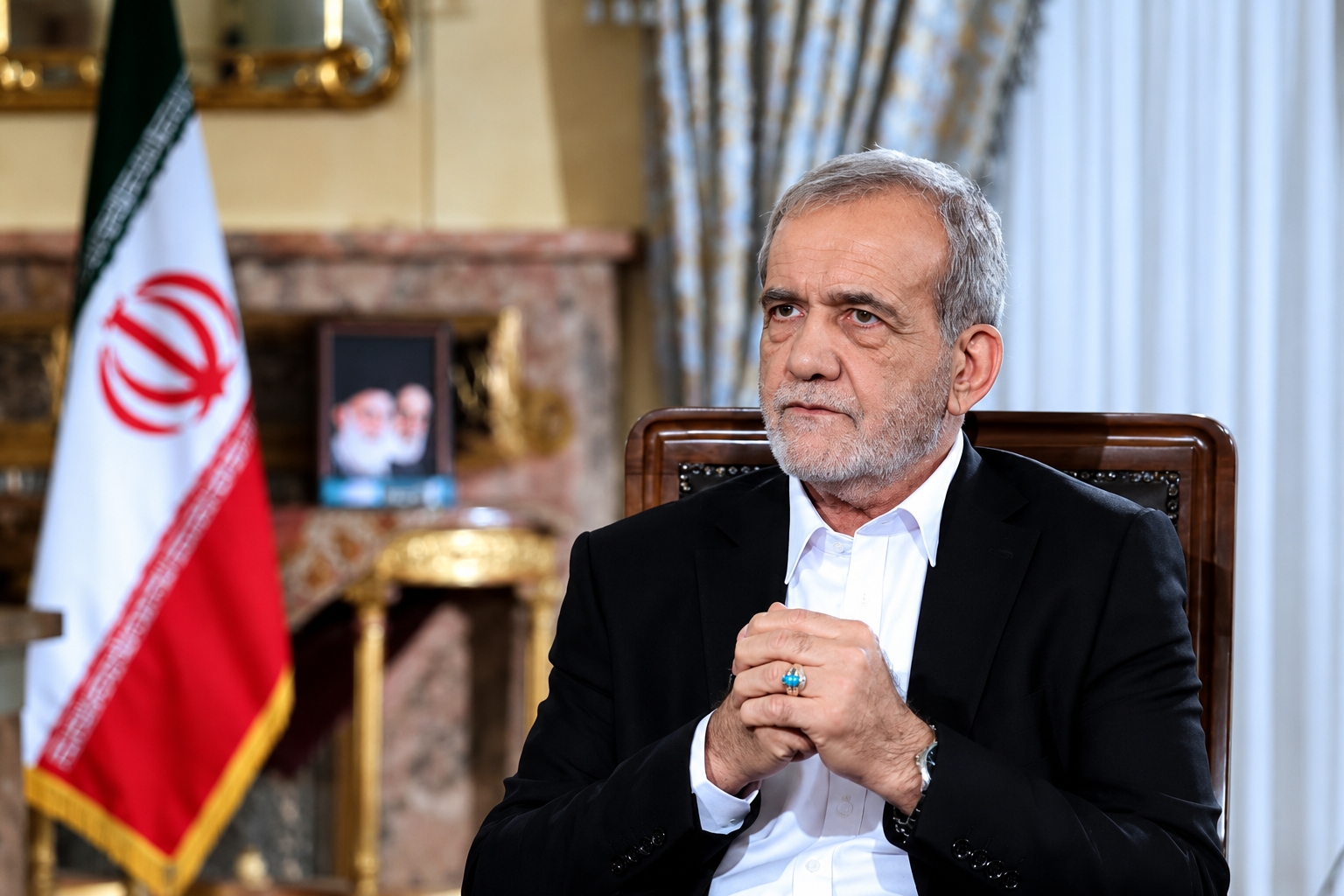
Iran’s president has acknowledged that the war with the United States and Israel is leaving many citizens unable to feed themselves, and has called on the leadership to find a way out of the stalemate.
Masoud Pezeshkian said in a speech posted on his website on Saturday (October 24) that many Iranians were “struggling to put food on the table” because of wartime conditions. He urged an end to what he called a “state of neither war nor peace”, saying Tehran must extricate itself, though he did not say how.
“There are many people in this society who are struggling to put food on the table because of the war we have found ourselves in, because of the wartime conditions we are living under,” Pezeshkian said.
Such candour is unusual from a government that has long projected defiance. It is as close as Tehran has come to conceding that open-ended confrontation carries a cost its citizens can no longer absorb.
Speaking under threat
The remarks come at a perilous moment. US ambassador to Turkey Tom Barrack said on Friday that American strikes could resume as early as this weekend, and the US and Israel have reportedly drawn up plans for new attacks.
Tehran, for its part, is signalling that it would hit back at the world’s digital arteries. Two senior Iranian security officials told Reuters that Iran has drawn up detailed plans to target undersea communications cables in the Gulf if war resumes. “There will be no more red lines,” one said. An IRGC commander named seven major cables beneath the Strait of Hormuz as potential targets, and Iran would also seek to block repairs to prolong outages.
No attack has been reported. Analysts read the threats as deterrence, designed to make Gulf governments and US technology firms press Washington to hold back. Undersea cables carry about 99 per cent of global internet traffic, though the Gulf accounts for under 1 per cent of global bandwidth, and land routes offer some alternatives.
A war that has changed shape
The conflict began on February 28, when the US and Israel attacked Iran, killing the supreme leader, Ayatollah Ali Khamenei, and senior commanders. Washington has since dialled back military operations in favour of economic pressure. A blockade of Iranian ports has cut off oil exports and trade, while Iran has restricted shipping through Hormuz, a vital route for global energy.
Prices and pain
The human cost has been building for months. Official figures cited by Al Jazeera showed food inflation at 115 per cent year on year. Earlier strikes on steel, petrochemical and energy sites triggered closures and job losses, according to AP.
Pezeshkian’s tone has hardened and softened by turns. In August, he conceded that Iranians faced “many problems” after Washington announced a sanctions campaign aimed at the regime’s “collapse”. In September, he accused the US of depriving civilians of food and medicine while vowing not to surrender.
Parliament Speaker Mohammad Bagher Qalibaf has warned that military strength alone cannot sustain a hungry country with a failing economy.
Diplomacy and its limits
On Saturday, Pezeshkian also blamed Washington for the collapse of an interim deal, saying “the cowards” had “messed everything up”. Yet, he added that Iran should return to the table and conclude an agreement.
That mix of grievance and pragmatism captures Tehran’s bind. Hardline politicians and media linked to the Revolutionary Guards have framed soaring prices as “economic revenge” by Iran’s enemies, casting hardship as proof of resistance rather than a reason to compromise.
The president also has limited room to manoeuvre. He apologised in February for the crackdown on the 2025-26 protests, which began over the cost of living. Hunger and unemployment are the conditions that fuelled that unrest, and they threaten to do so again.
Why it matters beyond Iran
Pezeshkian’s words can’t be read as a capitulation. He has renounced nothing and offered no concessions. But when a leader says his people cannot afford to eat, and that the country must escape its own limbo, even as his security establishment threatens the world’s data infrastructure, it suggests Tehran increasingly recognises that endless stalemate is a strategy with a shelf life.