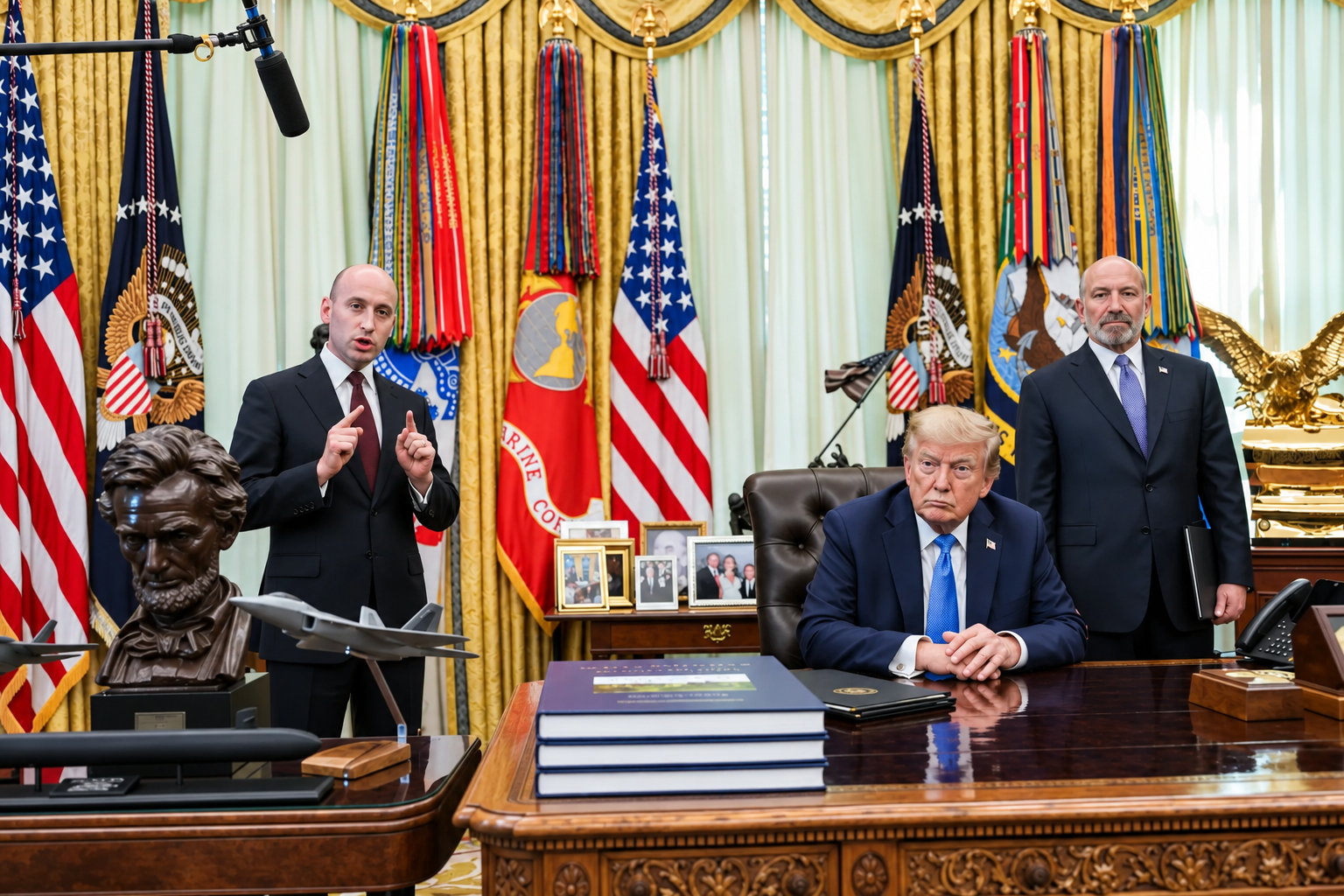
The Republican Party’s crushing defeat in the November 3 midterms makes little difference to Donald Trump, at least for now. He doubled down on his anti-immigration agenda on Friday (November 6) by appointing immigration hawk Stephen Miller as White House Chief of Staff. Miller is the principal architect of the mass deportation campaign that has defined Trump’s second term, and 57 per cent of voters in the exit poll said the administration’s enforcement had gone too far.
Trump announced the move on Truth Social. Miller, currently deputy chief of staff for policy and homeland security adviser, takes over on Monday, November 9. Susie Wiles, whom he replaces, will move to the Trump Political Operation, the president wrote. Wiles was the longest-serving chief of staff of Trump’s presidencies. Trump called Miller “one of my most trusted advisors.” Asked why, he told reporters he “wanted to make a change.” Miller said on X that serving Trump had been “the privilege of my lifetime.”
The timing is stark. Trump revealed the shake-up three days after Democrats won majority control of both the House and Senate. Voters also elected Democrats to every House seat along the US border with Mexico. After the midterms, it was speculated that Trump would soften his immigration stance, including scaling down highly disputed operations by U.S. Immigration and Customs Enforcement (ICE). However, Trump sent opposite signals with his latest high-level appointment.
Cheers from the right, alarm from the left
Reaction split along familiar lines. Vice President J.D. Vance and other immigration hawks applauded the decision. Vance called Miller “an amazing patriot” and congratulated him on a well-deserved promotion. Jeremy Carl of the Claremont Institute said Miller would make sure the policies Trump campaigned on in 2024 are actually carried out. Mark Krikorian, head of the pro-enforcement Center for Immigration Studies, offered a more cautious view. He said Miller’s presence neither rules out nor guarantees a slowdown in enforcement. He noted that Miller has spent a decade managing the GOP’s internal tensions on immigration.
Trump critics saw the President’s contempt for public sentiment. Sarah Pierce, a former Department of Homeland Security official now at the centre-left think tank Third Way, said voters rejected the present immigration approach, and Trump responded by naming his “most extreme adviser” as chief of staff. Political scientist Stephen Farnsworth of the University of Maryland, Washington, DC area, told Newsweek the pick showed Trump has “zero interest in compromising with the new Democratic majorities.”
Democratic leaders were harsher. House Democratic Leader Hakeem Jeffries called Miller a “dangerous xenophobe.” Senate Minority Leader Chuck Schumer said Trump had learned nothing from his defeat and that Democrats would fight him at every turn. House Homeland Security Committee Democrats called him a “vile, hate-filled extremist.” Rep. Robert Garcia, the incoming chair of the House Oversight Committee, said Democrats would keep investigating Miller and that he “should lawyer up.”
Dissent also exists within the Republican Party. Representative Don Bacon blamed Miller’s approach to immigration for costing Republicans the midterms. Senator Thom Tillis, who is retiring, earlier this year mocked Miller’s “expectations of incompetence.” Former North Carolina Senator Lindsey Graham, who was a war hawk and died in July this year, used to tell his Republican colleagues that Trump would never drop Miller.
Who is Stephen Miller
Miller, 41, began as a conservative activist in his Santa Monica school days and led the Duke Conservative Union at Duke University. In 2009, he joined the staff of Alabama Senator Jeff Sessions, where he worked on immigration policy and helped defeat the 2013 bipartisan immigration bill. He joined Trump’s first presidential campaign in January 2016. Steve Bannon once said Miller helped Trump find his voice.
In Trump’s first term, Miller is credited with shaping the 2017 travel ban on several Muslim-majority countries. He is also credited with the 2018 “Zero Tolerance” policy that led to widespread family separations. The Southern Poverty Law Center published emails in 2019 that it said showed him backing white nationalist sites and ideas. He founded the conservative legal group America First Legal in 2021.
Back in office from 2025, he has helped orchestrate the mass deportation drive, increasingly targeting people with no or only minor criminal records. He set a goal of at least 3,000 ICE arrests a day. He has also said the administration was looking into suspending habeas corpus. His attempt to end birthright citizenship has so far been unsuccessful. His worldview is blunt. On the use of American power abroad, he said the world is “governed by strength, … by force, … by power.”
A society on edge
The immigration crackdown by ICE has reshaped daily life well beyond the immigrant communities it targets. Its starkest episode was in Minneapolis. Operation Metro Surge ran from December 2025 to February 2026 and led to more than 3,000 arrests. Federal agents fatally shot two US citizens, Alex Pretti and Renee Good. Pretti was an ICU nurse at a veterans’ hospital. His death was later ruled a homicide. Videos contradict the administration’s account of the deaths. Miller initially called both victims “terrorists” and later walked back the statement about Pretti.
The killings set off protests across the country, including the January 30 “National Shutdown.” A federal judge found ICE had violated at least 96 court orders in Minnesota in a single month. The operation also brought a surge of wrongful-detention lawsuits and the detention of US citizens. Federal immigration officers shot 14 people between September 2025 and February 2026. At least 32 deaths were reported in ICE custody in 2025, and at least six more in the first weeks of 2026.
Civil-liberties groups say the tactics have chilled civic life. Wendy Weiser of the Brennan Center said that in the run-up to the vote, the methods “appear to be designed to try to intimidate voters.” She added that turnout surged in the communities targeted. Pollster Matt Barreto called ICE overreach “an important sub-theme of this election.” His survey found 7 in 10 voters want a ban on masks for ICE agents, body cameras and limits on use of force. A UnidosUS poll found 17 per cent of Hispanics who backed Trump in 2024 voted Democratic this year. Mexican President Claudia Sheinbaum said it was “very likely” the raids cost Trump Latino support.
The politics are less one-sided than the headlines suggest. Only 14 per cent named immigration as the most important issue, far behind the economy and democracy. Republicans kept a small edge on handling immigration. Among voters who wanted tougher enforcement, 91 per cent voted Republican. Miller’s crackdowns have been popular with Trump’s core voters, and ICE says its agents uphold the nation’s immigration laws.
What comes next
Democrats take control of Congress in January. They cannot block Miller, since the chief of staff’s post needs no Senate confirmation. Their leverage lies in oversight hearings, subpoenas and the power of the purse, including over the $240 billion appropriated to ICE. Bills to strip qualified immunity from immigration agents are already before Congress and the new majority could revive them. The post is often called the gatekeeper to the presidency because it largely controls the flow of information to the president. Putting Miller there suggests the next two years will bring more confrontation over immigration, not less.