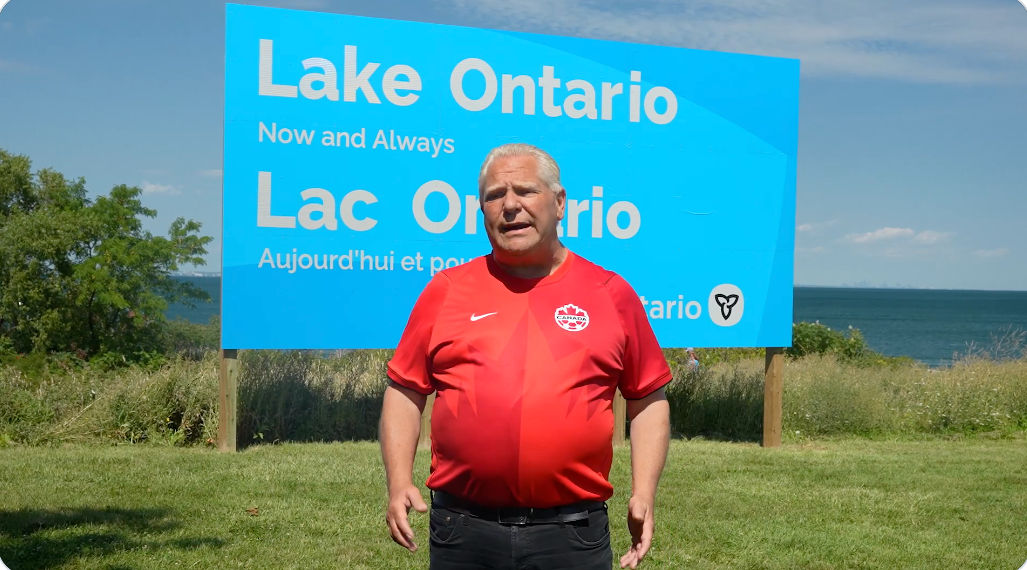
Canada has hit back after President Donald Trump renamed Lake Ontario as “Lake America”, with Ontario Premier Doug Ford unveiling a rival lakeside sign and Prime Minister Mark Carney imposing fresh retaliatory tariffs, deepening a trade war that has already cost billions in lost trade and tourism.
Drowned in lake
The order, signed on August 27, directed the Board on Geographic Names to make the change official across federal maps, contracts and paperwork, with Trump calling the lake “a tremendous asset” and part of America’s heritage. Google Maps complied within days with users in the U.S. now seeing “Lake America”, while Canadian users still see “Lake Ontario”, and in other places both names could be seen. Canadians barely budged as Carney noted that the name is more than 400 years old, predating both Canadian Confederation and American independence, and derives from a Wendat word meaning “the lake is beautiful, the lake is big”.
The mockery spread fast. MapQuest, an American company, mocked the change outright, building a tool that lets users invent their own names for the lake instead. Ford went further by sporting a Team Canada soccer jersey by unveiling a bilingual name sign near Grimsby, reading “Lake Ontario – Now and Always”. Trump, well-known for his escalating even the minutest matter, soon posted an AI video of himself kicking down a digital version of Ford’s sign, erecting his own “Lake America” placard, and dancing to the song YMCA. Canada’s Manitoba Premier Wab Kinew compared the whole spectacle to an ageing rock band doing a casino residency, playing the hits nobody asked for anymore.
Trading tariffs
The lake spat is the latest chapter in a trade war that began on February 1, 2025, when Trump imposed 25 per cent tariffs on most Canadian goods and 10 per cent on energy, citing border security and fentanyl concerns. Canada retaliated within days by imposing tariffs on $30 billion worth of U.S. goods, a figure that grew to $155 billion within three weeks. Tariffs on goods not covered by the US-Mexico-Canada trade deal took effect on March 4, with Canadian countermeasures landing the same day. Through 2025 and into 2026, the fight widened to steel, aluminium, autos, lumber and furniture, with Canada matching much of it via new tariff-rate quotas and levies on steel derivatives.
In early 2026, the U.S. Supreme Court struck down several of Trump’s emergency tariffs imposed under the International Emergency Economic Powers Act, 1977, a U.S. law that gives the President broad authority to regulate international commerce after declaring a national emergency related to a foreign threat. This verdict forced a partial reset: a flat 10 per cent global tariff replaced the earlier 35 per cent rate that had applied specifically to Canadian non-USMCA goods, starting February 24. However, sector-specific tariffs on steel, aluminium, copper and lumber stayed in place.
Tensions flared again this August. On August 22, the U.S. imposed 50 per cent tariffs on close to $20 billion of Canadian goods – dairy, electronics, furniture, building materials, clothing, toys, industrial machinery – after trade talks collapsed. Carney answered three days later with retaliatory tariffs on roughly C$27.6 billion (about US$19.94 billion) of American goods across nearly 700 categories, rates from 15 per cent to 50 per cent, effective September 8; doubling Canada’s own steel and aluminium tariffs to 50 per cent in the process. “Canada will match Washington’s new tariffs dollar for dollar,” Carney stated.
Canadian boycott
Ordinary Canadians opened their own front early on with a consumer boycott of American goods known as “Elbows Up”, borrowed from hockey legend Gordie Howe’s move to ward off opponents. Canadian provinces pulled American wine and spirits from liquor store shelves. British Columbia, Ontario and others removed millions of dollars’ worth of liquor within weeks. Jack Daniel’s vanished from shelves entirely. Canadian grocery chain Loblaws began marking Canadian products with maple leaf stickers, and apps like “Maple Scan” let shoppers screen out U.S. products by scanning barcodes.
The numbers showed increasing support for the boycott. By February 2025, roughly three in five Canadians said they intended to boycott American goods; by mid-2025, that had climbed to 71 per cent. Canadian tourism to the U.S. dropped sharply too – the U.S. Travel Association estimated a $5.7 billion loss in 2025 international tourism spending, driven largely by the Canadian boycott. Historically, Canadians are the largest group of foreign visitors to the U.S. The boycott had been losing steam by mid-2026, but August’s tariff escalation revived it, and retailers reported renewed customer demand for Canadian-only shelves.
Where it stands now
Eighteen months in, steel and aluminium continue to face tariffs upwards of 50 per cent on both sides, hundreds of product categories caught in the crossfire, billions in lost tourism revenue, a boycott that flares with every new tariff, and now competing names for a lake that predates either country's government. Canada’s latest tariffs take effect on September 8. Whatever comes next will be interesting, as Canadian leaders have not looked intimidated by Trump’s attacks so far. Instead, they are turning it into a global show of defiance and flair they have not displayed much earlier.