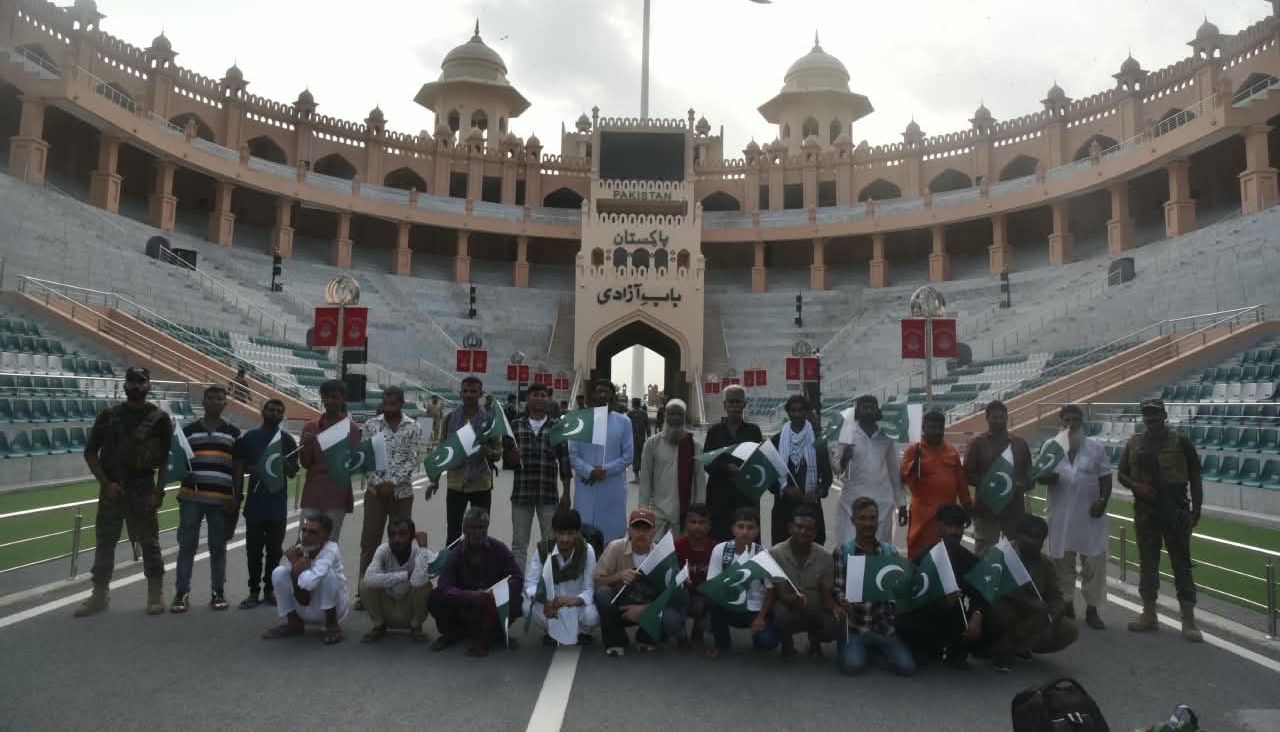
Twenty-five Pakistani fishermen crossed back into Pakistan through the Wagah-Attari border on Saturday (August 29), released from Indian custody as part of a prisoner-exchange mechanism that has governed the fate of hundreds of fishermen on both sides of the Arabian Sea for nearly two decades.
The fishermen, all from Karachi and Thatta, completed immigration formalities on Saturday afternoon and were handed over to Pakistani authorities, with officials from Pakistan’s mission in India present at the border to facilitate the process, the Pakistan High Commission in New Delhi confirmed.
Confirming Saturday’s release, the Pakistan High Commission said, “The Government of Pakistan will continue its efforts for the release and repatriation of all Pakistani citizens detained in Indian jails.”
The Fishermen's Cooperative Society (FCS), representing the fishing community in Sindh, welcomed the development, saying, “The Fishermen’s Cooperative Society (FCS) extends heartfelt congratulations to the fishing community on the release of 25 Pakistani fishermen who had been imprisoned in Indian jails.” The FCS added that it hoped “the released fishermen would return to their homes and families and resume their normal lives”, and thanked government institutions for their role in securing the release. FCS spokesperson Ghulam Rasool Sheikh told Dawn that the fishermen were handed over to the Punjab Rangers once they crossed the border.
The 2008 framework behind the release
The repatriation falls under the Agreement on Consular Access, signed by Pakistan and India in 2008, which obliges both countries to exchange lists of prisoners held in each other’s custody twice a year – on January 1 and July 1. Roughly a month before Saturday’s release, the two sides carried out that exchange. Pakistan handed New Delhi a list of 250 Indian nationals in its jails, including 52 civilian prisoners and 198 fishermen, while India provided a list of 439 Pakistani or suspected-Pakistani prisoners, comprising 386 civilians and 53 fishermen.
Islamabad had specifically pressed New Delhi to release 97 Pakistani prisoners – 64 civilians and 33 fishermen – whose sentences had already lapsed and whose nationality had been confirmed. Saturday’s group of 25 fishermen represents a portion of that backlog finally being cleared.
Why fishermen keep ending up in each other’s jails
The steady traffic of fishermen through both countries’ prison systems stems largely from the unresolved Sir Creek dispute – a roughly 96-km tidal estuary between Gujarat and Sindh where the maritime boundary has never been formally agreed. Because the line separating Indian and Pakistani waters is not clearly demarcated, boats from both sides regularly drift across it while chasing catch, and are picked up by the Indian Coast Guard or Pakistan’s Maritime Security Agency, often with little warning that they had crossed at all. Once detained, fishermen are typically routed into the judicial system of both the countries. Those held in Pakistan are usually sent to Landhi or Malir jail in Karachi, and can spend years in custody even after finishing court-ordered sentences, pending nationality verification and diplomatic clearance.
A two-way problem
The practice cuts both ways. Pakistan has periodically detained Indian fishermen on the same charges, with the Pakistan Maritime Security Agency confirming arrests of Indian crews found well inside Pakistani waters near Sir Creek on more than one occasion in recent years. India has followed the same pattern with Pakistani boats straying into its waters. Large-scale releases have also occurred before on both sides. In 2023, close to 500 Indian fishermen who had been held for years in Pakistani jails on illegal-fishing charges were freed, a release credited in part to sustained cross-border advocacy by journalists and civil society groups rather than government action alone. As of the latest exchange of lists before Saturday, 198 Indian fishermen remained imprisoned in Pakistan, against 53 Pakistani fishermen still held in India – figures underlining how the backlog persists on both sides even as periodic releases chip away at it.
A rare surviving channel amid a wider freeze
The consular access agreement’s continued functioning stands out precisely because so little else between the two countries still does. India-Pakistan trade has stayed largely frozen since 2019, when New Delhi revoked Islamabad’s ‘Most Favoured Nation’ status and imposed a 200 per cent tariff on Pakistani goods after the Pulwama attack; it shut down almost entirely following the 2025 Pahalgam attack, when both sides imposed sweeping bans on shipping and cross-border commerce.
Yet even as formal trade has all but ceased and diplomatic ties remain downgraded, the biannual exchange of prisoner lists and the periodic release of fishermen through Wagah-Attari have persisted largely on schedule – evidence, observers say, that both states have found it politically tenable to keep this narrow humanitarian channel open even amidst deep hostility over Kashmir and other disputes that continue to block any resumption of trade.
Earlier this month, the Pakistan-India Peoples’ Forum for Peace and Democracy, the National Fishworkers Forum of India, the Pakistan Fisherfolk Forum and families of detained fishermen wrote jointly to the prime ministers of both countries, urging them to mark the Independence Day period by releasing all prisoners who had completed their sentences and had verified nationality, a call that appears to have fed into the momentum behind this latest batch of releases.