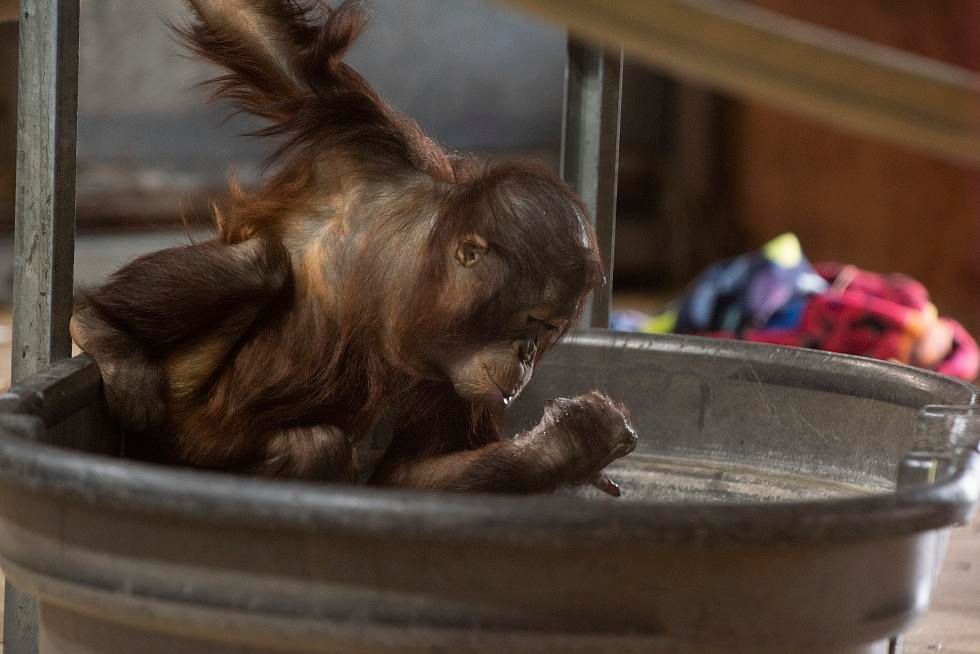
Five baby orangutans – a species with no wild population anywhere near the Indian subcontinent – have turned up in a forest in Indian province Odisha’s Balasore district, an appearance so implausible that officials have opened a trafficking investigation rather than a routine rescue file. Orangutans are great apes, among humans’ closest living relatives, and exist in the wild only in the rainforests of Indonesia’s Borneo and Sumatra. Finding five of them, unaccompanied by any adult, on India’s east coast leaves smuggling as effectively the only logical explanation.
Residents near Badapai village in the Bhograi area first spotted the animals moving through the Bichitrapur mangrove forest at around 6 a.m on Tuesday (September 8). Within an hour, word spread and thousands of onlookers gathered at the site, forcing the state forest department to intervene, secure the animals and take them to the forest office for veterinary observation. Odisha’s Principal Chief Conservator of Forests (Wildlife), Prem Kumar Jha, has since put their age at around one to two years old, and reports indicate the group comprises two females and three males, found roughly 40 kilometres from the Balasore-Kolkata stretch of NH-16.
Likely trafficked
The finding has caused a sensation because orangutans are not native to Odisha, not even to the Indian subcontinent. Only three recognised species – Bornean, Sumatran and Tapanuli – exist only in the rainforests of Borneo and Sumatra, Indonesia, thousands of kilometres from Odisha, and have no land bridge. Speaking to the media, Balasore divisional forest officer Pratik Prakash Indalkar said four of the five were healthy, eating solid food and drinking oral rehydration solution, while veterinary staff were still evaluating the fifth. They are roughly one to one-and-a-half feet tall, and their exact ages are yet to be established.
The forest department has ruled out the possibility of the animals arriving through natural migration. Investigators are examining whether the orangutans were deliberately transported and released. Odisha’s Forest and Environment Minister Ganesh Ram Singhkhuntia said the state government has referred the case to the Wildlife Crime Control Bureau (WCCB), an Indian government body, for investigation. He suggested traffickers may have abandoned the animals in the Balasore forest, which borders West Bengal, as part of a larger illegal wildlife trade operation. Wild orangutan infants normally stay with their mothers for seven to nine years, so a group with no adults nearby points strongly towards animals taken from the wild and forcibly separated; Singhkhuntia has put the black-market value of each animal at roughly Rs 20-25 lakh (roughly USD $21,005 to $26,251).
‘Must be repatriated’
The babies could be shifted to Nandan Kanan Zoo, according to Bahar Dutt, associate professor at Shiv Nadar University, Noida. Talking to NDTV, she said these juveniles could have arrived through a seaport, and their mother most likely has been killed. However, she emphasised that the Indian climate is not suitable for their survival and that they need to be repatriated immediately. Sumanth Bindhumadhav, director of Humane World for Animals India, warned against keeping these animals in “animal shelters”. “These wild animals are not for us to be rescued. Don’t confine them and pretend that they were being rescued,” he said. Forest officials have indicated the five are most likely to be shifted to Nandankanan Zoological Park in Bhubaneswar once quarantine procedures are complete.
Not the first incident
This was not the first time that an orangutan was found in India. In November 2024, forest officials in Thane district, Maharashtra, raided a rented flat in Dombivli and recovered a smuggled orangutan along with several reptiles. The animals were reportedly kept in poor conditions and likely would not have survived without the rescue. These incidents point to an established smuggling pipeline bringing orangutans into India rather than a one-off event.
Rare species
All three orangutan species are listed as Critically Endangered on the International Union for Conservation of Nature's (IUCN) Red List, driven toward extinction in the wild by habitat loss, poaching and capture for the illegal pet trade. Infant orangutans have long been targeted by traffickers to meet demand in underground exotic pet markets across Asia, making the Balasore discovery consistent with a wider, well-documented pattern of smuggling networks moving young apes far from their native forests.