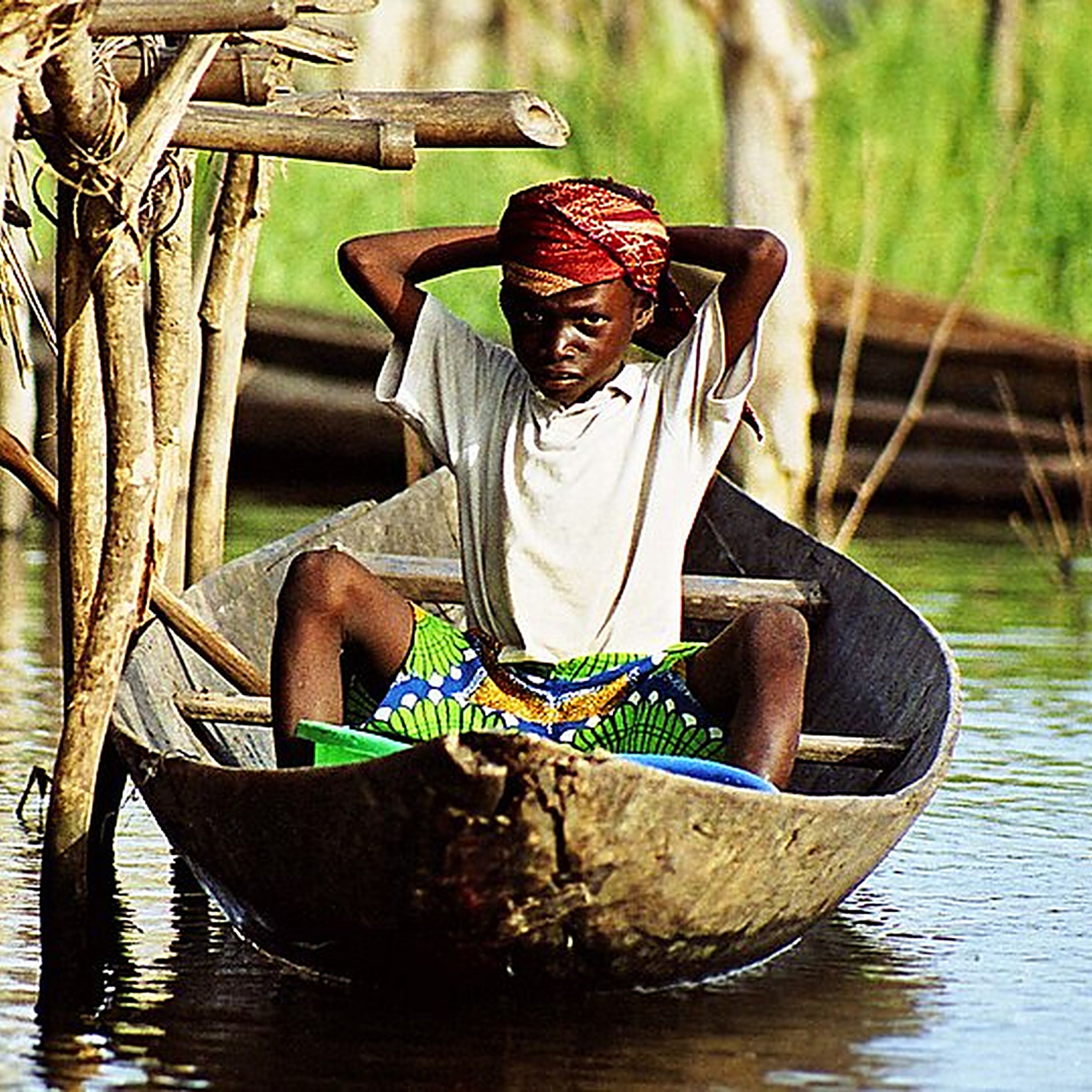
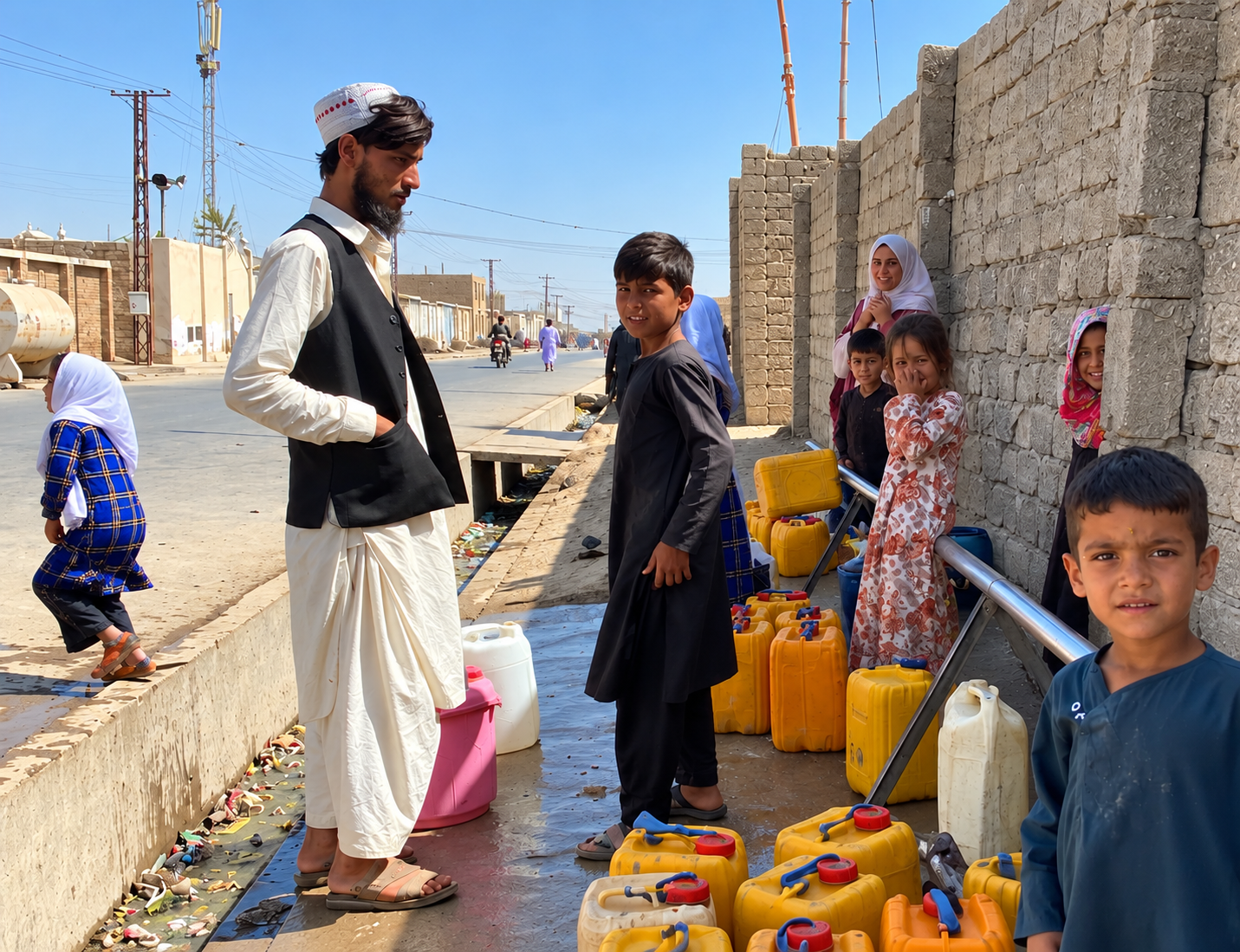
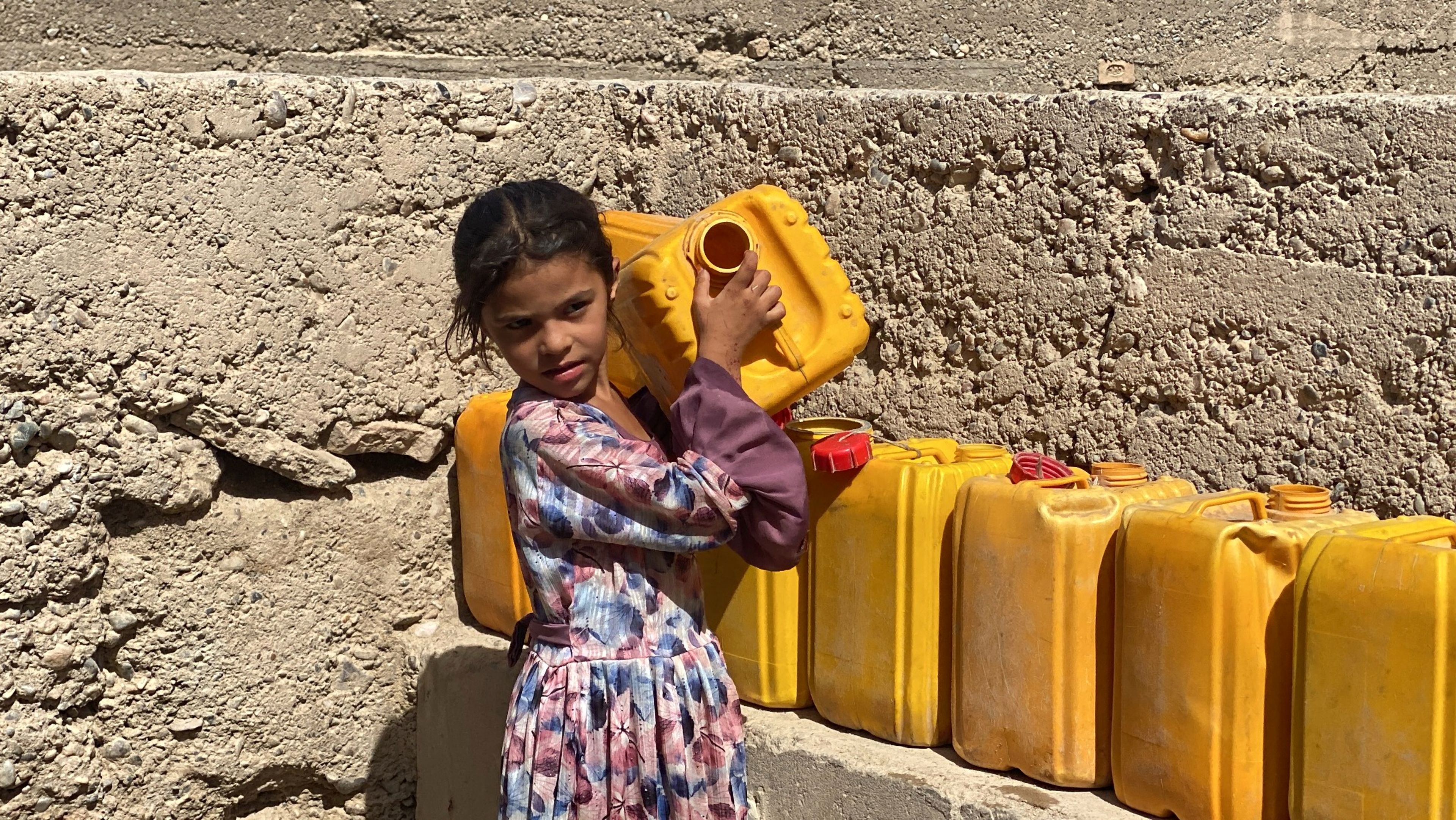
Every morning, 14-year-old Naqibullah should be going to school, joking and laughing with his friends. Instead, he walks to a distant water point with buckets and jerrycans and joins the queue to fetch water for his family. He was about 10 when the well near his home dried up. His parents took him out of class to fetch water, and his days have since shrunk to the walk, the wait and the heavy return. He says going back to school and sitting next to children his age is his greatest dream.
Naqib is shy in front of a camera and says little. His father, Noor Mohammad, tells the rest. “There is no water left in the well at our home or anywhere in our area. The children who fetch water miss school and every other part of their day and come home exhausted,” he explained. Noor Mohammad works all day to feed the family. If a water distribution network were built near their home, he says, his son would be back in a classroom.
A line of children
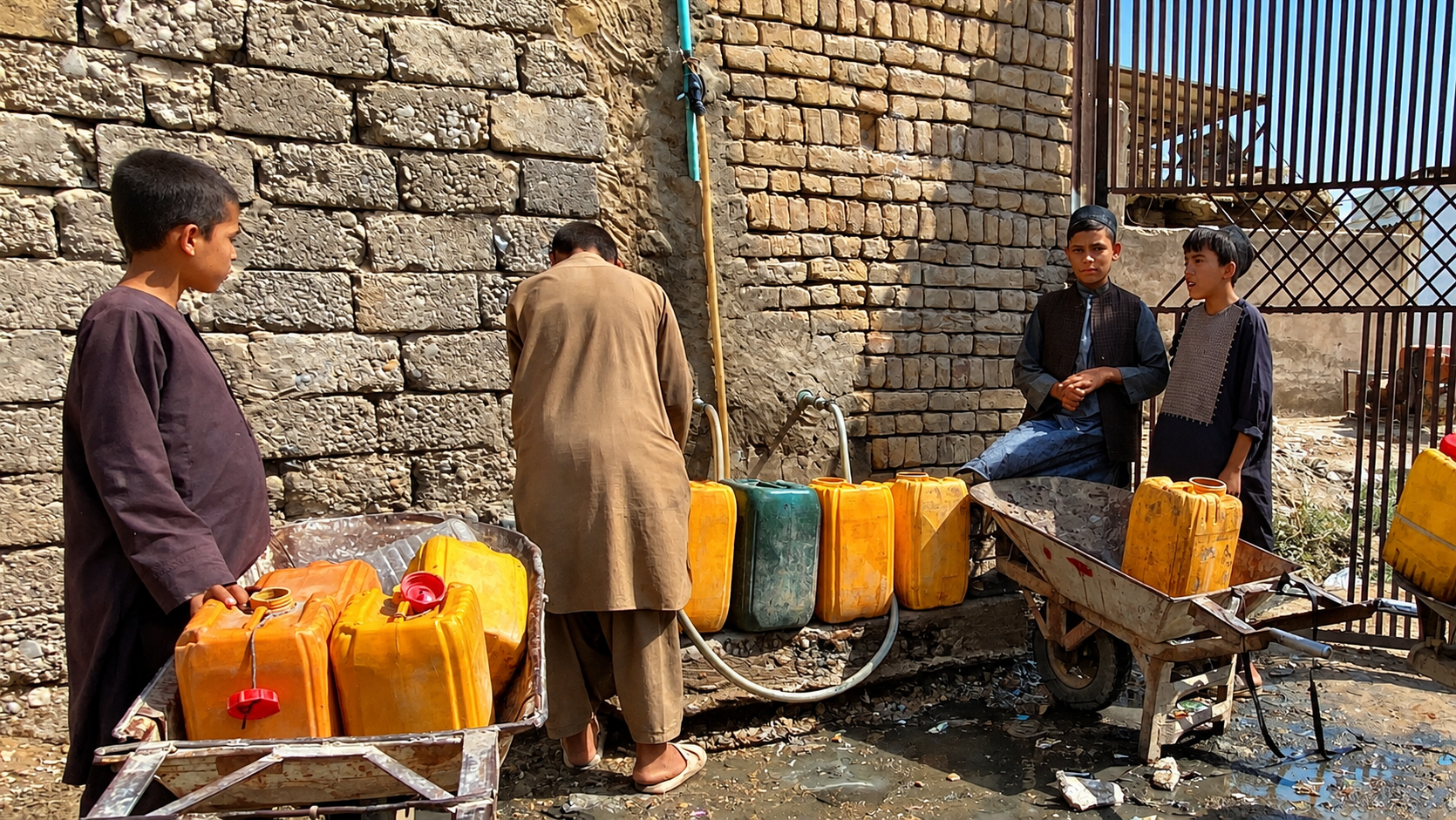
Naqibullah is not alone. A few minutes away, about 20 children, boys and girls, queue at another distribution point. Among them is 12-year-old Hamidullah, who pushes a handcart carrying about 500 litres of water home four times a day. Each round trip, waiting included, takes about 80 minutes. He has attended school for two years. “I bring water home while my father works to support our family,” he says.
Asked who goes to school in that group, only one boy raised his hand. They all have to wait for the water because the tanker comes once a day, and nobody knows when. Some days it arrives at 9 am; some days, mid-afternoon. A child sitting in school when it comes risks leaving the family without water for another 24 hours. So, children wait, and classrooms stay empty.
A drought that keeps returning
Drought is not new to Afghanistan. But in the last two decades, it has returned faster and hit harder. Severe droughts struck in 2001–2002, 2008, 2011 and 2018, then three years running from 2021 to 2023. A 2025 UNDP report says drought affected 64 per cent of the country, up from 34 per cent a year earlier, and reports of dried-up or broken water points tripled in that single year. In the worst-hit regions, 92 per cent of households reported drought impacts.
Snowfall across the country fell by nearly 20 per cent between 2014 and 2020, according to Prosper Global, shrinking the melt that feeds rivers and refills aquifers. Rising temperatures, over-pumping and weak water management have done the rest. Then the vicious circle takes over: as surface water dwindles, people dig deeper wells, and the pumping drains the water table further.
A country that lives off rain and wells has no cushion left. Water shortages are already putting pressure on Afghanistan’s two major cities, Kandahar and Kabul. Rapid population growth, returning families and unregulated drilling are draining groundwater, and households increasingly depend on private wells and tankers.
Chasing water in Kandahar, Kabul
In Kandahar, most of the city’s wells have dried up, and in others, water now lies more than 100 metres down. Fazil Rahman, a community leader in District 09 of the city, paid for an 86-metre borewell and found no adequate water. UN-IGRAC, the UN-affiliated International Groundwater Resources Assessment Centre, says water tables in Kandahar, Kabul and Herat have dropped 15 to 20 metres over decades, and a peer-reviewed study found Kandahar’s fell by up to 18.3 metres between 2019 and 2023.
Water has become a costly commodity that many families cannot afford. Some households in Kandahar buy a tanker every four days. At about $31 a delivery, that is roughly $233 a month for water alone, in a country where average national income is as little as $390. “Throughout our village, the underground water has dried up,” says 22-year-old Zabihullah. His village can sell its homes and leave or stay and keep buying water. “We cannot afford it anymore,” he says.
Kabul is sliding the same way, on a far larger scale. Prosper Global, the aid group formerly known as Mercy Corps, reports that Kabul’s groundwater has fallen 25 to 30 metres in a decade. Nearly half the city’s boreholes are dry. Kabul’s population has swelled from fewer than a million in 2001 to about six million, yet only about one in five households is connected to piped supply, and even those get water just two or three days a week.
Some residents report drilling up to 300 metres, and more than half of well-owning households surveyed had re-drilled at least once in five years. Households spend up to 30 per cent of their income on water. In western Kabul’s Khair Khana district, a family’s weekly water bill can exceed its food spending. The average resident gets about 20 litres a day, far below the recommended minimum of 80. If trends hold, the aquifers could run dry by 2030, and UNICEF projections cited in the report suggest about 3 million of the city’s 6 million people could be displaced.
Empty classrooms
Teachers in southern Afghanistan watch their classrooms empty. Sediqullah Rasouli, a primary school teacher in Helmand city, says families in dry areas either move to places with water or keep their children home to fetch it. Talking to NWS, he described the picture in Nawsad district. “Half of Nawsad has dried up, and people have left their homes. Some have not enrolled their children in school in new areas. The situation is truly distressing.”
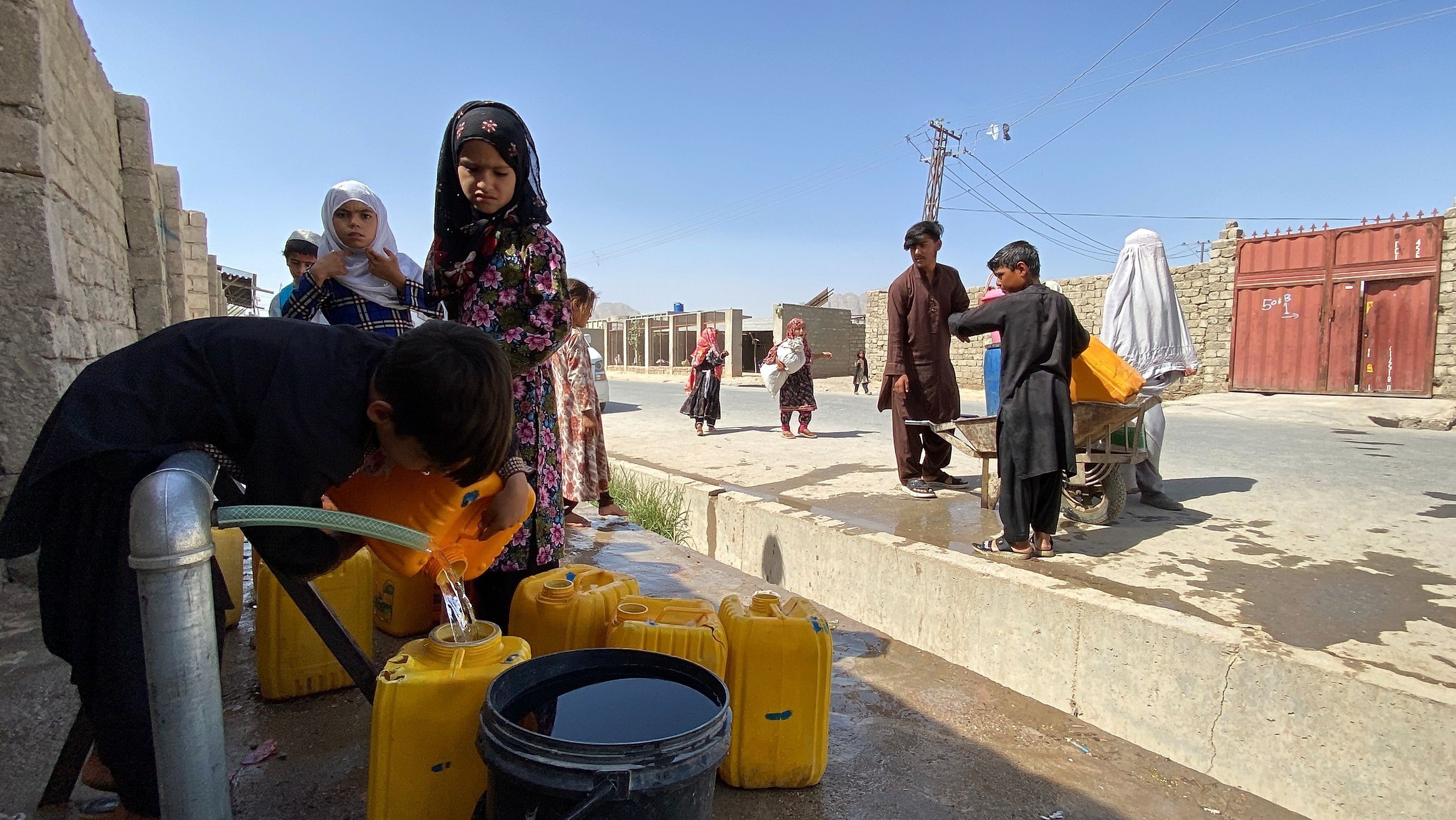
Mohammad Anwar Barakzai, another Helmand teacher, says neither the Education Ministry nor UNICEF runs any programme for children who dropped out because of water. “So far, no one has checked on these children,” he says. No one is counting them, and so no one is helping them. He fears that if the drought worsens, perhaps half the children in his area will lose their education.
Dollars and dams
Asked about the water shortage, the Taliban government points to its dams. Officials from the Ministry of Economy told NWS that they have built hundreds of small dams and check dams in five years, including about 410 small dams, with some foreign assistance. The officials say they are effective against drought, though larger plans are not yet final.
They cite Pashdan Dam in Herat province, which cost $117 million, stores about 54 million cubic metres and irrigates 32,000 acres. The previous government began work in 2011. The officials also highlighted Kabul’s Shah-wa-Arous Dam, inaugurated in December 2024 at $53 million.
Yet the country's water needs dwarf the spending. The previous government received more than $4 billion in donor money for the water sector, according to the World Bank, yet the sector remains underdeveloped. Under the current government, donor money has slowed to a trickle. Early in 2025, the UN Office for Coordination of Humanitarian Assistance (OCHA) said its aid partners had received only $8.4 million of the $264 million needed for water and sanitation. Promised new aid has not arrived, compounding the problem.
When the land gives up
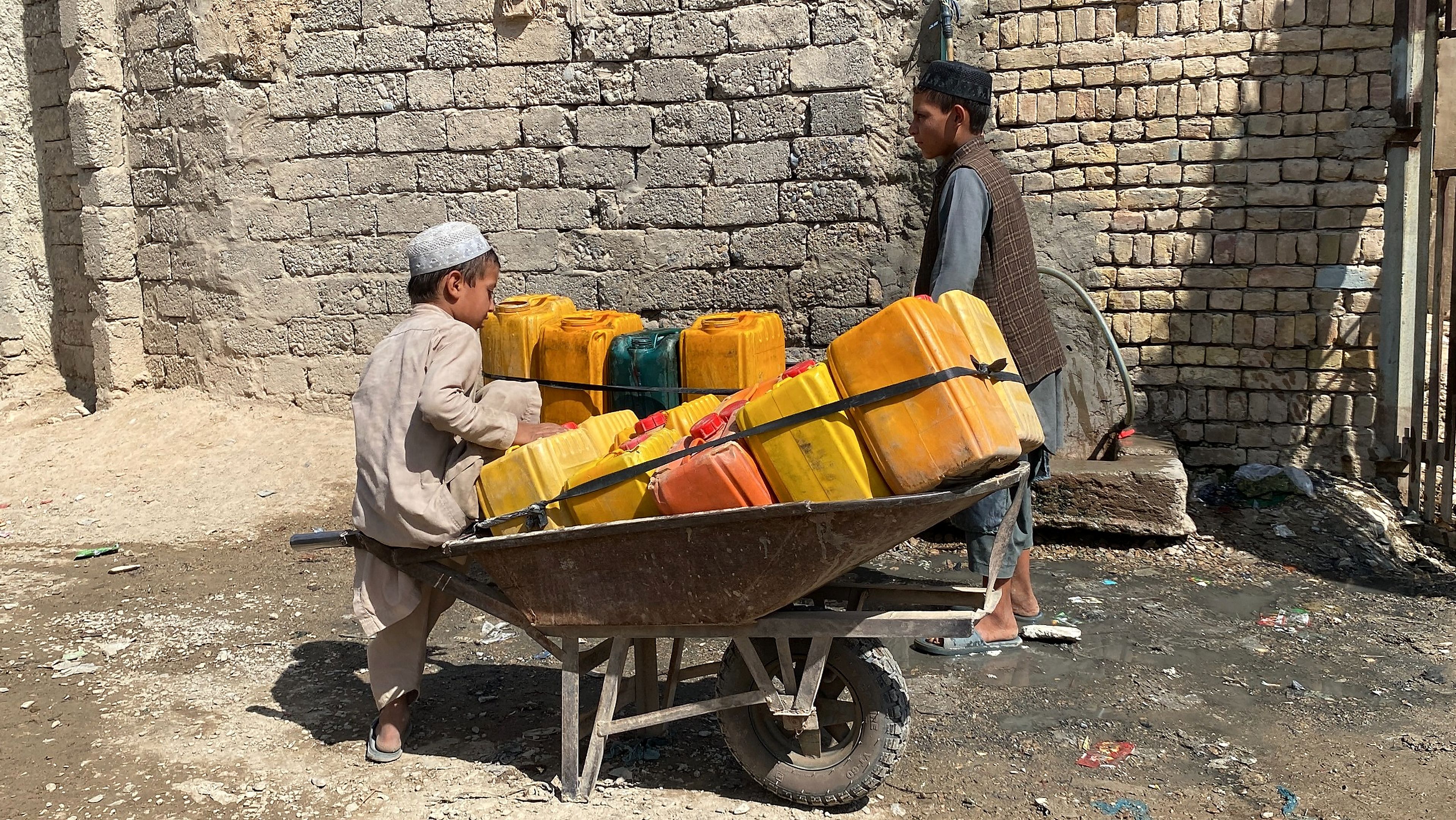
Water shortage is also hitting agriculture and horticulture, mainstays of the Afghan economy. Ongoing droughts have failed the rain-fed wheat crop in several provinces, including Faryab, Jawzjan, Samangan, Ghor, Badghis, Zabul, Nimroz, and Daykundi. Pomegranate orchards in Wach Bakhto, Kandahar’s Shah Wali Kot district, have dried up.
Shamsullah, 44, a pomegranate orchard owner, says wells 250 to 300 metres deep have run dry, and some owners are cutting down their trees. Hashmatullah, a 51-year-old orchard owner, sits beside an orchard that was green six months ago. It once earned about $10,000 a year. This year it earned nothing. He blames past governments for the lack of water infrastructure. “In the last 25 years, Afghanistan got a lot of foreign aid for improving it; however, the governments could not construct more check dams. The Dahla Dam was also not expanded to store some water. Because of drought, we are now forced to leave this place. No one buys our land because it has no water,” he explains.
Internal displacement
Drought has been emptying Afghan villages for years, and many of those who left have never gone back. The 2018 drought forced about 371,000 Afghans from their homes. The southern Badghis and Herat provinces accounted for 74 per cent of those displaced. Over the decade to 2023, drought displaced 418,000 Afghans, nearly 28 per cent of the 1.5 million people displaced in that period. The Migration Policy Institute notes that people displaced by long-term drought are unlikely to return.
The pace has not eased. Extreme weather displaced at least 38,000 people in the first half of 2024, more than the 37,076 recorded in all of 2023. Forced returns from Pakistan are adding to the problem. More than 2.61 million Afghans returned from Iran and Pakistan in 2025, and the International Organisation of Migration (IOM) says more than four million have returned since September 2023, many into districts already short of water.
What would help
Noorullah Noor, a water and environment specialist, says groundwater extraction must come down, and the government must invest heavily in water infrastructure. “To prevent children from being deprived of schooling, large water supply networks must be built in cities in time and large dams on the country’s water resources. If this continues for a few years, Kabul will dry up first, then Kandahar. We will no longer be able to pursue education or develop industry. Instead, we will have to think about leaving our cities and country. We have no wells to replenish the underground water,” he explained.
Small interventions by NGOs and donors have proved useful, but they may not be sustainable. In Naw Abad, a village near Gardez city in southeastern Paktia province, the change was immediate. A well, a tower, and a 7.5 kW solar system now supply 119 taps. People once had to walk 60 to 90 minutes, three or four times a day, for water. “Now I do not have to go far because the water is here,” says Eid Bibi, a mother of eight. In Jalalabad’s Woch Tangi area, a solar network now supplies more than 600 families.
However, such projects can only draw on depleting groundwater; investing in large water projects that raise groundwater tables could make a faster, more tangible difference. Today, Naqibullah and Hamidullah are standing in a water line instead of sitting in a classroom. Their families say they would send them to school if water reached their doorsteps. Behind every jerrycan is a lesson not learned. If the intervention does not come, the boys who carry buckets today may one day leave their villages with everything they have.