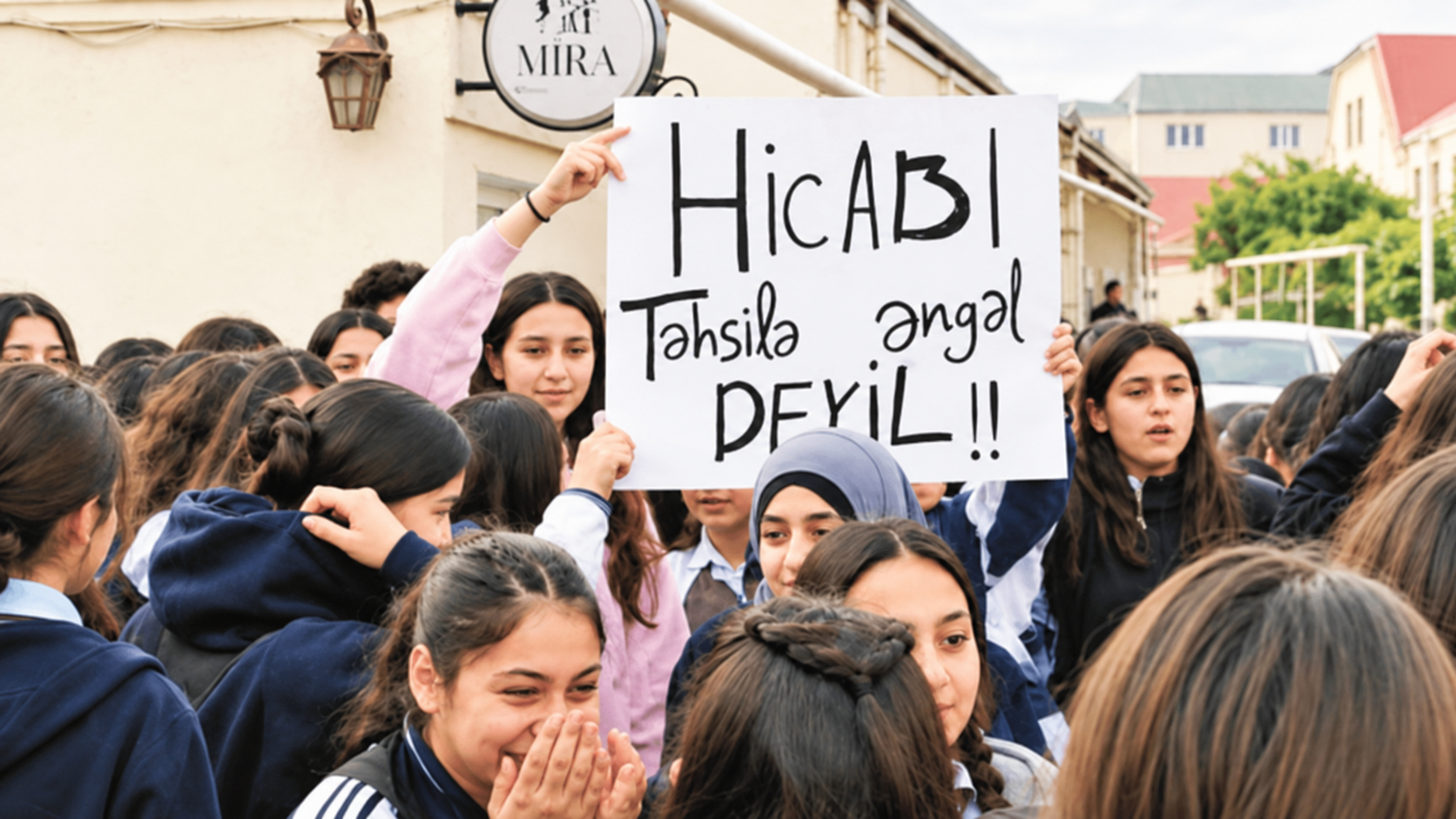
Remarks by a senior adviser to Turkey’s president condemning Azerbaijan’s new school dress rules, which effectively ban the hijab, have drawn a sharp response from Azerbaijan’s ruling party, straining ties between two close, Muslim-majority allies. The rules have also triggered protests, class boycotts and 37 arrests inside Azerbaijan.
Oktay Saral, an adviser to Turkish President Recep Tayyip Erdogan, called the move “unacceptable” in a post on X on October 13. He asked how leaving a student who covers her head out of faith at the school gate could “fit into any conscience, any sense of justice.”
“A headscarf is not an obstacle; it is a requirement of religious belief,” he said. “We expect Azerbaijan to reverse this mistake as soon as possible.”
Azerbaijan’s ruling Yeni Azerbaijan Party (YAP) hit back on Tuesday, calling Saral’s remarks “irresponsible” and warning that they risked damaging Baku’s closest relationship on the international stage. The spat is notable given Turkey’s backing for Azerbaijan in its 2020 war with Armenia, in which Baku retook swathes of territory in and around Nagorno-Karabakh. Azerbaijan took full control of the region in 2023.
Both countries are Muslim-majority but constitutionally secular. About 96 per cent of Azerbaijanis are Muslim, mostly Shia, while Turkey’s population is overwhelmingly Muslim, mostly Sunni. Turkey itself lifted its own hijab restrictions in schools and public institutions under Erdogan.
The criticism also comes amid Turkish public anger over Baku’s growing ties with Israel. Azerbaijan’s delegation stayed in the UN General Assembly Hall during Israeli Prime Minister Benjamin Netanyahu’s address in September. Azerbaijan actively supported Israel in its recent war on Iran by hosting Israeli military operations on its soil.
Protests and arrests
Inside Azerbaijan, the new rules have led to sporadic protests, class boycotts by pupils and a nationwide social media campaign. The Interior Ministry told the Azerbaijani Press Agency (APA) that 37 people were arrested after a criminal investigation was opened into “disturbing public order”. It said people in Baku had confronted school staff over the uniform requirements.
Azerbaijan is a Shia-majority country, but its constitution defines it as a secular state. The APA reported that the September 21 amendment to the Descriptions of Uniforms for Students of State General Education Institutions, formalised in Cabinet Resolution No. 309, aims to ensure a unified dress code reflecting the country’s “secular principle”. The rules do not mention the hijab explicitly but effectively bar students and teachers from wearing it. Follow-up directives issued on 6 October also barred staff from wearing headscarves when entering schools.
History of hijab bans
Azerbaijan first banned religious attire in schools on December 10, 2010, when the Ministry of Education began strictly enforcing a uniform policy that effectively barred the hijab for students. The September resolution renewed and expanded the ban under the principle of secularism, and the October 6 regulations extended the dress code to school staff, preventing hijab-wearing teachers from entering schools.
Comparison with France and Italy
The new directives have drawn comparisons with Italy and France, though the three countries have taken different routes.
Azerbaijan enforces its restrictions indirectly, through a Cabinet resolution. Italy has taken a security approach: it has no specific national ban on the hijab in classrooms, but uses public security laws from the 1970s that prohibit attire masking a person’s face or preventing immediate identification in public spaces. France took a more direct, statutory approach in 2004, banning “conspicuous” religious symbols in public schools, including Muslim hijabs, Christian crosses and Jewish kippahs, under its constitutional principle of laïcité, or state secularism.
Other Muslim-majority countries
Azerbaijan is not the first Muslim-majority country to restrict the hijab or veil. In 2024, Tajikistan enacted a nationwide law outlawing the hijab as an “alien garment” incompatible with national culture. Kazakhstan, Uzbekistan, Turkmenistan and Kyrgyzstan have instead focused on full-face veils such as the burqa and niqab to ensure identification in public spaces.
In North Africa, Tunisia and Algeria prohibit face veils inside government offices and civil service workplaces. Morocco uniquely bans the manufacture, sale and marketing of the burqa entirely. Egypt and Kosovo have institutionalised restrictions within their education systems, with uniform mandates that bar the hijab or niqab from classrooms and university campuses.
Non-Muslim-majority countries
Among non-Muslim-majority countries, regulation of Islamic attire is concentrated in Europe and is typically framed around secularism, civic integration and public security. After its 2004 school ban, France imposed a public-space ban on face-covering burqas and niqabs in 2011. Belgium, Austria, Denmark, Bulgaria, Switzerland and, most recently, Portugal have since passed nationwide laws prohibiting garments that conceal the face in public.
The Netherlands and Norway limit full-face veils within schools, hospitals and public transport, while Austria has expanded its school restrictions to ban headscarves for girls under 14. Outside Europe, China enforces a strict ban on head-coverings and full-face veils in Xinjiang, and Sri Lanka has announced a public face-veil prohibition citing national security. Most of these countries avoid naming Islamic clothing, framing their laws as neutral “anti-face covering” measures designed to ensure public transparency and identity verification.