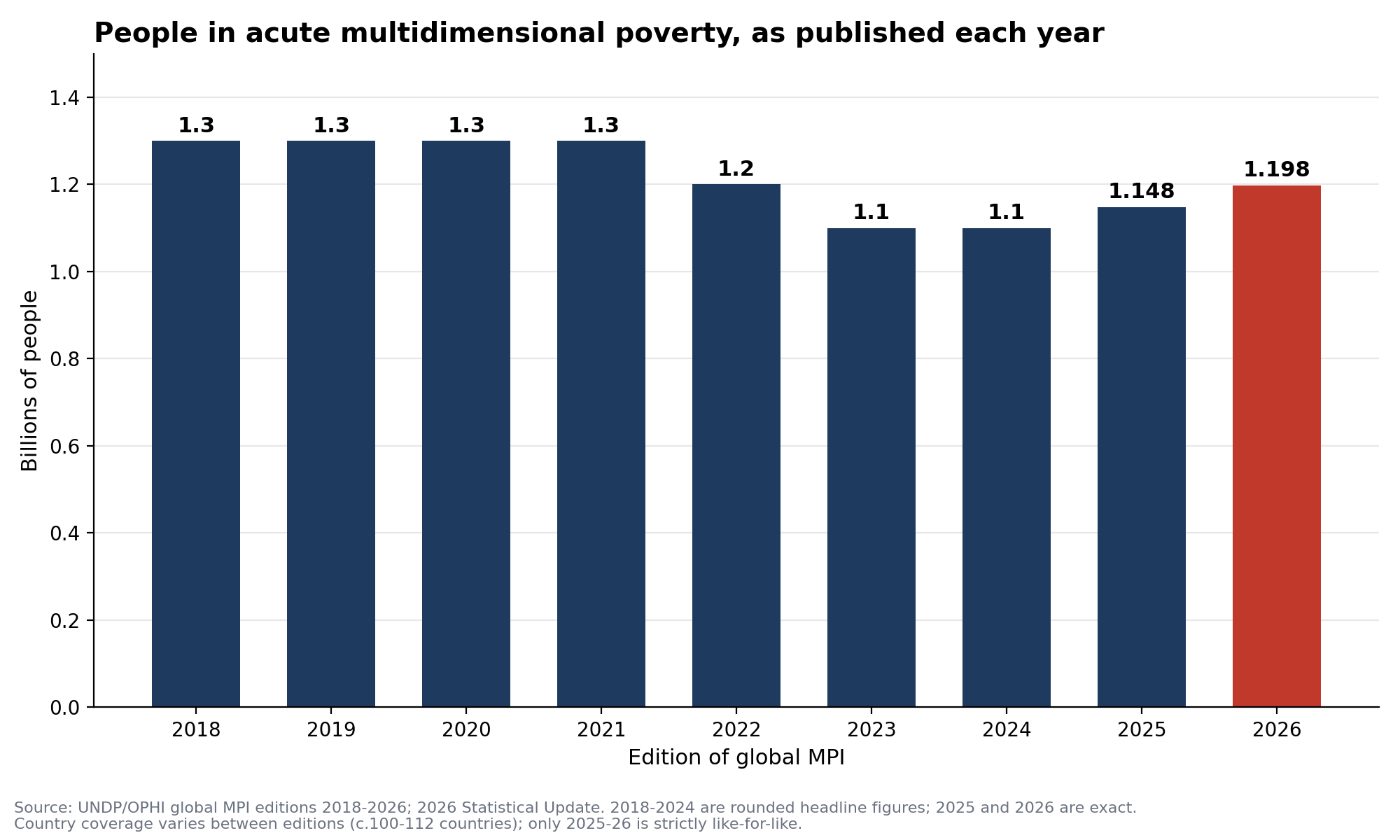
The number of people living in acute multidimensional poverty has risen for the first time since the United Nations began counting in 2010. The UN and the University of Oxford published figures on Monday (October 12) showing that 1.2 billion people, 617 million of them children, are deprived of adequate health, education and living standards.
The 2026 update of the global Multidimensional Poverty Index (MPI), produced by the UN Development Programme (UNDP) and Oxford’s Poverty and Human Development Initiative (OPHI), counts 1,198.1 million poor people across 108 countries. That is 51.5 million more than on a like-for-like basis in 2025. UNDP Administrator Alexander De Croo said: “The rise in poverty should be a wake-up call for the world.”
Who is counted as poor
Unlike the World Bank’s income-based measures, the MPI looks at ten indicators: nutrition, child mortality, years of schooling, school attendance, cooking fuel, sanitation, drinking water, electricity, housing and assets. A person is classed as poor if their household is deprived in at least a third of the weighted indicators. The update covers 6.3 billion people, or 78 per cent of the world's population.
The report finds that poverty is often severe. Some 534 million people, or 44.6 per cent of the poor, are deprived in half or more of the indicators, and a further 952 million are classed as vulnerable. Children carry a disproportionate share of the burden: about one child in three is poor, compared with one adult in seven, and sub-Saharan Africa alone has 355 million poor children.
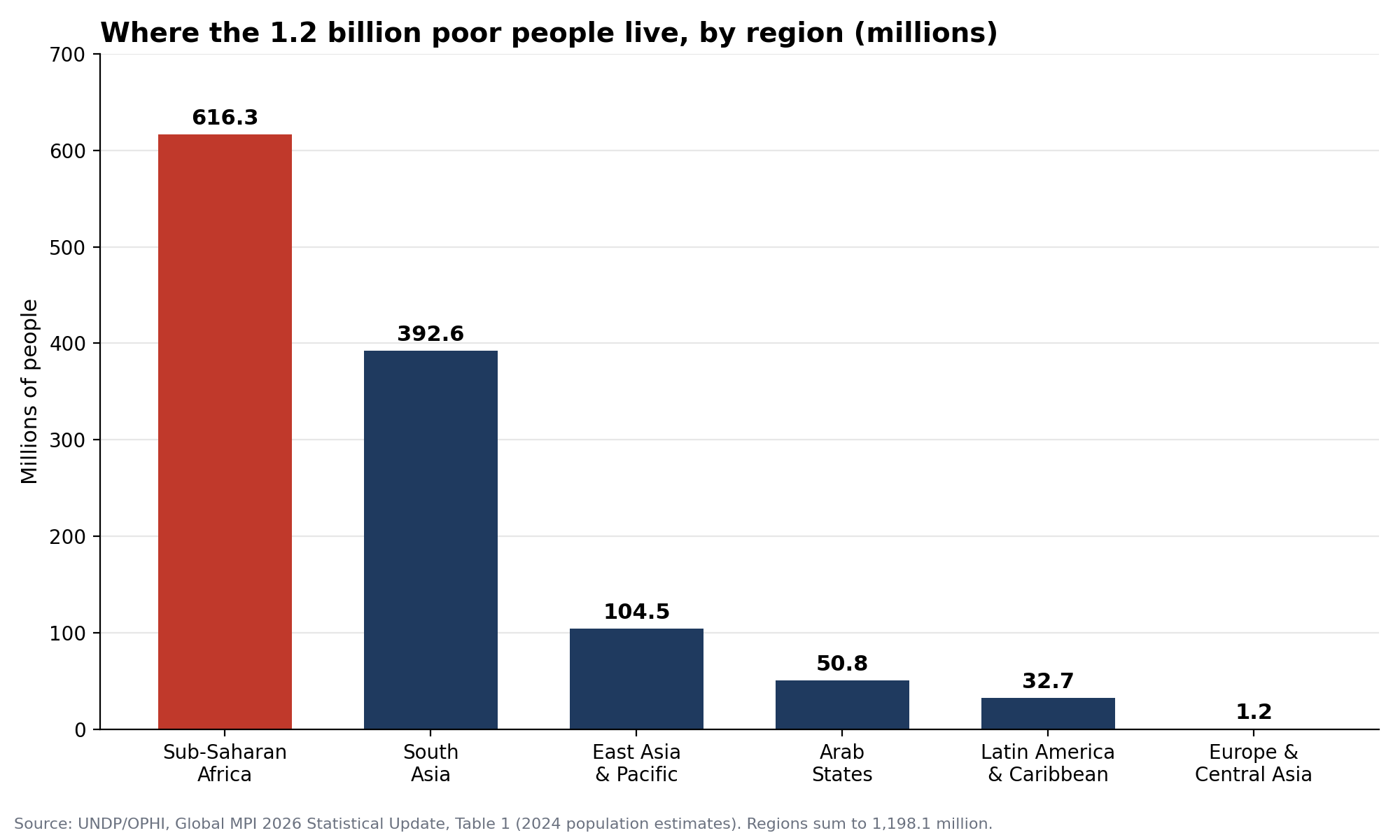
Poverty is also heavily concentrated. Sub-Saharan Africa has 616 million poor people, more than all other regions combined, and South Asia has 393 million. Across all regions, 83.3 per cent of the poor, or 998 million people, live in rural areas. Chad has the highest national incidence at 84.2 per cent, and in 387 subnational regions, home to just 14.9 per cent of the population covered, live 53.6 per cent of all poor people. Roughly two-thirds of the poor (65.1 per cent) live in middle-income countries rather than the poorest ones.
According to the report, India showed sustained progress. Between 2005-06 and 2019-21, its poverty incidence fell from 55.1 per cent to 16.4 per cent, and the number of poor people dropped from about 646 million to 232 million, although critics argue that the figures are way better than reality as India’s poverty line is counted to mark out only extreme poverty.
Why the number rose
The report’s own explanation is narrower than many headlines suggest. In its box on the increase, it splits the 51.5 million into two parts. The first is population growth: in 95 countries with no new surveys, updated UN population estimates alone added 15.8 million poor people, about 31 per cent of the rise, with poverty rates held constant. The remainder, about 35.7 million, comes from 13 countries with fresh surveys, including Angola, the Democratic Republic of the Congo, Egypt, Nigeria and Zambia. UNDP says that this mixes genuine changes in poverty, demographic shifts and differing indicator coverage across survey rounds.
Among those 13 countries the results were mixed. Egypt, Nepal and Tajikistan cut both the poverty rate and the number of poor people. In Angola and Zambia the rate fell, but population growth outpaced it, so the number of poor people rose. Seven countries showed no significant change.
Nigeria is the report’s cautionary tale. Its poverty rate fell until 2021 and then rose again. On the report’s harmonised trend basis, incidence went from 33.0 per cent in 2021 to 38.7 per cent in 2024, adding 17.9 million poor people. That is the largest absolute increase in the trend tables, followed by Afghanistan with 5.3 million between 2015-16 and 2022-23.
The update does not attribute the rise to conflict, climate shocks, debt or aid cuts, and it does not explain Nigeria’s reversal. An earlier edition found that 455 million poor people lived in countries exposed to violent conflict, but that makes its context, not a finding of the 2026 update.
A thin evidence base
The authors stress that the data are old. Only 38 countries have surveys from 2021-22 or later, and they hold about 35.7 per cent of the world’s poor. Seventeen countries, with 1.98 billion people and 155.3 million poor people, still rely on surveys from 2016 or earlier. The statistical update warns that more frequent data “are in short supply, especially in the poorest countries.” Many of the poorest countries’ surveys predate the pandemic, so the true picture may differ from the report’s conclusions.
Reasons for hope
Among 89 countries with trend data, 33 have halved their MPI value in fewer than 15 years, six of them in sub-Saharan Africa. That compares with 25 countries out of 81 in the 2023 edition. China halved its value in four years, from 9.5 per cent incidence to 4.2 per cent between 2010 and 2014, and Vietnam did so in seven. Eswatini cut its incidence from 38.7 per cent to 8.0 per cent over 15 years, and Nepal’s fell from 30.1 per cent to 13.9 per cent over 10.5 years.