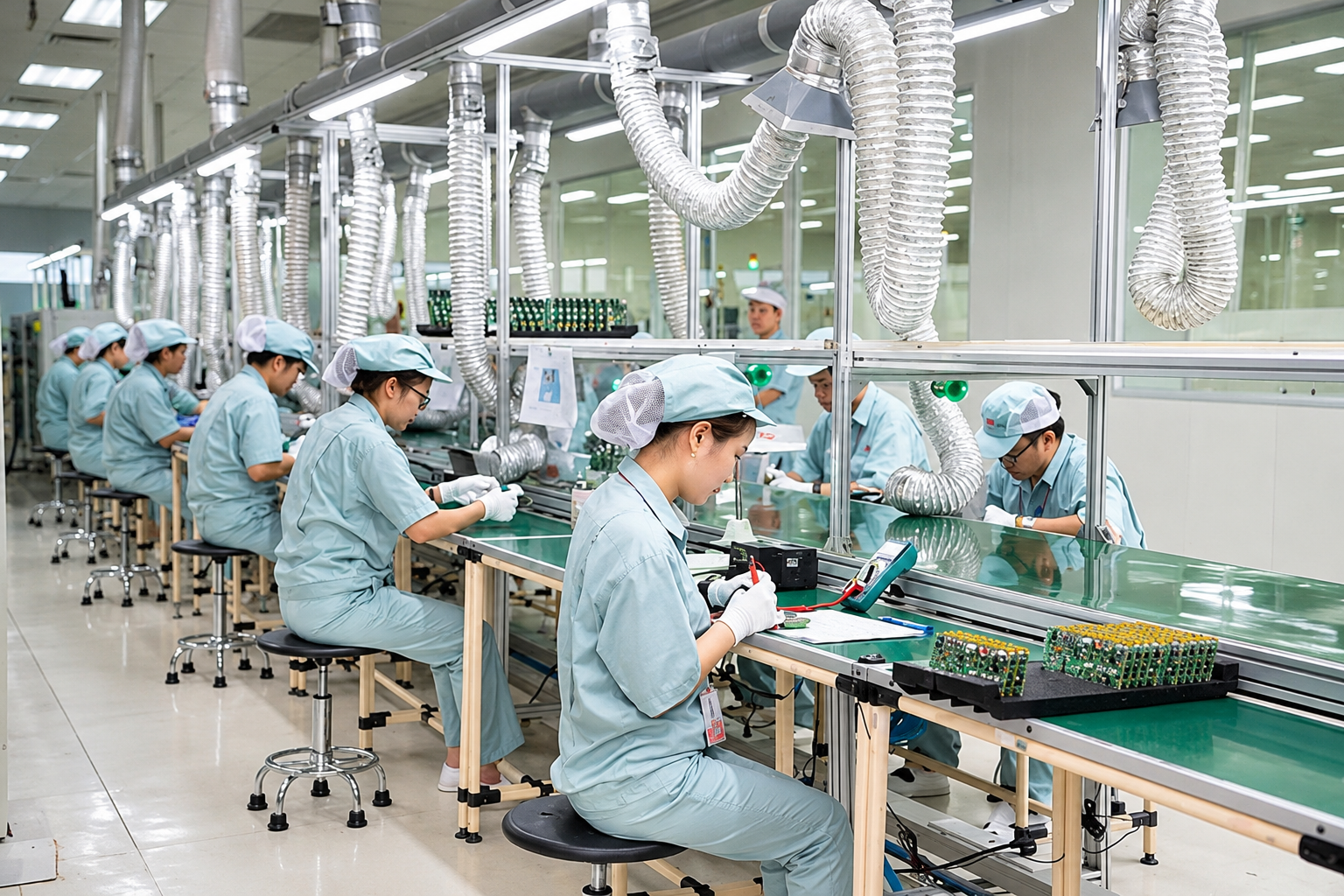
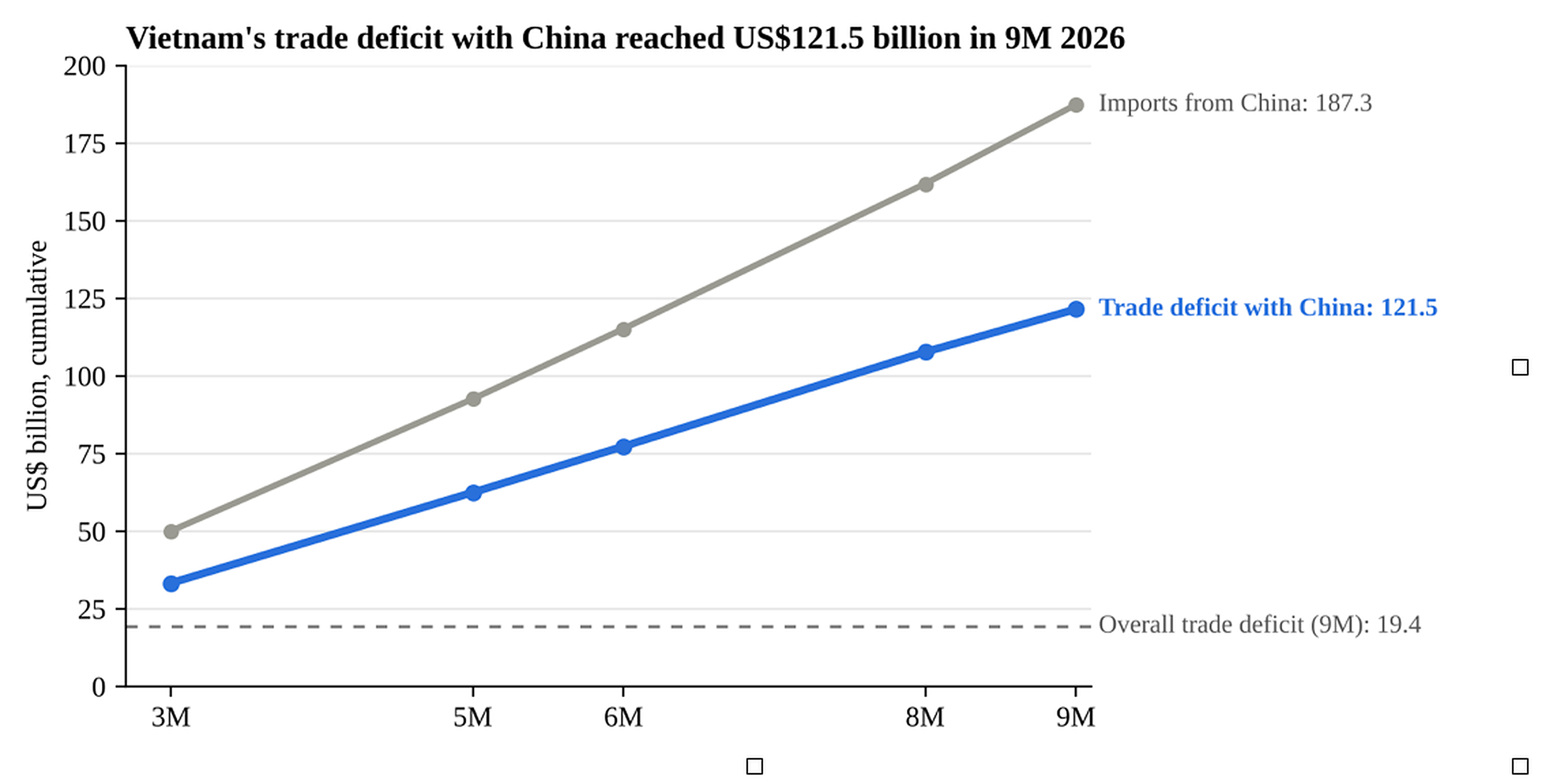
Check the label on a smartphone, an electric bus or a battery pack and it may say “Made in Vietnam”. However, much of what is inside was made in China. Chinese-owned factories are creating jobs in Vietnam and drawing it deeper into global supply chains for electronics, batteries and cars, but the economy still depends heavily on Chinese components. In the first nine months of 2026, Vietnam’s trade deficit with China rose 43 per cent to $121.5 billion.
Chinese investors hold about $36 billion in registered capital across 6,386 projects in Vietnam. Yet China ranked only fifth by newly registered capital in the first nine months of 2026. It was, however, the leading investor in new manufacturing projects in the first half of the year, with 177.
Who is investing, and what they are making
Chinese investment has shifted towards precision sectors: electronics, batteries and car parts. Of the registered capital Chinese investors have put into Vietnamese manufacturing, 38 per cent goes to electronics and technology-based components and only 25 per cent to textiles and light industry.
Chery Automobile plans an assembly plant in Hung Yen province worth about $800 million when fully operational. Luxshare-ICT, a major Apple supplier, has increased its investment in a component plant in Bac Ninh province to $504 million. In Hue, Kim Long Motor is funding a $130 million plant making batteries for commercial electric vehicles, with technology from BYD.
Chinese investors choose Vietnam for three reasons: first, US tariffs are generally lower on Vietnamese goods than on Chinese goods; second, consultants say big customers, including Apple and Samsung Electronics, have built extensive supply chains there; and third, northern Vietnam is linked to southern China by highway and rail. Many investments follow a “China plus one” strategy, in which a company keeps its main operations in China but adds a second production base elsewhere, in this case Vietnam. Design and core component development stay in China.
Jobs and wages
Unskilled workers at Chinese-owned firms in Vietnam earn VND9-12 million a month (about $340-460). Skilled workers who also speak Mandarin may earn VND18-20 millions ($690-770). Both are well above the Region I minimum wage of VND5.31 million (about $200) set by law. Region I is the highest-paying of Vietnam’s four regional minimum-wage zones and covers the main cities and industrial hubs.
Labour disputes have hit several Chinese-owned factories. In September 2025, about 500 employees at the Lihao Furniture Factory in Ho Chi Minh City struck work over wages. The same month, about 1,300 employees at the Southern Garment Factory in Dong Thap province struck for four days, demanding shorter hours and higher pay. NWS, however, found no data or account showing that Chinese-owned enterprises treat workers markedly worse than other foreign-invested enterprises. China Labour Bulletin reported a similar finding in 2019.
Local suppliers on the margins
Domestic vendors supply an estimated eight per cent of inputs bought by foreign-invested enterprises (companies with foreign capital) in Vietnam, as reported in a 2023 study. Technology transfer typically happens when Vietnamese partners have enough capital and bargaining power to secure it. It happened when Kim Long Motor partnered with BYD, and when Delta E&C received technical help from CATL-backed CNTE. Steve Bui, chairman of the Vietnam-China Business Council and head of Delta E&C, said that in 2025 twelve Chinese member companies had transferred technology to Vietnamese partners or planned to, up from none in 2024.
Dependent on inputs
Much of Vietnam’s dependence on China lies in imported components and machinery, and it has deepened sharply in 2026. Vietnam’s trade deficit with China is now larger than its overall trade deficit.
Capital flows, however, tell a very different story. Chinese investors accounted for only 7.8 per cent of new registered capital in Vietnam in the first nine months of 2026. Hong Kong investors accounted for another 10.3 per cent.
Ho Quoc Tuan, an associate professor at the University of Bristol, argues that the deficit reflects Vietnam’s rapid expansion of output on the back of new investment, chip stockpiling and higher fuel costs, rather than stronger consumer spending. The risk, he says, is that domestic value added, the share of a product’s final value created inside Vietnam through local wages, inputs and profits, stays low. In the first seven months of the year, the foreign-invested sector ran a trade surplus of nearly $8 billion, while the domestic sector ran a deficit of about $28.5 billion.
Trade and geopolitical risks
The deficit with China has a mirror image in Vietnam’s trade with the United States. Vietnam's biggest export market bought about $140 billion of its goods in the first nine months of 2026, leaving Vietnam with a surplus of about $122.6 billion with the US. That is almost exactly the size of its deficit with China. Components flow in from China and finished goods flow out to America, which is why US rules on what counts as “Made in Vietnam” matter so much.
A change in those rules is one threat to the “Chinese components, Vietnamese assembly” model. A July 2025 deal set a 40 per cent tariff on goods deemed to have been transshipped through Vietnam, meaning made elsewhere, typically in China, and routed through Vietnam to avoid higher duties. When the US Supreme Court invalidated tariffs imposed under the International Emergency Economic Powers Act (IEEPA), a law giving presidents emergency powers, in February 2026, the emergency tariffs, including the transshipment tariff, were removed and replaced with a temporary 10 per cent tariff.
On July 24, 2026, a 12.5 per cent tariff under Section 301 of the Trade Act of 1974 replaced that on most Vietnamese goods. Section 301 lets Washington impose duties after investigating another country's trade practices. This investigation, which covered 60 economies, cited weaknesses in enforcing bans on imports made with forced labour. Since June 2026, Vietnam’s customs department has strengthened inspections of eighteen high-risk product categories.

On the South China Sea, Vietnam keeps economics and security apart. In the year to May 2026, it added about 216 hectares of land in the Spratly Islands. In April 2026, Chinese President Xi Jinping reiterated his commitment to deeper cooperation with Vietnam in a meeting with To Lam in Beijing. But if a serious conflict arose between the two countries, China could use its dominant supply of components as leverage.
What experts and businesses say
Automotive expert Cao Hieu Thuan tells NWS that if Chinese firms only build assembly plants in Vietnam, it will learn little from them. Incentives, he argues, should depend on technology transfer or the growth of domestic suppliers. An expert from the Asia-Pacific Center for Security Studies warns that if Chinese investment continues at present rates, Vietnam “may become a ‘torn country’ rather than a ‘swing state’.”
A Luxshare-ICT executive said Vietnam is the company’s most important manufacturing hub among the 29 countries and territories where it invests. He stressed that the company is committed to training Vietnamese engineers and technicians.
Bigger, but still not more resilient
Chinese manufacturers have helped make Vietnam a larger industrial economy, but rapid growth has not made its industrial base more resilient. Outcomes depend largely on partnerships between foreign-invested enterprises and Vietnamese firms. Vietnam could do better by: a) tying incentives to audited levels of domestic purchasing and to training programmes; b) publishing data on domestic value-added content, so it can engage the US proactively; and c) prioritising partnerships with foreign-invested enterprises that plan to source components locally, rather than simply assembling imported components.