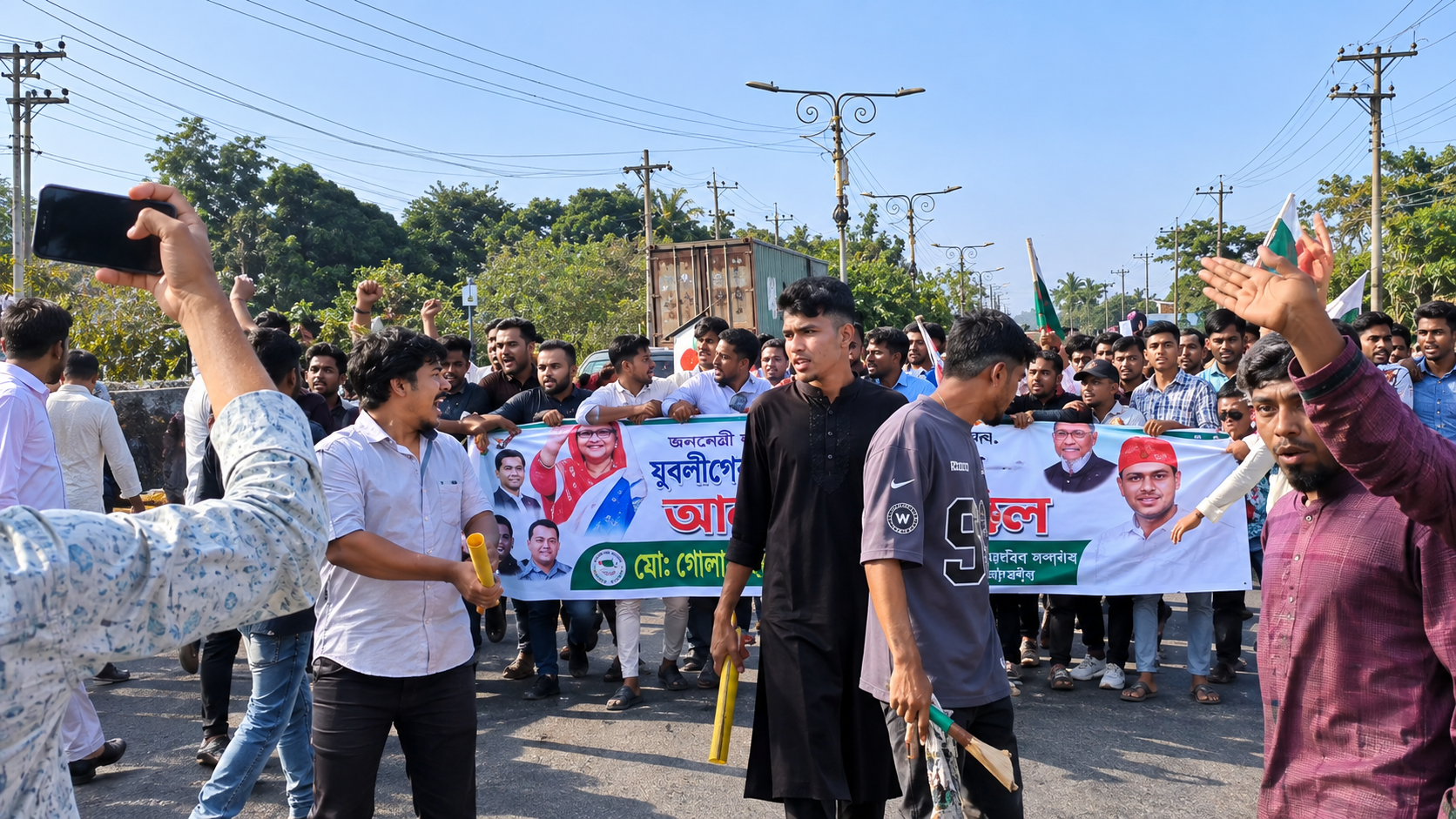
Nationwide demonstrations by supporters of deposed Prime Minister Sheikh Hasina’s banned student wing turned violent in Bangladesh on Tuesday (November 10), prompting police to fire tear gas and rubber bullets to disperse protesters. At least one person was killed, while clashes between demonstrators and security forces were reported across the country.
The unrest marks the most significant show of organised resistance by Hasina’s allies since she went into exile in India in August 2024 following a mass uprising that ended her 15-year rule.
The immediate trigger for the protests was Hasina’s announcement that she had formally requested a passport from the Bangladesh High Commission in New Delhi, signalling her intention to return to Bangladesh despite facing a death sentence handed down by a special tribunal last year. The Bangladesh government flatly rejected the application, declaring it would not issue her a travel document and labelling her ‘a terrorist.’ Humaiun Kobir, Bangladesh's junior foreign affairs minister, was unsparing in his response. “She is a fugitive criminal. We have an active extradition treaty with India. We want her handed over,” he said. Dismissing the passport request with evident contempt, Kobir added: “Should we treat her like an ordinary commercial traveller and tell her to come and visit her in-laws' residence?”
A state prosecutor confirmed on Tuesday that any death sentence verdict would be carried out should Hasina return, noting that she had already missed the window to appeal against her conviction.
The demonstrations, organised through Hasina's student wing, the Bangladesh Chhatra League (BCL) - itself a banned organisation - spread rapidly across multiple cities. In Faridpur, a 60-year-old bus driver died from smoke inhalation after protesters set his vehicle ablaze in the early hours of Tuesday morning. In Gopalganj district, a police vehicle was set on fire as BCL members clashed directly with security forces. Dozens of crude bombs exploded in Dhaka and elsewhere in the days leading up to the demonstrations, according to Bangladeshi local media. Several passenger vehicles were torched in various parts of the country, and traffic was disrupted as protesters erected roadblocks using burning tyres.
In one of the more symbolic acts of defiance, about 200 protesters briefly blocked the 6.2-km Padma bridge across the Ganges, which connects the capital, Dhaka, with the country's south-western region. Despite the widespread disorder, a senior BCL leader speaking from exile abroad denied that his organisation bore any responsibility. "Our supporters were not responsible for the violent incidents. Unknown miscreants carried them out. We believe in peaceful protests," he said.
Bangladesh's Home Minister Salahuddin Ahmed issued a stern warning that appeared directed partly at India, where Hasina remains in exile. “Any attempt to worsen the law-and-order situation or create instability through any conspiracy within the country from across the border will not be allowed to succeed,” he said. The government’s position reflects deep anxiety that Hasina’s return could reignite the mass polarisation that defined her final years in office, and officials in Dhaka have consistently maintained that she must face justice rather than be allowed to re-enter Bangladesh on her own terms.
Who is Sheikh Hasina?
Sheikh Hasina Wazed, 77, is Bangladesh's former Prime Minister and the daughter of Sheikh Mujibur Rahman, the country’s founding father and first president. Rahman was assassinated along with most of his family in a military coup in August 1975. Hasina survived because she was abroad at the time. She went into exile for six years before returning to Bangladesh in 1981 to lead the Awami League, the party her father had founded. She served as Prime Minister on four separate occasions - first from 1996 to 2001, and then continuously from 2009 to 2024. During her later period in power, she oversaw significant economic growth, including Bangladesh's graduation from least-developed-country status.
She also championed the construction of the Padma Bridge, insisting Bangladesh fund it without World Bank support after the institution withdrew over corruption allegations. This decision became one of the defining symbols of her tenure. However, that tenure was also characterised by what critics described as an increasingly authoritarian grip on power. Opposition parties accused her of jailing political rivals, rigging elections, suppressing a free press, and overseeing widespread human rights abuses.
The uprising that ended her rule
The movement that ultimately toppled her began in June 2024 as student-led demonstrations against a quota system that reserved a substantial proportion of government jobs for descendants of veterans of Bangladesh's 1971 liberation war. Protesters argued the system was being used to entrench Awami League loyalists in the civil service. The government's response - deploying security forces and reportedly arming Awami League-affiliated groups to attack demonstrators - dramatically inflamed public anger, transforming a targeted protest into a broad-based uprising demanding Hasina's resignation. The United Nations has estimated that up to 1,400 people were killed during the crackdown, the majority by gunfire from security forces acting under her government.
By August 2024, the movement had become unstoppable. Hasina resigned and fled by helicopter to India on 5 August 2024, reportedly with little more than the clothes she was wearing, as crowds stormed her official residence in Dhaka. Nobel Peace Prize laureate Muhammad Yunus was subsequently appointed as head of an interim government tasked with stabilising the country and preparing for fresh elections. The Awami League was formally banned and barred from contesting the February general election. A special tribunal was established to try individuals accused of crimes against humanity in connection with the 2024 crackdown, and last year that tribunal sentenced Hasina to death in absentia. She has rejected the verdict as "biased and politically motivated."
A country at a crossroads
Claims of systematic reprisals against Awami League supporters have further complicated the political situation. Party leaders allege that in the two years since Hasina's ouster, hundreds of their supporters have been killed in mob violence and dozens have died in the custody of security forces. Tarique Rahman’s government has rejected those accusations, insisting that any prosecutions or detentions are conducted through lawful processes.
The violence on Tuesday laid bare the divisions that continue to fracture Bangladeshi society. The BCL’s ability to mount coordinated action across multiple cities - despite its banned status - signals that Hasina’s support base, though driven underground, retains both organisational capacity and the willingness to deploy it. With Hasina showing no sign of abandoning her stated desire to return, and the government equally resolute in its refusal to facilitate or tolerate that prospect, Bangladesh faces sustained instability at a moment when it can least afford it.