Tehran, Iran: Sajjad, a supermarket owner in northern Tehran, has noticed a change in recent months: customers are buying less and less. They are choosing cheaper products or dropping things they used to buy every week. Decades of sanctions and a sudden war brought on by the United States and Israel are turning Iranians' daily life into a hell. Iranians also blame their government's mismanagement for their hardships. In interviews for this article, Iranians spoke of exhaustion, fear of what comes next, growing anger at their own government and at the US and Israel. For some, the war has prolonged hardships they have been enduring for years. Others see it as a possible way out, even if that means welcoming destruction.
Iranians are sharply divided over whether the war should continue or end at any cost. Iran entered the war on February 28, 2026, after years of inflation had already eroded household purchasing power. A study by the Iranian Sociological Association found that the 40-day war altered consumption patterns through higher prices and falling incomes, as well as fears of shortages and disruption. The NWS spoke to ordinary Iranians, workers and small-business owners, to understand how the war and years of economic pressure have changed their lives.
Shopping basket gets smaller
Because of the war and related restrictions, prices of daily essentials are soaring. Data from the Statistical Center of Iran shows that consumer prices in the Iranian month of Mehr (September 23 to October 22) were 88.7 per cent higher than a year earlier. The rural areas were hit particularly hard. Year-on-year inflation reached 107 per cent in rural areas, against 85.5 per cent in urban centres. Skyrocketing inflation is squeezing small businesses.
Talking to NWS, Reza, who runs a fast-food business, said the price of pizza cheese has shot up from about $0.67 to $2.81 per kg. He had to raise the pizza price from about $0.49 to $1.12, and his customers nearly halved. (US$ 1 = 264,900 Iranian rials). Raising prices drives customers away, while holding them leaves little room for profit. Mehdi, a restaurant owner, says customers who once ordered two hookahs for two people now often settle for one. He hiked the prices twice since the beginning of the year, by about 20 per cent each time. Customer numbers have fallen about 20 per cent, and his profit margin has dropped from around 35 per cent to 20 per cent. For him, the hardest part is not knowing what next month will bring.
Imports become tough
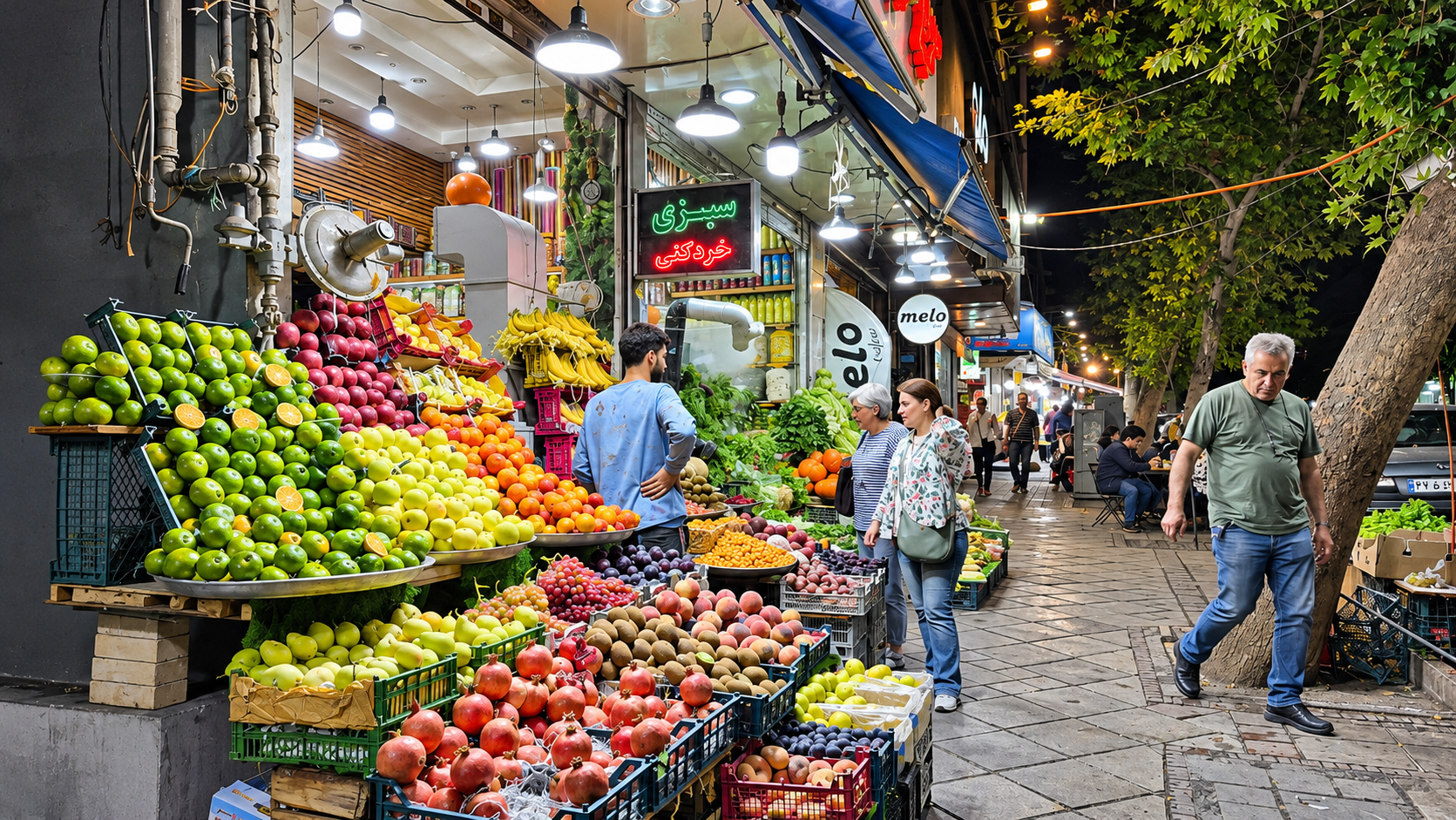
Due to the US and European sanctions, imports are becoming increasingly tough. Importers face not only rising costs but also uncertainty about whether their goods will enter the country. Mohammad, who imports 3D printers and accessories from China, says restrictive regulations and foreign-exchange difficulties have made it hard to bring in complete printers. He now concentrates on accessories and components. He used to receive full printers directly at Bandar Abbas port. However, he now depends on an indirect route through Mersin in Turkey. This route change increased transport costs roughly three times compared with the previous level.
Import restrictions are affecting Iran’s manufacturing activity. Shahin Kazemi, a textile-industry trade union activist, told NWS that textile units depend heavily on polyester products and petrochemical inputs. Disruptions to raw-material supplies are interrupting the production cycles and making factory planning difficult. Iran's dependence on oil exports for the foreign currency needed to pay for imports compounds the problem. Al Jazeera, citing official data, reported that crude oil and natural gas activity contracted by 26.4 per cent in the first quarter of the Iranian year 1405, which ran from late March to late June 2026. Lower energy exports reduce government revenue and the country's ability to buy industrial inputs.
When people lose jobs
Falling incomes and ongoing job cuts are forcing people into odd jobs. A report on taxicab drivers for Tehran-based ride-hailing platforms Snapp and Tapsi said people from diverse industries are shifting to cab driving to make a living. Computer programmers, designers, small-business owners and private-sector employees are among them. Alireza, 27, used to work in search engine optimisation (SEO) and now earns a living by riding a motorcycle. He told NWS that a trip once fetched him $0.67 now brings only $0.45. Saeed, who worked in advertising, also turned to taxi driving after his company was shut down following an internet disruption. What began as temporary work has become his full-time job.
The economic downturn is also eroding the hope and aspirations of a generation that invested its youth years in education. Ali, 25, a doctoral student at a Tehran university, sees little future in his field. With the Rial's collapse, even emigration is beyond his financial reach. His frustration is so intense that he supports the American attack on Iran, arguing that the present situation is no better than war and that destruction caused by foreign intervention may be a necessary evil. Questions about the moral standing of the United States and Israel, including their conduct in Palestine and the death toll of their wars in Iraq and Afghanistan, do not change his position. For him, escaping the present matters more than who delivers the change.
Mostafa, 36, holds a PhD from a leading Tehran university but works as a security guard in an office building. Despite publishing numerous scientific papers, he has been unable to join the academic staff of any university in the country. He doesn’t support the US or Israel, but believes an attack must happen because the uncertainty has become unbearable and the authorities have not changed their behaviour. He holds the Islamic Republic's policies responsible for what the two countries have done to Iran. "Everything gets more expensive every day," he says, "and any protest is put down most severely."
He doubts foreign attacks will bring a clear outcome and does not support the exiled opposition but has lost hope in the government. An attack, he says, would settle matters once and for all and end the limbo. "My circle is educated, upper-middle-class people, and even we are drowning. We are trapped, watching the best years of our lives bleed away in a desperate struggle to survive tomorrow. We live in constant fear of the next power cut, the next stolen month of our lives, the next economic execution. This is no longer sadness or any ordinary bad feeling. It is something deeper," he complained, talking to NWS.
Government support fails to reach people
Despite the serious downturn, government support is not reaching businesses and people.
Davoud Manzoor, former head of Iran's Plan and Budget Organisation (PBO), says GDP contracted 10.1 per cent year on year in the first quarter of 1405. He argues that the war is only part of the explanation: weak investment, foreign-exchange instability, financing constraints, energy imbalances and ageing production capacity had already undermined the economy. More than 100 support measures for businesses were announced during the war, according to a report by Iran’s leading business daily Donya-e-Eqtesad. Still, nationwide satisfaction with them was reported at less than 10 per cent. Keyvan Kashefi, a member of the board of the Iran Chamber of Commerce, points to difficulties with trade and customs, financing, taxation, registration, foreign exchange and social security.
In September, Tehran Municipality launched a six-month price-stabilisation programme, dubbed 'Zero Inflation', to shield households from rising food costs. It promised to keep prices of an initial basket of 12 essential products, including rice, meat, cooking oil, sugar, pasta and pulses, unchanged at 108 municipal markets and 18 selected retail outlets. Purchases are subject to monthly household quotas, with online ordering also available. The basket was subsequently expanded to 15 products. However, the scheme offers only limited relief, leaving families exposed to rising costs of housing, healthcare, medicines, transport, education and utilities.
Divided nation
The hardship did not produce national unity. Iranians are divided on who is responsible for their trouble. While some think it was the US, Israel and their allies, others think the policies of the Iranian government have caused the troubles they are facing. For some Iranians, anger at the authorities goes beyond how they handle the economy. Fatemeh, 55, who runs a company, says the authorities killed many people two months before the war. Two young people from her residential complex were among them. She told NWS that she would never forget their faces. Afraid that her son could share his friends’ fate, she has decided to send him to live in Turkey. Her anger is so deep that she wants the United States and Israel to attack Iran. She argues that even if they are oppressors, there is no difference between a domestic oppressor and a foreign one. She sees the ruling establishment as fundamentally at odds with the Iranian nation and describes her country as occupied by its own government.
Not everyone who wants the war to continue shares her view. Hossein, 43, is among the government's supporters who gather at night in Tehran's Enqelab Square, carrying flags and chanting against the United States and Israel. He calls the former supreme leader, killed on the first day of the American attack in February, one of Iran's historic heroes. He says the US has attacked Iran several times during negotiations and that talks cannot be trusted. Asked about rising prices and people's struggle to afford necessities, he blames Washington, which he says has besieged and sanctioned Iran for 47 years. He believes Iran should continue fighting until it receives compensation and guarantees that Iran, Lebanon and Yemen will not be attacked.
Azita, 60, a lawyer, is also critical of American domination. She told NWS that the international community applies double standards to Iran. “A Houthi attack on Saudi oil facilities is called ugly and illegal, but an attack by Trump and Israel on Iran’s factories, airports and hospitals is considered commendable.” However, she has little confidence in her own government. She doubts it can manage the economy even without war. “If the war ends, all sanctions are lifted, and Iran can sell oil and trade freely, I still doubt inflation would fall or even that the risk of it rising would diminish,” she wondered.
Adapting to survive, but at what cost?
Across households, shops, factories and service businesses, people are adapting. Households delay purchases or switch to cheaper products. Business owners choose between raising prices and losing customers or holding prices and accepting thinner margins. Skilled workers take jobs below their training. Importers change routes or drop products altogether.
Each response helps in the short term and costs something later. When families cut spending, businesses lose demand. When firms cut investment and hiring, household incomes fall further. When trained people leave their professions, their experience goes with them. The weak rial adds to the damage by putting foreign education and travel out of reach. Reuters reported that some Iranian students abroad have had to abandon their courses because their families can no longer pay tuition.
The same strain shapes how Iranians think about the war. Ali, Fatemeh and Mostafa, for different reasons, see a foreign attack as a way out of a situation they find unbearable. Hossein says Iran must fight on until it is compensated. Azita, who blames Western double standards, still doubts that ending the war and sanctions would bring inflation down. For all of them, the squeeze emptying shopping baskets has become a question of the country's future, and none of them has an easy answer.
Note: In this story, the names of interviewees have been changed to protect their identity.