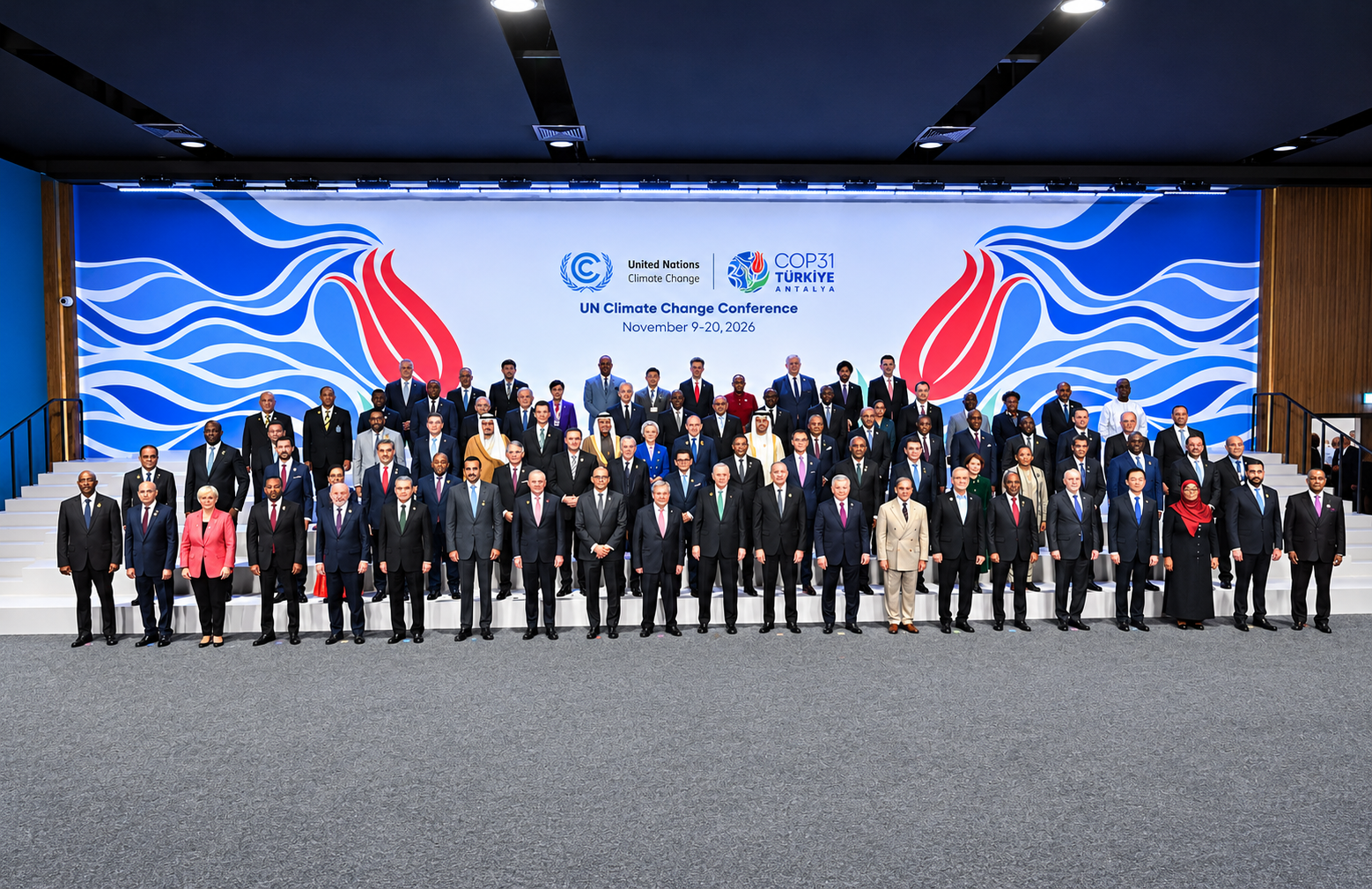
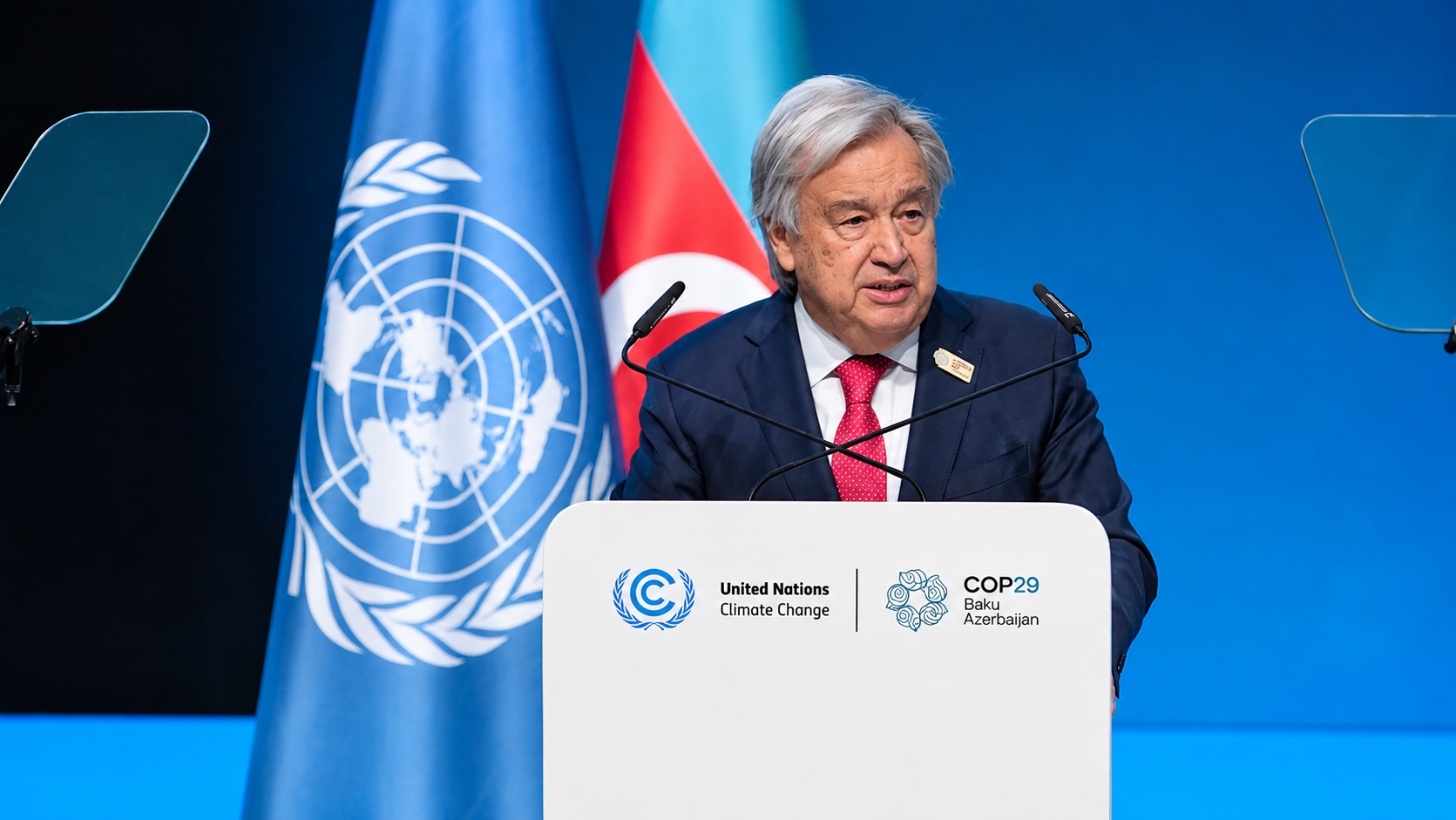
The United Nations climate summit entered what many called a “major political phase” on Wednesday (November 11), the stage at which heads of state and government join the negotiators who began technical talks on November 9. The UN Secretary-General António Guterres opened it with a warning that the world is losing the race against global warming, even as the US, the largest historical emitter, stayed away for a second consecutive year. He told leaders that the climate crisis is “outrunning us”, and urged them to phase out coal, oil and gas. He said fossil fuels must “go the way of the dinosaurs.”
The 31st Conference of the Parties (COP31) to the UN Framework Convention on Climate Change is being held at the Antalya Expo Center on Türkiye’s Mediterranean coast. It runs from November 9 to 20, 2026. The presidency is split as Türkiye hosts and leads the voluntary Action Agenda under Environment Minister Murat Kurum, while Australia’s climate minister, Chris Bowen, presides over the formal negotiations. The UN had expected more than 100 leaders from some 95 countries, though several of the biggest powers sent deputies instead.
The talks are important because national climate plans still fall far short of what the science requires. Guterres said, according to the UN’s COP31 page, that global emissions must fall by about six per cent a year, while current plans, including conditional ones, deliver at best a third of that. Even if fully implemented, they would leave the world above 2.5°C by the end of the century. Delegates from nearly 200 parties will try to narrow that gap by consensus over the next nine days. They are working on finance, adaptation, carbon markets and the just transition, alongside a set of voluntary pledges from the Turkish presidency.
What is at stake
Opening the conference, Simon Stiell, the UN’s climate chief, said COP31 must “supercharge solutions.” Kurum, the president, said that he wanted delegates to leave saying that something had changed in Antalya. Behind the rhetoric lies a test of whether a process in its fourth decade can turn pledges into money, policy and emissions cuts, in a year of heatwaves in Europe, deadly floods in Nepal and major wildfires in Indonesia.
According to IISD, the main negotiating issues are climate finance, emissions reductions, adaptation, and loss and damage. The formal agenda also includes Article 6 carbon markets, the mitigation work programme and the just transition mechanism. The presidency’s headline initiative is voluntary: a target of raising electricity’s share of global final energy demand to 35 per cent by 2035.
Adaptation is expected to be a key test. Bonn talks in June failed to settle the indicators for measuring progress. Governments must also work out how to deliver the pledge made at Belém last year to at least triple adaptation finance by 2035.
How countries differ
Fossil fuels. A transition away from fossil fuels is not a formal agenda item. Brazil, the previous host, published a voluntary roadmap on November 3. Germany, France and the Netherlands have set national phase-out plans, though experts have criticised Germany’s 2045 target as unambitious. The host country is itself a coal user. Coal was Türkiye’s largest source of power last year, and Ankara argues that fossil fuels remain necessary for energy security. Qatar’s climate undersecretary has said emissions can be cut without requiring countries to abandon particular fuels. Campaigners at Greenpeace want governments to turn the COP28 pledge into national roadmaps.
Finance and adaptation. Developing countries won a work programme on finance on the opening agenda, but an African proposal for a separate item on tripling adaptation finance failed. The gap is wide. UNEP estimates developing countries will need $310bn to $365bn a year by 2035, against about $26 billion of international public adaptation finance in 2023. India has argued that such money should come as grants rather than loans. The European Union is pressing for faster emissions cuts and places the adaptation pledge within the wider finance goal agreed at COP29.
Trade and technology. China has said it wants COP31 to discuss the free flow of green technology. This is widely seen as a reference to US and EU tariffs on Chinese solar products and electric vehicles.
Kerry: the world should follow China
John Kerry, the former US climate envoy, used the opening of the conference to argue that China is setting the pace on clean energy and that others, including the United States, must follow. He said that most countries are still “stumbling along”, while China is the only country that has “hugely accelerated”. He described the shift as “unstoppable.”
Reports of the interview cite China’s clean-technology exports of more than $220bn in 2025. They also credit it with about 85 per cent of global solar supply-chain capacity and 80 per cent of lithium-ion battery capacity. Kerry argued that countries exposed by conflict in Iran and West Asia are recognising the risk of depending on imported oil and gas.
China’s own role remains unsettled. Its five-year plan adopted in March 2026 pledged for the first time to lead global climate governance, but Beijing has historically shied away from that role. It is represented in Antalya by Vice-President Han Zheng, not President Xi Jinping.
Today’s speeches and absences
After Guterres, Turkish President Recep Tayyip Erdoğan, Brazil’s Luiz Inácio Lula da Silva, European Commission President Ursula von der Leyen, Marshall Islands President Hilda Heine and Iran’s Masoud Pezeshkian were among those due to address the summit. Guterres, who is attending his last COP before his term ends in December, said that science was not telling the world to surrender but to fight harder.
The guest list drew criticism. The heads of the United States, China and India skipped the summit, even as a new report warned that the gap between promises and real emissions cuts is widening. Britain’s Prime Minister, Andy Burnham, is the only G7 leader scheduled to speak. France, Germany, Italy, Canada and Japan are not sending their leaders. The EU’s climate commissioner, Wopke Hoekstra, called the absences “not completely atypical.” Climate Action Network Europe said that absent leaders were missing “more than just a photo opportunity.” No US government official is attending, after President Donald Trump withdrew his country from climate cooperation.
Points of confrontation
Four disputes are likely to define the fortnight. The first is who pays for adaptation, and how much. The Belém pledge has no baseline and no named donors. The second is whether the fossil-fuel exit enters the formal outcome or stays in voluntary coalitions outside the process. The third is the relationship between trade and climate policy, including tariffs on clean technology. The fourth is political weight. A conference without the US, and with China and India represented below head-of-government level, has less leverage to extract ambitious commitments.
Previous COPs: what was settled and what was not
The record shows a pattern of progress on principles but delay on delivery. In Paris, in 2015, governments agreed to hold warming well below 2°C and pursue 1.5°C, and created the system of national pledges. The promised $100 billion a year in climate finance for developing countries was met only years later.
At Glasgow in 2021, COP26 produced the first COP text to mention coal, though it called only for a “phase down.” A pledge to double adaptation finance by 2025 is widely expected to be missed. The following year at Sharm el-Sheikh, COP27 created a loss-and-damage fund, a long-standing demand of vulnerable states, but money has been slow to follow.
COP28 in Dubai in 2023 reached the first agreement to “transition away from fossil fuels”, with no timetable or enforcement. At Baku in 2024, COP29 set a finance goal of $300 billion a year by 2035, with an aspiration of $1.3 trillin, a headline figure that developing countries called inadequate.
Last year at Belém, COP30 agreed to at least triple adaptation finance by 2035. Oil-producing states blocked binding language on a fossil-fuel roadmap, and Brazil took the idea outside the formal process.
Leaders’ statements continue on November 12. Their segment resumes on November 17 and 18 for countries that did not speak this week, before ministers try to close the negotiations on 20 November. With fossil-fuel phase-out off the formal agenda, the likeliest outcomes are procedural gains on finance and adaptation plus voluntary pledges on electrification, not a binding global exit from coal, oil and gas.