US President Donald Trump has declared the war with Iran “effectively over” militarily. It is his clearest signal yet that he may not resume the bombing campaign that has devastated Iran and pushed up fuel prices worldwide. The remarks, made after talks with Qatar’s prime minister and days after Trump’s Republican Party lost both chambers of Congress in the midterms, came with no ceasefire, no deal and no lifting of the US naval blockade. Responding to the announcement, Tehran said his announcement may mean nothing and rejected his account as “fake news”.
A surprise briefing
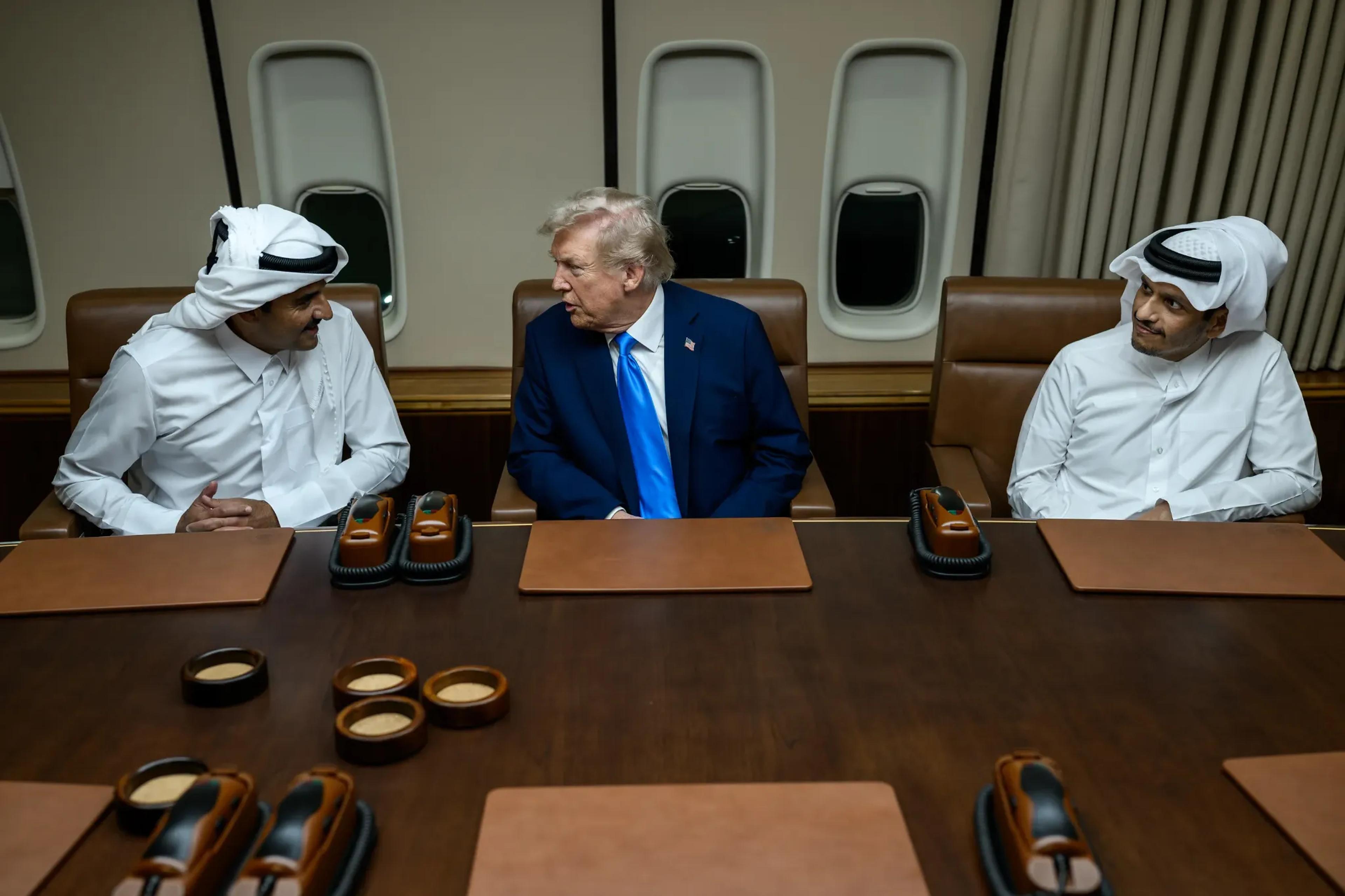
Trump walked into the White House briefing room on Monday (November 9) after meeting Qatar’s prime minister and foreign minister, Sheikh Mohammed bin Abdulrahman bin Jassim Al Thani, and Vice-President JD Vance.
“Iran militarily is effectively over,” Trump said. He told reporters the US was keeping the “status quo” largely at the request of Iran’s Gulf neighbours, whom he named as Qatar, Saudi Arabia, the UAE, Bahrain and Kuwait.
Sheikh Mohammed said he was “grateful for the positive discussions on reaching a deal”. Al Jazeera reported that he brought a two-day proposal from Tehran to end the war, and that Qatari officials had presented ideas on Iran’s nuclear programme the previous week, citing two West Asian officials. The White House declined to comment on that accounts.
Qatar’s role as mediator
Monday’s meeting capped weeks of intensified Qatari shuttle diplomacy. Qatari mediators travelled to Tehran on November 2 to discuss a draft US-Iran deal. Qatar’s foreign ministry said both sides were reviewing the mediators’ proposals. The emir, Sheikh Tamim bin Hamad Al Thani, spoke to Trump by phone on Friday about Doha’s efforts to reach a comprehensive agreement. Qatar works along with Pakistan and, increasingly, Oman. “The mediators, Qatar, Pakistan and now Oman, are all working together,” foreign ministry spokesperson Majed al-Ansari said in August.
Doha’s role, however, pre-dates the current push. Sheikh Mohammed met Vance in Washington in late March and again in May, and Qatar backed the Pakistani-led efforts that produced the June memorandum of understanding. Qatar has also been on the receiving end of the war: Iran fired on Gulf states that host US forces, Qatar among them. That gives Doha a direct stake in an end to hostilities, which the Gulf states want to be durable.
A declaration after electoral defeat
Trump’s announcement came as Democrats won control of both the House and the Senate on November 3. They flipped more than two dozen Republican-held House seats and that anger over the war’s effect on the cost of living helped them take the Senate. Vance blamed the war directly: “The reason we lost is the war,” he wrote on X. Trump acknowledged that surging petrol prices had weighed on voters but defended the conflict. “The Iran thing we had to do,” he said. Before the vote, he had threatened renewed strikes once the elections had passed. Instead, he now faces a Congress that, from January, can block legislation, challenge war spending and press for limits on his war powers. The House has already passed war powers resolutions, and the Senate approved its own version in June.
Pressure and caveats
“Effectively over”, however, was not a declaration of peace. “We’re locked and loaded, ready to go for any reason that changes,” Trump said, giving no sign of drawing down the thousands of US troops positioned off Iran. He had told CNN on Sunday that renewed strikes were highly unlikely if Iran signed a strong agreement. He said targets, including 38 bridges, had been identified in case fighting resumed.
The blockade of Iranian ports will continue. So will Task Force Iron Gate, a unit CENTCOM announced on Sunday to disrupt Iranian arms and trade routes over land and across the Caspian Sea. US military action has not stopped entirely as Washington confirmed what it called minor strikes on Iran’s Qeshm Island in recent days. At least two limited strikes on Iranian air defences were also reported in the past week. A commercial ship that the US said was trying to breach the blockade was disabled on Saturday.
Tehran pushes back
Mohsen Rezaei, secretary of Iran’s Supreme National Security Council, told Washington to stop publishing fake news about “imaginary” talks. He said that it was time for the US to accept Iran’s seven conditions for ending the war.
President Masoud Pezeshkian said Supreme Leader Mojtaba Khamenei wanted an end to a situation he described as “neither war nor peace”. Iran was open to further negotiations, he added, but “we will not surrender to force and bullying.”
Tehran’s demands include ending the blockade, lifting sanctions, unfreezing assets, compensation for war damage and an end to hostilities on all fronts, including Israel’s operations in Lebanon. Trump has previously refused to meet these demands.
How the world got here
The war began on February 28, when US and Israeli strikes killed Iran’s then Supreme Leader, Ayatollah Ali Khamenei. Iran responded by closing the Strait of Hormuz, through which about a fifth of the world’s oil passed before the war, and by firing missiles and drones at Gulf states hosting US forces. Washington later imposed its own blockade of Iranian ports.
A memorandum of understanding on June 17 briefly reopened the strait, but traffic stayed far below normal. Within weeks, attacks on ships and renewed US strikes put the truce in doubt. Since then the fighting has been sporadic. Related conflicts have flared, with Saudi Arabia renewing its fight against the Iran-backed Houthis and Israel occupying parts of southern Lebanon.
The economic and wider stakes
The war has been costly beyond the region. Brent crude climbed to a six-month high in October. It then fell by more than eight per cent on November 4 to near $95 a barrel as hopes of a deal grew, although prices remain well above pre-war levels.
Defence Secretary Pete Hegseth, a leading defender of the war, faces a push by Republican Rep. Thomas Massie to force a vote on impeaching him. Critics say the administration launched the war without proper authorisation. Trump has made curbing Iran’s nuclear programme the central aim of the war, and the US has offered a $20 million reward for information on it. Iran has long denied seeking nuclear weapons.
Asked why he would not simply end the war, Trump said he wanted a long-term solution that protected US allies, who remained at risk from an Iran he called a bully.