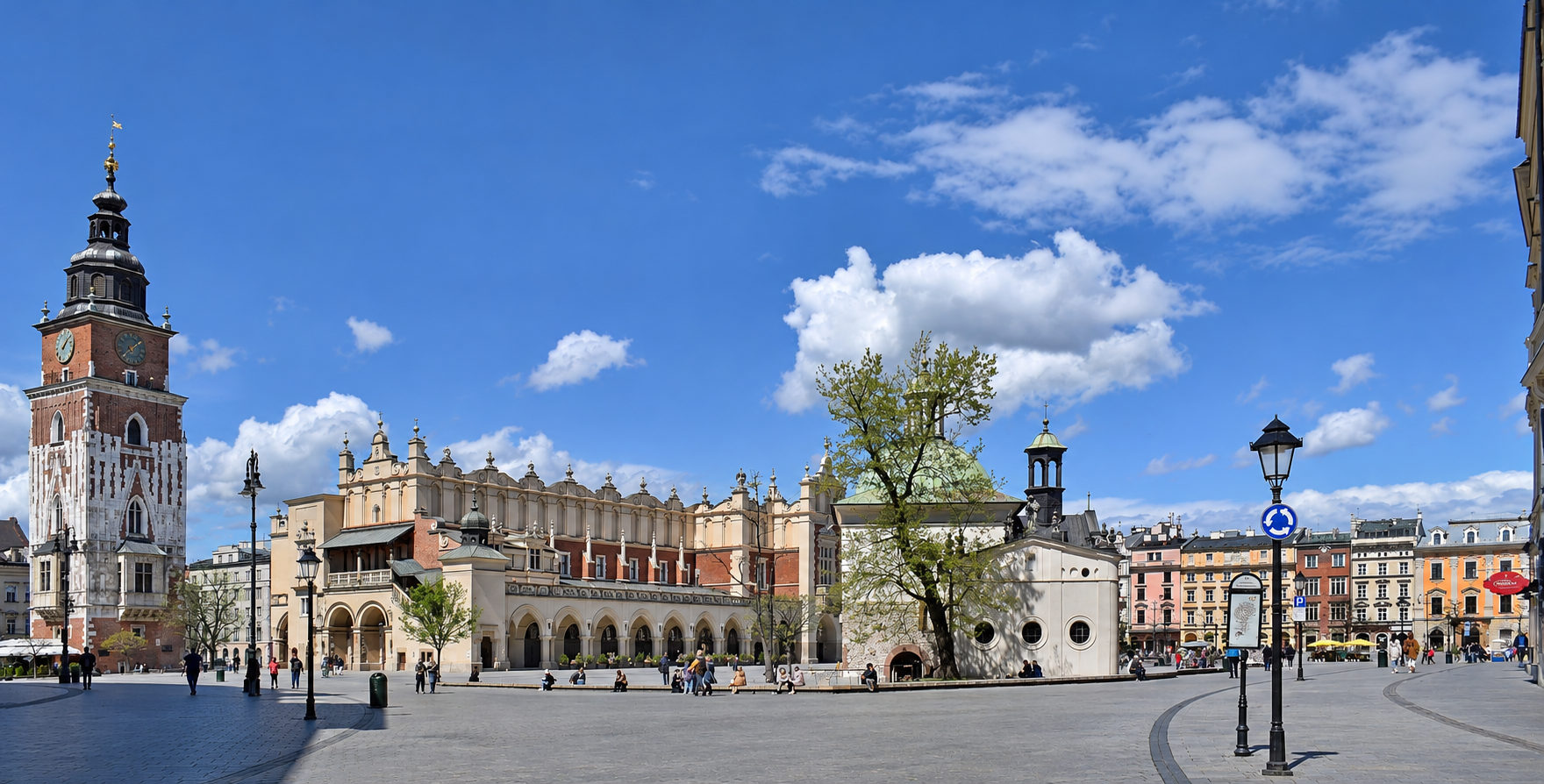
A 24-year-old gunman drove into the medieval heart of one of Europe’s most visited cities on Saturday (October 7) afternoon and opened fire on tourists and locals in the Main Market Square, killing six people, among them a Briton and an Austrian, and wounding about a dozen more, before two police officers shot and detained him after a close-range exchange of fire.
Hours later, officers found the bodies of his parents and sister at the family home 200 km away, and Poland, a country that prided itself on being safer than much of Western Europe, began two days of national mourning amid a bitter dispute over whether far-right ideology drove the attack. The government says the man appeared fascinated by it, nationalist opposition politicians demand proof, and prosecutors, who have classed the shooting as a terrorist offence, say the motive is still under investigation, as a nation already shaken by a string of school stabbings in October asks whether its sense of security has gone for good.
The attack
The shooting began at about 3 pm, when a masked man in military-style clothing drove a car onto the square and started firing as people fled into nearby shops and cafés. The regional government described the vehicle as a Subaru with no number plates. Police exchanged fire with the man at close range, wounded and detained him, and took him to hospital, where he remains in a critical condition. His car was checked for explosives and residents of surrounding buildings were evacuated.
According to police, he carried a semi-automatic rifle similar in design to an AR-15, fitted with an optical sight, along with a pistol, and officers recovered a large quantity of further weapons and ammunition from his car. Officials put the toll at six dead in the square and 16 wounded, a figure that includes two police officers and the gunman himself. The AP counted 15 wounded, apparently excluding the attacker.
Later on Saturday, police found three more bodies at the suspect’s home in Ostrowiec Świętokrzyski. They were his parents and his sister, and all had gunshot wounds. Firearms and a significant quantity of ammunition were recovered there. A prosecutors’ spokesman said that it was highly likely that one person was responsible for both sets of killings, though the investigation continues.
The suspect
The accused had no previous convictions, was not on police records and held a firearms licence, and police believe he fired weapons covered by it. Some reports said that he belonged to a shooting club. Defence Minister Władysław Kosiniak-Kamysz rejected reports that he had been a soldier, saying he had never had anything to do with the military.
The victims
The authorities have not yet released the names of those killed. Four women and two men died in the square. Four were Polish, one was a British citizen and one an Austrian woman. Krzysztof Jan Kleczar, head of the regional government, confirmed that the Austrian was 51 and the Briton 32. Among the wounded were nationals of Austria, Britain, Germany, Portugal and Russia.
The suspect’s 53-year-old father, 52-year-old mother and 21-year-old sister were also killed at home. Early reports gave the sister’s age as 20.
Two police officers were shot while overpowering the gunman. Prime Minister Donald Tusk named them as senior constables Jakub Kulik and Artur Morański. Both have since regained consciousness after surgery. An off-duty doctor treated one of them on the pavement before paramedics arrived. A Kraków surgeon later told the media that his colleague’s decision to stem the officer’s bleeding, without gloves or protection, probably saved his life.
What officials said
Tusk called the attack an act of “terrorism” and praised the courage of police, paramedics and ordinary people who rushed to help the wounded. Interior Minister Marcin Kierwiński said that everything pointed to an attacker who held very radical views and was “fascinated by far-right ideologies”. On Sunday, he declined to retract the claim, but stressed that the police were still testing it and that nobody was judging the case in advance.
That prompted a sharp response from the opposition. Przemysław Czarnek, deputy leader of the nationalist Law and Justice party (PiS), demanded an immediate explanation of the evidence behind the minister’s words and said he should face political consequences if he had misled the public.
President Karol Nawrocki called for a full investigation and described public safety as an absolute priority. US ambassador Tom Rose wrote of a “savage and murderous attack” that had shattered the country’s peace. Kraków’s mayor, Łukasz Gibała, promised that the city would remain "proud, welcoming and open".
A shaken country
Witnesses spoke of hiding in shops with the lights turned off and of mistaking the gunfire for fireworks. Police have tightened security in Warsaw and other cities, and barriers have gone up on the streets leading to the capital’s historic Krakowskie Przedmieście. The square reopened late on Sunday, with candles at a makeshift memorial. St Mary’s Church suspended its hourly trumpet call for 12 hours overnight, reportedly for the first time since 1939. The newspaper Rzeczpospolita wrote that the shooting had brought a brutal end to the era in which Poland was seen as an island of safety.
The background: a radicalising right
The attack comes after a difficult autumn. In early October, a series of knife attacks at schools, including one in which a 15-year-old killed a caretaker at Leszczydół-Nowiny, led the government to summon internet companies over violent content. Tusk attributed the attacks to the online glorification of violence and said some of those detained were active in the “ultraright environment”, with rising searches for Nazi material and for mass killers who have become online idols. Officials dismissed rumours that the attacks were coordinated.
The electoral picture has shifted too. In the 2025 presidential election, Sławomir Mentzen of the far-right Confederation took 14.81 per cent of the first-round vote and the more radical Grzegorz Braun 6.34 per cent. Their supporters made up about 34 per cent of Nawrocki’s second-round vote, according to exit polls. Analysts found that Confederation voters were overwhelmingly male and that nearly half were aged 18 to 34.
Meanwhile PiS, the dominant force of the Polish right for a decade, has slipped to its lowest polling since 2012. By March, Confederation was averaging about 13 per cent in polls and Braun’s Confederation of the Polish Crown about eight per cent. In July, PiS leader Jarosław Kaczyński expelled three dozen sitting MPs, effectively splitting the party.
Braun has faced moves in the European Parliament to strip his immunity over charges including Holocaust denial and antisemitic, anti-Ukrainian and anti-LGBT incidents. In September, he smashed a memorial to fallen Ukrainian Insurgent Army soldiers with a sledgehammer, and in October Nawrocki floated the idea of inviting his party into a right-wing coalition. Parliamentary elections are due next year.
Symptom or part of a wider trend?
It is too early to say, and three distinctions matter. First, the motive is unproven. The interior minister’s account is a hypothesis that he himself says is being tested, and prosecutors have not said what drove the attack. The killing of the man’s own family before the shooting suggests a personal or psychological dimension that could complicate any purely ideological reading.
Second, violent radicalisation is not the same as electoral nationalism. The Confederation and Braun's party are legal parties competing for votes, and nothing in the reporting so far connects the gunman to either. The pattern the government itself stresses is online, with young men absorbing extremist and violence-glorifying content. The October school attacks and this shooting may belong to that pattern.
Third, the two trends coexist and may feed each other. Radical-right parties have grown among young men at the same time as the authorities have grown alarmed about online radicalisation. Whether one nourishes the other is the central question, and it is already being fought over as a political one, with the government stressing the far-right link and the nationalist opposition insisting the evidence be shown.