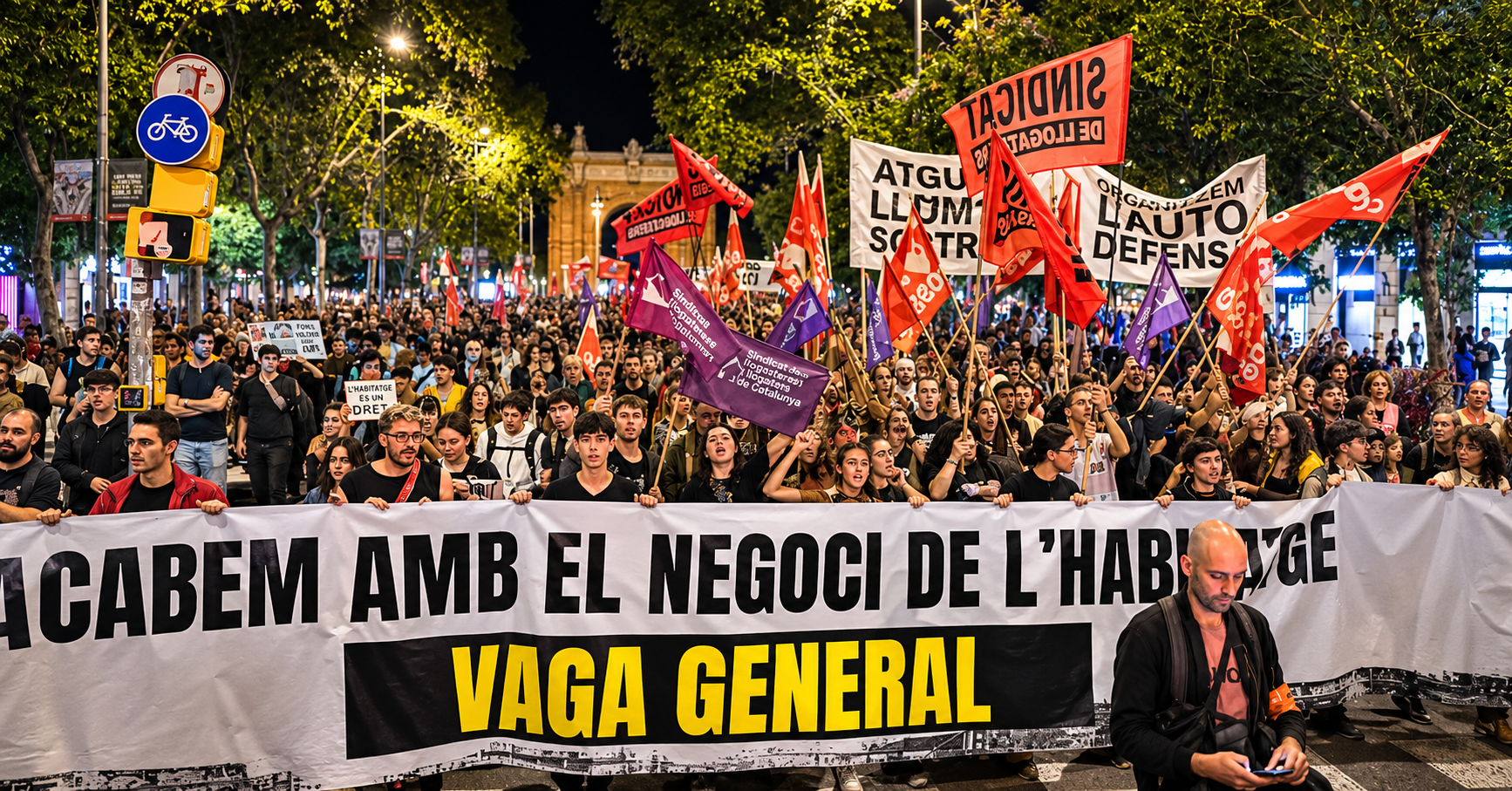
Millions of Spanish workers took part in a nationwide general strike on Wednesday (November 11), protesting soaring rents, evictions and the growing difficulty of finding affordable homes, as the housing crisis emerged as a major electoral issue less than three weeks before the November 29 general election. The 24-hour stoppage, initially called by tenants’ associations and later backed by trade unions, was the first general strike jointly supported by Spain’s two largest unions in 14 years.
The Confederation of Tenants’ Associations estimated that around four million people had participated by midday. Unions reported high participation in several sectors, including 90 per cent in the automotive and port industries and 82 per cent in waste collection, although the scale of the stoppage varied across regions. Employers disputed these figures, describing participation as limited but the visuals show otherwise.
The strongest support was reported in Catalonia and Andalucía, where housing costs have risen sharply in recent years. Transport services were disrupted, while schools and universities closed or operated at reduced capacity. Protesters blocked roads and industrial facilities. In Barcelona, clashes with police followed roadblocks and incidents of vandalism. Reuters reported 115 arrests nationwide by the evening, although earlier reports put the figure lower.
The anger reflects a decade of steeply rising housing costs. Rents have increased by about 80 per cent over the past decade, while house prices have climbed 63 per cent. Sandra Mora of the Madrid Tenants’ Union told broadcaster RNE: “It’s extremely important to remind people that we, the workers – who are also renters or who also pay mortgages – are the ones with the power to halt production and bring the economy to a standstill.”
Eviction that stirred the country
The tenant movement gained sudden momentum in September following the eviction of 87-year-old Maricarmen Abascal from the Madrid home where she had lived for more than seven decades. Her death in October turned the eviction into a symbol of the insecurity facing tenants, particularly elderly people on fixed incomes. The incident triggered spontaneous protests and encampments across Spain, with campaigners accusing landlords and property investors of treating homes as financial assets rather than places to live. Tourist accommodation and short-term rentals have become particular targets of public anger in cities and coastal destinations.
The personal consequences were evident at Wednesday’s demonstration in Madrid. Almudena López, 74, attended with her husband, concerned about the prospects facing younger generations. “My son is 43 years old, still doesn’t own a home as he cannot afford one. When I was young, if you had a university degree, you could get a job by saving a bit – which always required some sacrifice – but you could manage. It’s nothing like it is today,” she said.
A structural crisis
Spain’s housing crisis has developed over years of insufficient construction, population growth and rising demand in major cities and tourist destinations. The country also has one of the smallest social housing stocks in the European Union, accounting for just 1.5-1.7 per cent of total housing, compared with an EU average of around 6-7 per cent, according to the European Commission. The shortage is particularly acute in Madrid, Barcelona, the Balearic Islands and coastal regions. The expansion of short-term tourist rentals has added pressure in popular destinations, although construction bottlenecks, limited land availability and slow planning procedures are also major factors.
The crisis has become a generational issue. Spain’s national statistics institute reported that 44.3 per cent of people aged 26-34 lived with their parents in 2025. Among them, 47.3 per cent said they could not afford to rent or buy a home. The government has introduced rent regulation and tenant protections through its 2023 Housing Law and announced plans to expand public housing. However, implementation has been uneven, and further measures have faced parliamentary resistance.
Housing an election issue
Prime Minister Pedro Sánchez called an early general election for November 29 after his minority government faced parliamentary resistance to a package of housing measures. The strike has further elevated the issue into a central test of his administration’s record. Sánchez has defended the action as a legitimate expression of public frustration. “This is not a strike against anyone, but rather one in favour of a common response from all levels of government to a real problem, which is access to housing,” he said in an interview with La Vanguardia.
The opposition has accused unions of using the strike to help the government electorally. PP leader Alberto Núñez Feijóo warned that proceeding with the action before the election was a “serious mistake” and said unions risked being linked to Sánchez “forever”. The PP has called for more housing construction, faster planning approvals and fewer restrictions on landlords, arguing that rent controls discourage investment and reduce supply. It has pledged to repeal the existing Housing Law.
Vox, meanwhile, has linked housing pressures to immigration and called for national priority in access to certain public housing and benefits. The party opposes much of the government’s interventionist approach to the rental market. Recent polls place the PP ahead of Sánchez’s Socialists, with Vox potentially providing the parliamentary support needed for a right-wing government. A PP-Vox administration could therefore change the direction of Spain’s housing policy, particularly on rent regulation, tenant protections and public housing.
However, the strike does not automatically translate into electoral support for Sánchez. Its organisers represent a broad coalition of housing activists and workers, not a single political party. The opposition could also argue that the crisis has worsened despite years of Socialist-led government. The November 29 election will show how public frustration over the lack of affordable housing influences voters’ choices.