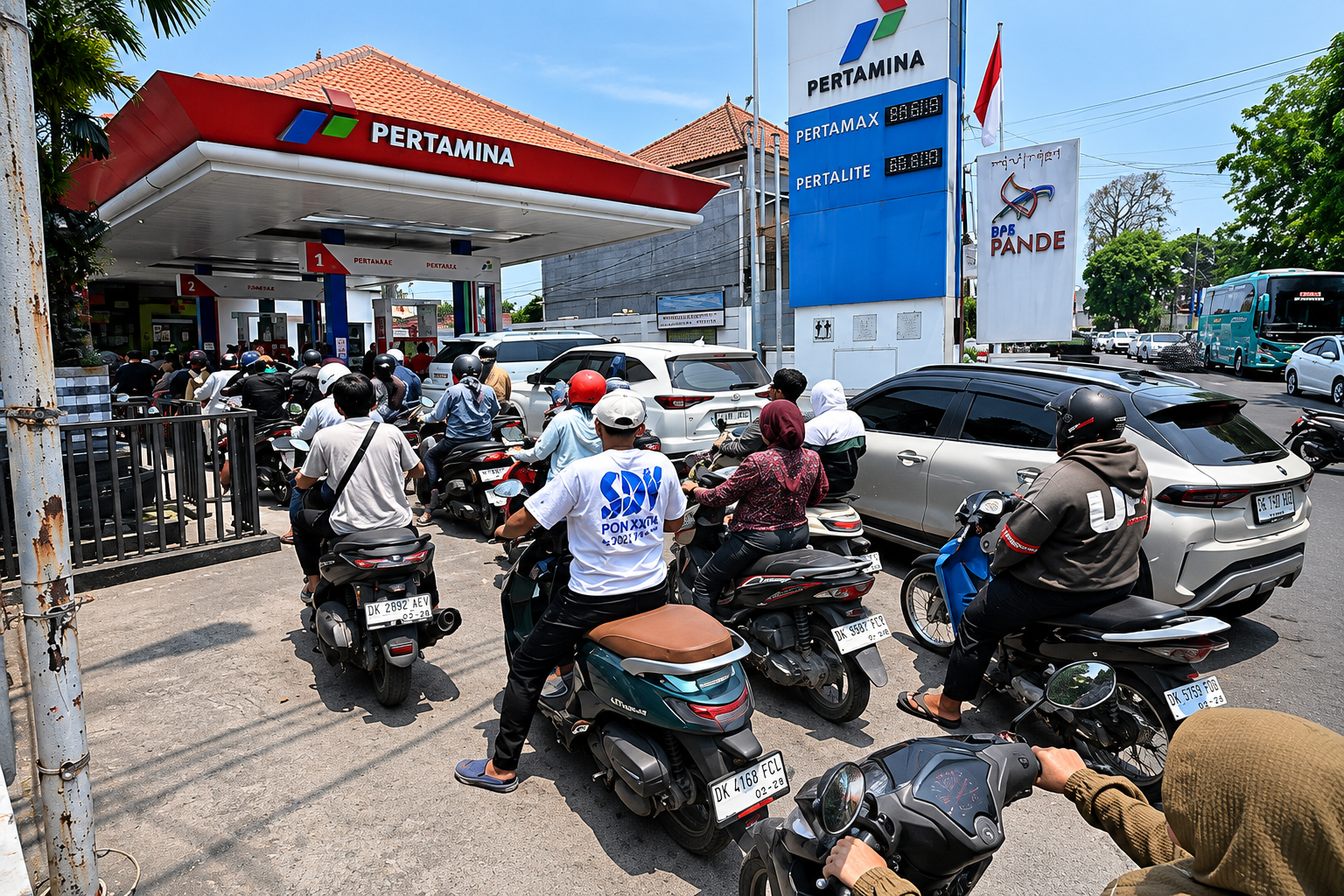
Indian entrepreneur Susheel Jain nearly missed his flight home from Bali, stuck in traffic snarled by a petrol shortage that has also stranded tourists from Moldova to Russia. Indians are among the island’s largest group of foreign visitors every year. Queues at some stations stretched up to three kilometres. Authorities rationed subsidised petrol by number plate and sent government staff home to work. Officials blamed a tanker’s anchor fault, bad weather and panic buying rather than a global supply shock owing to the conflict around the Strait of Hormuz.
Bali draws millions of tourists a year with its temples, terraced rice fields and surf-worn beaches. However, queues have formed since Sunday, October 11. Motorists waited hours, and some visitors cancelled excursions. Available reporting does not tie the crisis directly to the Hormuz conflict.
Tourists stranded across the island
Moldovan tourist Raisa Neagu was caught in the disruption while trying to refuel her scooter. “We had to cancel all our plans,” Neagu, 43, told AFP. She had wanted to travel to northern Bali. A Russian visitor, Sergey, described being sent from one station to another, and then to the north of the island, after hours in line. Tourist hubs such as Uluwatu and Ubud were among the worst-affected areas.
Jain, founder of Shusheal Yoga, warned fellow travellers in an Instagram video. “It was a nightmare,” he said. Other Indian tourists have also taken to social media and travel forums with warnings and practical tips.
A growing Indian market, exposed
India has become one of Bali’s fastest-growing source markets. Indian arrivals jumped 26.88 per cent in a month to 59,014 in May, according to Bali’s statistics bureau (BPS). That put India second only to Australia, with a 10.21 per cent share of visitors. Daily direct flights from India have helped drive the growth. Many of these visitors, including families and wedding and wellness groups, rely on airport transfers and rented scooters. Both were hit by the queues.
Travel coverage in India notes that existing guidance for Indian travellers does not specifically mention the shortage. It advises contingency planning rather than cancellation.
Residents bear the brunt
The problem extended well beyond tourists. Komang Juli Astawa, a 28-year-old resident of Pendem village in Jembrana, spent the night on his motorcycle while waiting to buy petrol.
“I joined the queue at around 5 p.m on Wednesday (October 21), and by Thursday morning, I still hadn’t gotten any gasoline. I slept on my motorcycle,” he told Detik.com. “I’ve never experienced anything like this just to get fuel. I don't even know who to complain to,” he added.
Hotel worker Ni Wayan Susiani, 22, said she waited about five hours to refuel her motorbike. Governor I Wayan Koster ordered government employees to work from home for three days from October 15, and moved schools and universities online. About 500 people rallied outside his office in Denpasar. Tourists depend heavily on scooters, taxis and hired drivers to travel between Ngurah Rai International Airport, the resort areas of Kuta and Seminyak, and inland destinations such as Ubud.
Officials blame distribution delays
Laode Sulaeman, director-general of oil and gas at Indonesia’s Energy and Mineral Resources Ministry, described the problem as a distribution issue. “This is purely a distribution issue,” he told the AP. A tanker had encountered an anchor problem while preparing to unload. Rough seas also slowed deliveries to the Sanggaran terminal in Denpasar and the Manggis terminal in eastern Bali. Strong demand for Pertalite, a subsidised petrol cheaper than higher-octane alternatives, compounded the disruption, and panic buying added pressure at some stations. Pertamina chief Simon Aloysius Mantiri apologised to affected residents and users.
Koster urged residents not to panic. “People don’t need to worry because the fuel is available,” he said, according to AFP. He said a tanker carrying more than 22 million litres had arrived and would meet demand for up to seven days. Authorities ordered stations in tourist-heavy Denpasar and Badung to operate around the clock and stationed soldiers and police at stations.
Rationing and reinforcements
On October 17, Bali introduced an odd-even system for subsidised petrol. Motorists could buy fuel only on dates matching the last digit of their number plate. The initial rules also capped purchases at 20 litres for cars and three litres for motorcycles. Koster extended the system to October 23 after deliveries ran smoothly over the weekend. Queues eased in Denpasar and Badung from October 18, though long lines persisted in Buleleng and Jembrana.
Energy Minister Bahlil Lahadalia announced on October 19 that the fleet shipping subsidised fuel from Java to Bali would grow from three vessels to seven. “Currently, Bali’s fuel reserves can cover 11 to 12 days of demand. I seek to extend the duration to 15 days,” Bahlil said.
Tourism faces a test of resilience
The disruption came at a difficult time for an island that depends heavily on international tourism. Hotels, restaurants, transport operators, tour guides and small businesses all rely on the steady movement of visitors. For tourists, a fuel shortage can quickly turn a carefully planned holiday into a logistical problem. Trips to the volcanic slopes of Mount Batur, the sea temple of Tanah Lot, and the craft villages around Celuk may depend on drivers’ ability to refuel.
The queues also highlighted the difficulty of supplying an island that relies on fuel shipments and has limited local energy production. The wider geopolitical situation adds urgency to energy security. The Strait of Hormuz is a critical route for global oil shipments, and Indonesia has struggled with fuel shortages this year since the Iran war disrupted global supplies. But available reporting does not establish that conflict in the waterway caused Bali's October crisis.
Officials said supplies were improving by October 19. The episode nevertheless showed how quickly a distribution failure can reach everyday life on a major tourist island. For Bali, keeping visitors’ confidence depends not only on its beaches, temples and culture, but also on the reliable transport and essential services that let tourists enjoy them.