It was the same question my taxi driver asked me the first time I landed at Changi. “Are you visiting? Do you live here?” The driver’s attitude became decidedly welcoming when I said I was a visiting professor. A teaching assignment at the Lee Kuan Yew School of Public Policy took me to Singapore in 2008. Last week my driver responded with “Oh wow, Madam Professor!”, when I said I was accompanying my academic wife to a conference where she would deliver the opening address. The respect for a teacher is palpable in this knowledge-based society.
In 1993, Singapore’s Prime Minister Goh Chok Tong spoke of an ‘India fever’ gripping his island republic. It was triggered by Prime Minister P.V. Narasimha Rao's ‘Look East Policy’ and the outreach to Singapore. Prime Minister Goh’s remarks were conveyed at a business event in Kolkata. It was an expression of hope. Not yet of experience. It was believed that the region would take a liking to a rising India in the manner it had to a rising China.
In 2006, Prime Minister Manmohan Singh appointed the diplomat S. Jaishankar as India’s High Commissioner to Singapore. Jaishankar, now the external affairs minister and then a joint secretary handling the United States, came to me with a request. Would I (then the PM’s media advisor) let the PM know that he would prefer a posting to Colombo rather than Singapore? The thinking in those days within the Indian foreign service was that to be considered eligible for the foreign secretary’s job a posting in the neighbourhood was necessary. Indian diplomats typically sought postings in the West and in the neighbourhood.
I conveyed Jaishankar’s request to Dr. Singh, who immediately responded: “Tell him that Singapore is a window to Asia. It's an opportunity to understand the region.” Both a window to Asia and a microcosm of Asia. Why did Singapore suddenly become important? Surely Narasimha Rao’s ‘Look East Policy’ was one reason, but more importantly Singaporean leadership decided to chaperone India around the region seeking to balance China’s growing influence.
Singapore’s founder Lee Kuan Yew, an India sceptic during the Cold War era, accepted Goh's reformulation of Singapore’s view of India and even went to the extent of asking why the world was welcoming of India’s rise but was apprehensive of China’s – an argument he set out in an article on ‘India's Peaceful Rise’, published in Forbes in December 2007. Lee’s answer bears quoting in full and remains relevant to this day: “Is it because India is a democracy in which numerous political forces are constantly at work, making for an internal system of checks and balances? Most probably, yes – especially as India’s governments have tended to be made up of large coalitions of 10 to 20 parties.”
In 2026, Singaporean observers of India feel less comfortable and confident about India’s rise. Three things have happened.
First, since Lee’s essay in Forbes, China has risen rapidly and has become a global superpower, leaving India way behind. Singapore cannot regard both countries as the ‘two engines of the Asian jet’, as Lee once put it. One engine is now five times more powerful than the other.
Second, India’s multi-party democracy has transformed into an authoritarian democracy characterised by majoritarianism. A few years back, Singapore’s home minister K Shanmugam addressed a meeting of India Foundation, a think tank headed by the Bharatiya Janata Party’s Ram Madhav, and chose to speak about Singapore’s multi-culturalism and tolerance for all religious communities. He held up Singapore’s conscious policy of ensuring representation to all communities as a model for India.
When I was researching the diaspora for my recent book, Secession of the Successful: The Flight Out of New India (Penguin, 2025), a Singaporean diplomat asked me whether Prime Minister Narendra Modi was trying to ‘weaponise the diaspora’ with his constant engagement of Indian Hindus around the world. If so, would Singapore still take a benign view of this ‘new’ India’s rise?
Finally, while Goh spoke of an ‘India fever’ in the early 1990s, what the region has seen over the past quarter century is a ‘Singapore fever’ among highly qualified and high-net-worth Indians. Tens of thousands of Indian professionals have made Singapore their home. This has triggered waves of anti-India sentiment, both among ethnic Chinese and ethnic Malay Singaporeans. Less visible is the flight of capital to Singapore. From billionaires to wealthy politicians, many have moved their money to a country where the State keeps a close eye on banking and finance.
The sharp rise in Indian immigration has generated hostility towards an often loud and boisterous community. Last week, Singapore’s Prime Minister Lawrence Wong had to step out and publicly respond to a series of anti-India posts on social media, urging Singaporeans not to allow prejudice to become normalised. “We can and should have robust debates. But we should never use seemingly legitimate arguments as a cover to fuel prejudice against any community or hostility towards foreigners,” he said.
Some of this anti-India stuff is spread by pro-China elements. Singapore has had to deal with both ethnic Chinese and immigrant Chinese assertion. I recall how after the success of the Beijing Olympics, which triggered a rush of pride among Singaporean Chinese, there was a demand by some extreme elements that all signboards, public and commercial, be only in Mandarin. Singapore has had a four-language formula – officially recognising English, Chinese, Malay and Tamil. It is possible that pro-China elements, including elements from mainland China, have become more assertive. The government, for its part, maintains a strict balance by not allowing majoritarianism to gain ascendance.
Another development that has reduced ‘India fever’ in Singapore has been disappointment with certain business decisions. Singapore responded enthusiastically in 2014 to Andhra Pradesh chief minister Nara Chandrababu Naidu’s invitation to join his new capital city project at Amaravati. However, the manner in which that project has moved dissipated such enthusiasm. When Naidu returned to power in 2024 and renewed his invitation, Singapore responded cautiously and hesitantly. More recently, Singapore Airlines’ decision to invest in loss-making Air India has come under intense criticism, requiring some robust defence from the management and the government.
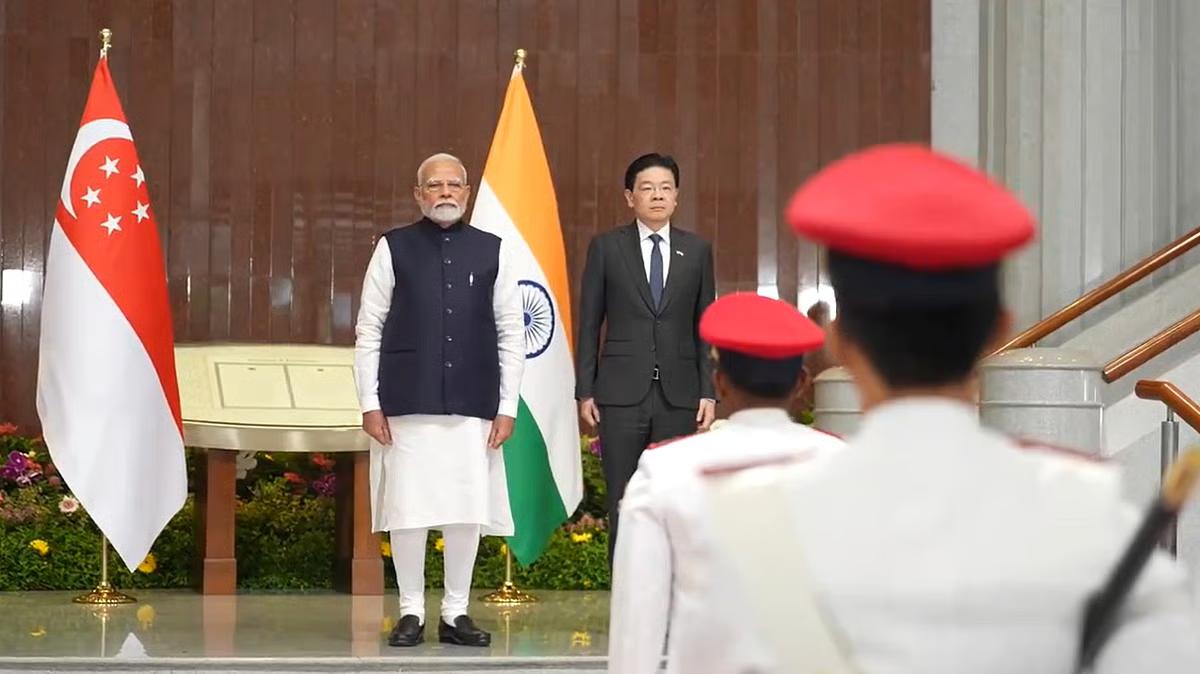
It was perhaps a recognition of the cooling down of the relationship – notwithstanding the friendship between foreign minister Jaishankar and his Singaporean counterpart Vivian Balakrishnan – hyped up on social media as a bromance between two well-attired gentlemen, that prompted the Indian government to depute a high-powered delegation of four Union ministers led by finance minister Nirmala Sitharaman and including the ministers for external affairs, commerce and industry. There is clearly an attempt to rekindle the relationship.
Singapore is a knowledge-driven society and economy and a city-state that has so far successfully managed her larger neighbours and three major powers – the United States, China and India. Though, it would seem, the investment in the study of and outreach to India has reduced in recent years. India would do well to keep her ear to the ground and a close eye on Singapore and the region. This multi-ethnic, multi-lingual city-state can still play an important role in keeping Asia’s rise balanced and on an even keel.
The writer is an editorial adviser to NWS and a former media adviser to Prime Minister Manmohan Singh.