Ukraine is reportedly supporting Tuareg rebels in northern Mali who cooperate with Al-Qaeda-affiliated jihadists, according to reports that have drawn fresh attention to Kyiv’s efforts to challenge Russian influence in Africa. Kyiv has not confirmed the claims, but it has not denied them either. A CNN report published in September detailed how a team of 15 Ukrainian drone specialists were supporting the militias, who oppose Mali’s military government in Bamako and its Russian allies. CNN said the Ukrainians provided drone training, operational planning and remote support for drone missions.
Who are Tuareg rebels?
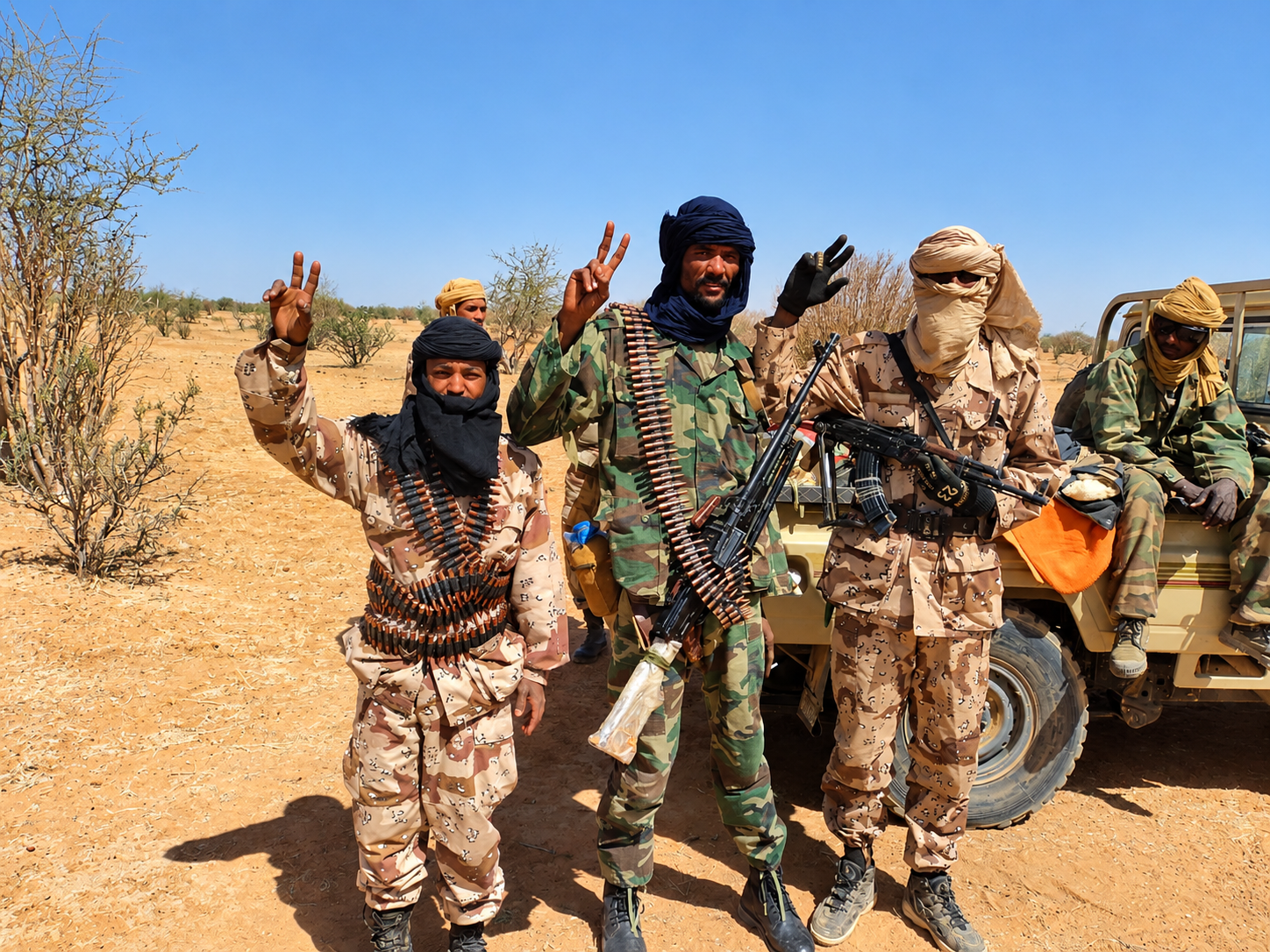
The Tuareg rebels are fighters from the Tuareg community in northern Mali, which they call Azawad. The main group, the Azawad Liberation Front (FLA), demands a separate state in the north and opposes Mali’s government and its Russian allies. The FLA intensified its campaign after the assassination of Libyan leader Muammar al-Gaddafi in October 2011. Heavily armed Tuareg militants returned to Mali and renewed the push for statehood. Since then, the separatists have also joined hands with Islamists, who seek to impose Sharia law in Mali. The FLA cooperates with Jama’at Nusrat al-Islam wal Muslimeen (JNIM), the Al-Qaeda-affiliated group that wants to impose strict Islamic rule, even though their goals differ. JNIM’s current leader, Iyad Ag Ghaly, was himself part of the Tuareg rebellion before turning to jihadism.
Link to jihadists
Kyiv’s specialists are predominantly training the militants in drone warfare. A report by DW said that Ukraine’s support to the FLA would not in itself prove that Kyiv backs JNIM, but jihadists could benefit indirectly through joint operations or access to equipment and know-how. Ukrainian analyst Marta Oliynyk-D’omochko of the National University of Kyiv-Mohyla Academy described the FLA’s relationship with the jihadists as tactical and situational. Cooperation between Tuareg and Islamist groups goes back more than a decade. Ukraine doesn’t see much problem with this arrangement as long as both oppose Russia.
Russian support kept Sahel standing
When the Sahel’s military governments broke with France and the West, Russia became their main security partner, and its backing has helped them hold ground against the insurgents. As many as 2,500 Russian personnel were reportedly in Mali as of early 2026, supporting combat operations against Islamist and separatist insurgents. Smaller Russian contingents have arrived in Burkina Faso and Niger, and Russian personnel reportedly helped repel a militant attack on Niger’s international airport.
Moscow’s help has been substantial and wide-ranging. Russia has also replaced the semi-private Wagner Group with the Defence Ministry’s Africa Corps, a more centralised force. After the militants coordinated attacks across Mali on April 25 this year, a Kremlin spokesperson said Russian forces would remain in Mali to combat extremism and terrorism. Russia began a fresh weapons airlift to Mali on July 7, 2026, according to Al Jazeera.
No confirmation from Kyiv
Russia's support for the military governments is the sole reason why Ukraine is supporting separatists and indirectly jihadists. Kyrylo Budanov, a former head of Ukrainian military intelligence who is now chief of staff to President Volodymyr Zelenskyy, wrote on X on September 7 that Ukrainian intelligence protects the country’s interests worldwide, from Russia to Africa. He did not mention Mali, and the post does not confirm any operation. DW asked Ukraine’s military intelligence agency (HUR) whether it had deployed personnel to Mali, whether the political leadership had approved a mission, and how it would ensure JNIM does not benefit. It received no specific reply. An HUR spokesperson said the agency might provide information later. Suspicions date to July 2024, when Wagner fighters and Malian troops suffered heavy losses in an ambush near Tinzaouaten. An HUR spokesperson said at the time that the rebels had received information they needed for the attack, but Ukraine denied direct involvement.
Sahel states accuse Kyiv
Military governments in Mali, Niger and Burkina Faso have accused Ukraine of supporting armed groups and threatening their territorial integrity. They have cut diplomatic ties with Kyiv and filed a complaint against Ukraine in the United Nations. Mali’s Foreign Minister Abdoulaye Diop told the UN in September that Ukraine was giving clear and open support to terrorist groups.
Analysts say Mali offers Kyiv a low-cost way to pressure Russian forces beyond Europe. Mali turned toward Moscow after coups in 2020 and 2021, and Russia replaced the Wagner Group with its Africa Corps in 2025. Setbacks there could tie down Russian resources and dent Moscow’s image as a security partner. The risks are political. Kyiv is promoting partnerships with anyone opposing Russia and marketing its drone capabilities across Africa. Kyiv is also quite unapologetic about its support for militias.